
Travellers say it often enough that it deserves a proper answer: Korean food tasted sweeter than they expected. Not dessert-sweet — sweet in savoury dishes, in the middle of dinner, where they were not expecting sweetness at all.
You are not imagining it. But the question is slightly wrong. The useful question is not is Korean food sweet — it is what does the sweetness come with.
First, the part that is a sampling accident
We keep a database of 91 Korean dishes, each scored 0 to 3 for sweetness.
| Sweetness | Dishes | Share |
|---|---|---|
| 0 — not sweet at all | 36 | 40% |
| 1 — a trace | 25 | 27% |
| 2 — noticeably sweet | 15 | 16% |
| 3 — sweet | 15 | 16% |
Two thirds have no real sweetness. Now look at the fifteen that scored a full 3: bulgogi, galbi (beef and pork), jajangmyeon, tangsuyuk, yangnyeom chicken, tteokbokki, japchae, jjimdak, bibim-guksu and jjolmyeon, hotteok, bungeoppang and patbingsu.
That is the list of Korean dishes foreigners already know. It is the menu at Korean restaurants abroad, what appears in dramas, and what a first-time visitor orders in week one.
The sweet dishes are not the typical ones. They are the famous ones. You did not eat a representative sample — you ate the greatest hits, and the greatest hits are the sugar-and-soy ones.

Run it the other way and the point gets clearer. Suppose your first week had been agujjim, raw fish in season, maeuntang, suyuk and a bowl of gukbap. We score every one of those at 0 or 1 for sweetness. You would have gone home asking why nothing was sweet. Same country, same week, opposite complaint.
Now the part that is not an accident
Here is what the numbers actually say. Of the fifteen sweetest dishes, twelve also score 2 or higher for both saltiness and umami. Sweetness almost never arrives alone.
Only three dishes in all 91 are sweet and nothing else — hotteok, bungeoppang and patbingsu. All three are snacks or dessert. In savoury Korean cooking, sweet does not travel by itself.
It travels in pairs, and the pairs have names people use every day:
| Combination | Known as | Dishes |
|---|---|---|
| Sweet + salty | dan-jjan | Bulgogi, galbi, jjimdak, japchae, jajangmyeon |
| Sweet + sour | saekom-dalkom | Tangsuyuk, bibim-guksu, jjolmyeon |
| Sweet + heat | — | Tteokbokki, yangnyeom chicken, jjolmyeon |
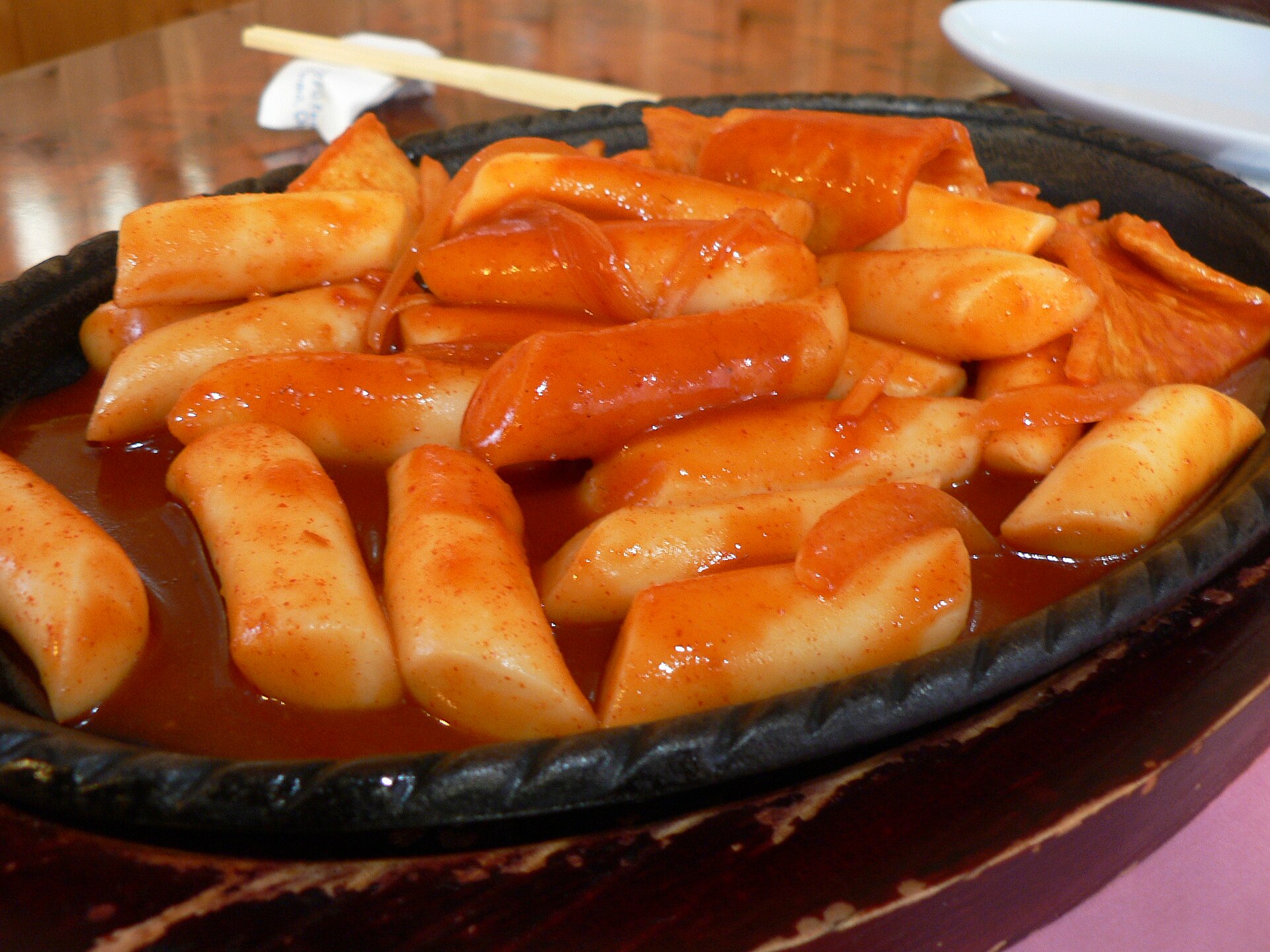
The preference is not for sugar. It is for a combination. What registered as “unexpectedly sweet” was most likely your palate meeting an unfamiliar pairing, not an unusual quantity of sugar. The sweetness was simply the part you had a word for.
There is a mechanical reason the pairing works: salt makes the tongue read sweetness more strongly, so a sweet-salty sauce tastes more of both than either would alone. It is also why these dishes exported well. A soy-and-sugar marinade caramelises on a grill, survives being cooked in front of you, and holds up to a long flight.
The test case: Korean dessert
If Koreans simply liked sugar, Korean dessert would be sweet. It is the opposite — “not too sweet” is among the highest compliments a Korean cake, bread or coffee can receive, and bakeries advertise it. Sweetness with nothing to balance it is held to be unrefined.
That is the same rule as above, seen from the other side. Sweet alone is not the point. Sweet in combination is.
A note on history, since it is easy to over-claim: dan-jjan is a recent word, and sweetness in older Korean cooking came mostly from honey and grain syrup, which were scarce and expensive. A missionary writing in 1890 called Korea a land without sugar. What this article describes is a modern palate, not an ancient one.
Why you cannot order it away
In nine of the dishes we track, the sweetener — sugar, corn syrup or grated pear — is in the sauce, cooked together with soy sauce, garlic and often a fermented paste. The soy sauce and the paste are where the salt and the umami come from. They are one object.

So asking for bulgogi “less sweet” is not asking for less of an ingredient. It is asking for a different sauce, and the sauce is usually made in advance in bulk.
One exception is worth knowing. A few chains now sell a reduced-sugar version as a separate item: the tteokbokki chain Yupdduk, for example, lists low-sugar versions of two of its sauce grades at no extra cost. That is a different product on the menu, not a change made to your order in the kitchen.
Switch dishes instead of modifying one. That is the move that works here.
Widening the range answers the question for you
40 of our 91 dishes are neither sweet nor spicy. You are not short of options — they are simply not on any list of famous Korean food.
| Instead of | Order | What you get |
|---|---|---|
| Bulgogi, galbi | Samgyeopsal or bossam | Unseasoned pork. The flavour comes from what you wrap it in |
| Jajangmyeon | Kalguksu or janchi-guksu | Clean broth, no sugar near it |
| Tteokbokki | Gimbap | Sesame and salt, not syrup |
| Any marinated grill | Seolleongtang, galbitang, samgyetang | Bone broth. You salt it yourself at the table |
| Yangnyeom chicken | Plain fried chicken (huraideu) | Same bird, no glaze |
The broth dishes are the easiest route out. Dwaeji gukbap, seolleongtang and kongnamul-gukbap arrive deliberately under-seasoned, with salt on the table. Nothing has been sweetened for you.

If you are in Busan, the easiest single test is a bowl of dwaeji gukbap with the banchan that comes with it: not one sweet thing on the table.
And this is the real answer to the original question. Eat eight more Korean dishes chosen from outside the famous fifteen and the question dissolves on its own — not because someone explained it, but because the range stops looking like one flavour.
One phrase worth knowing
To check before ordering, ask: “dalaeyo?” (달아요?) — “is it sweet?”
The short version
- Korean food is not broadly sweet — two thirds of dishes have no real sweetness
- The famous dishes are the sweet ones, and that is what you were served
- Sweetness almost never comes alone: 12 of the 15 sweetest dishes are also salty and savoury. The preference is for the combination, not the sugar
- Korean dessert is prized for being not too sweet — the same rule from the other side
- The sweetener is inside the sauce, so it cannot be subtracted
- 40 of 91 dishes are neither sweet nor spicy. Widen what you order and the question answers itself