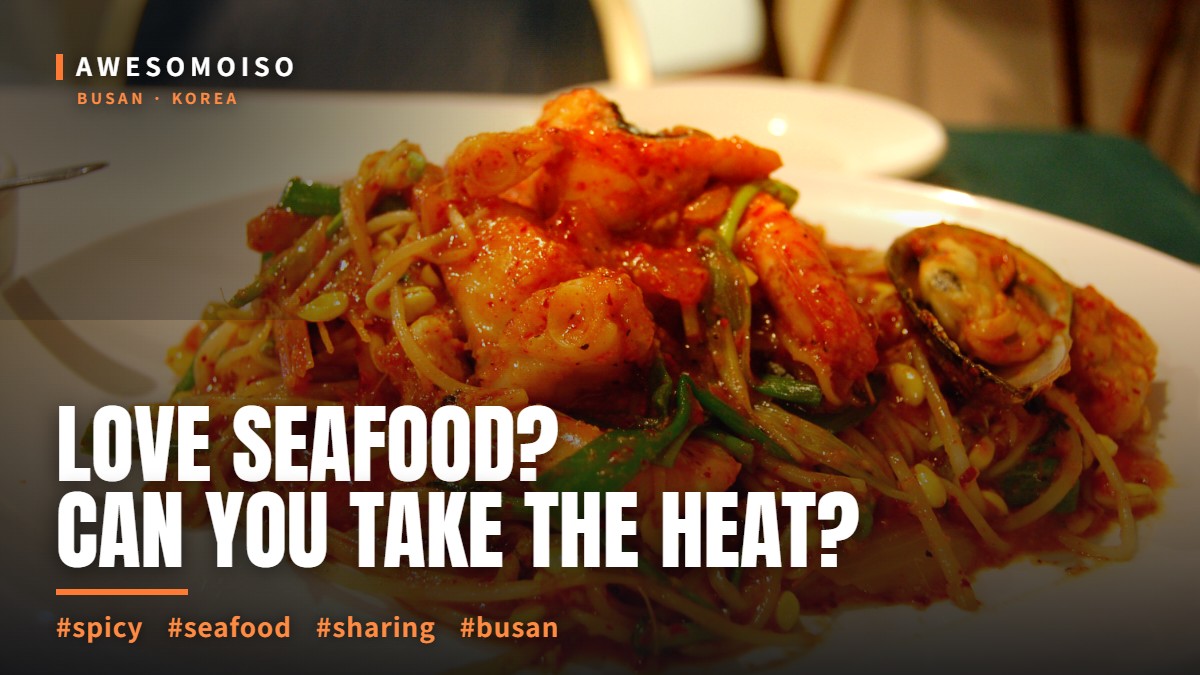
If you like seafood and you can take heat, this is the Korean dish to put at the top of your list. A whole fish or a pile of shellfish, buried in a thick chilli-garlic sauce, served on a bed of soybean sprouts, for a table to share.
It is not a dish most visitors find on their own. The menus are rarely translated, and the one English word on the menu — “steamed” — is the wrong word for what arrives.
First: it says “steamed.” It is not steamed
Jjim (찜) does mean steamed. But for these dishes the food never goes near a steamer. It is cooked down in a wide pan with chilli powder, garlic, soy and starch until the sauce thickens and coats everything.
So when a menu says steamed monkfish, do not picture a delicate white fillet. Picture something closer to a dry curry, or a Louisiana étouffée made with Korean chilli instead of cayenne. Thick, clinging, deep red, and hot.
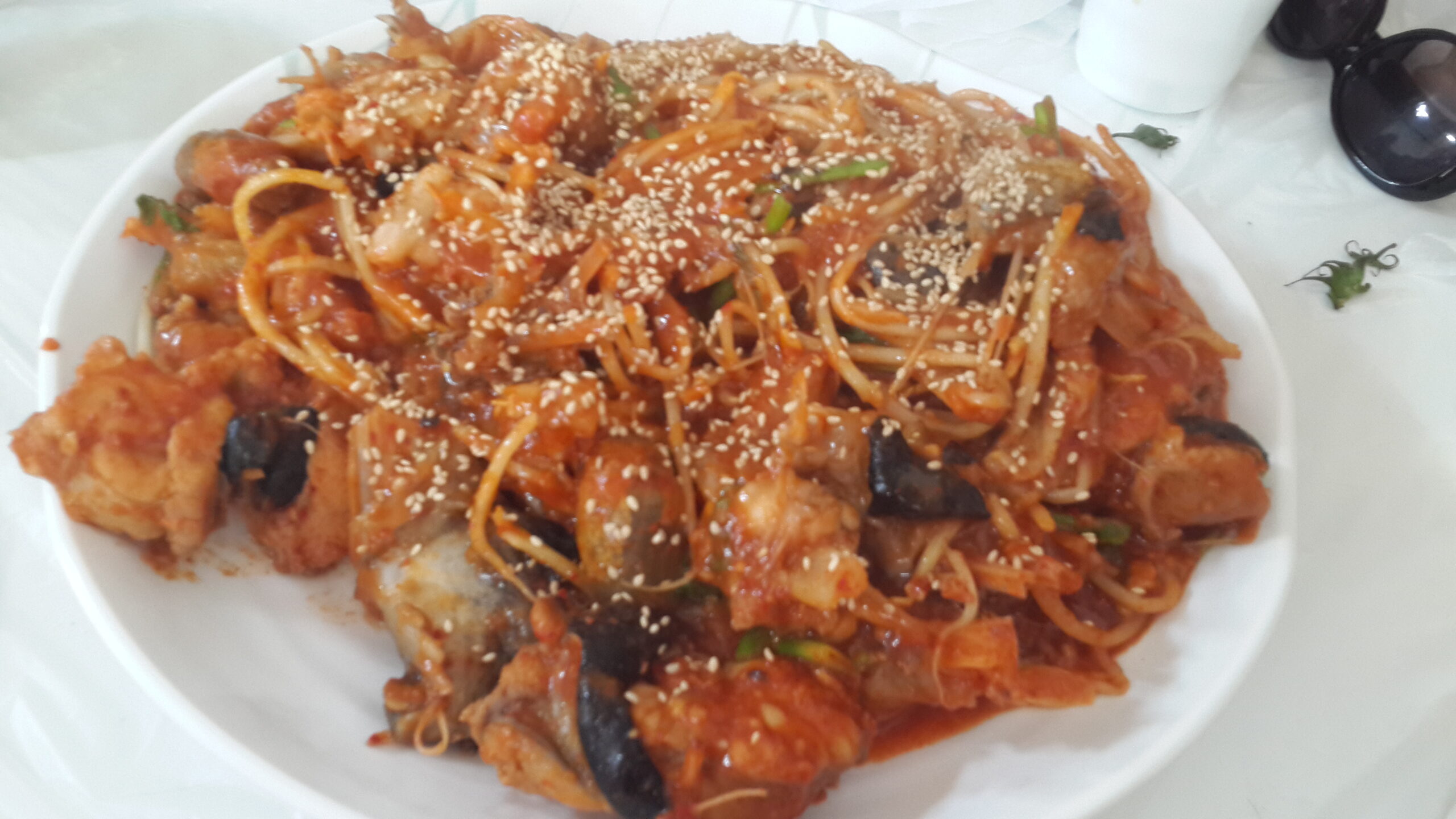
The dishes
Agu-jjim · 아구찜 · AH-goo-jjim · very spicy
Monkfish, braised in chilli sauce over a thick bed of soybean sprouts. Monkfish has dense, almost lobster-like flesh that does not flake apart — which is why it survives this treatment. Usually the house speciality and the reason the restaurant exists.
Expect bones. Monkfish is served on the bone and you work around it. Shops usually add shrimp, mussels and mideodeok (sea squirts — small, bright, and they squirt hot broth if you bite them whole; chew carefully).
Daegu-ppol-jjim · 대구뽈찜 · DAY-goo-ppol-jjim · very spicy
Cod cheeks and head meat in the same sauce. Leaner and firmer than monkfish — less fat, more bite. If you found agu-jjim too soft, this is the one to try next.
The sauce is essentially identical. The fish is the whole difference, which is why most shops sell both from the same kitchen.
Haemul-jjim · 해물찜 · HEH-mul-jjim · very spicy
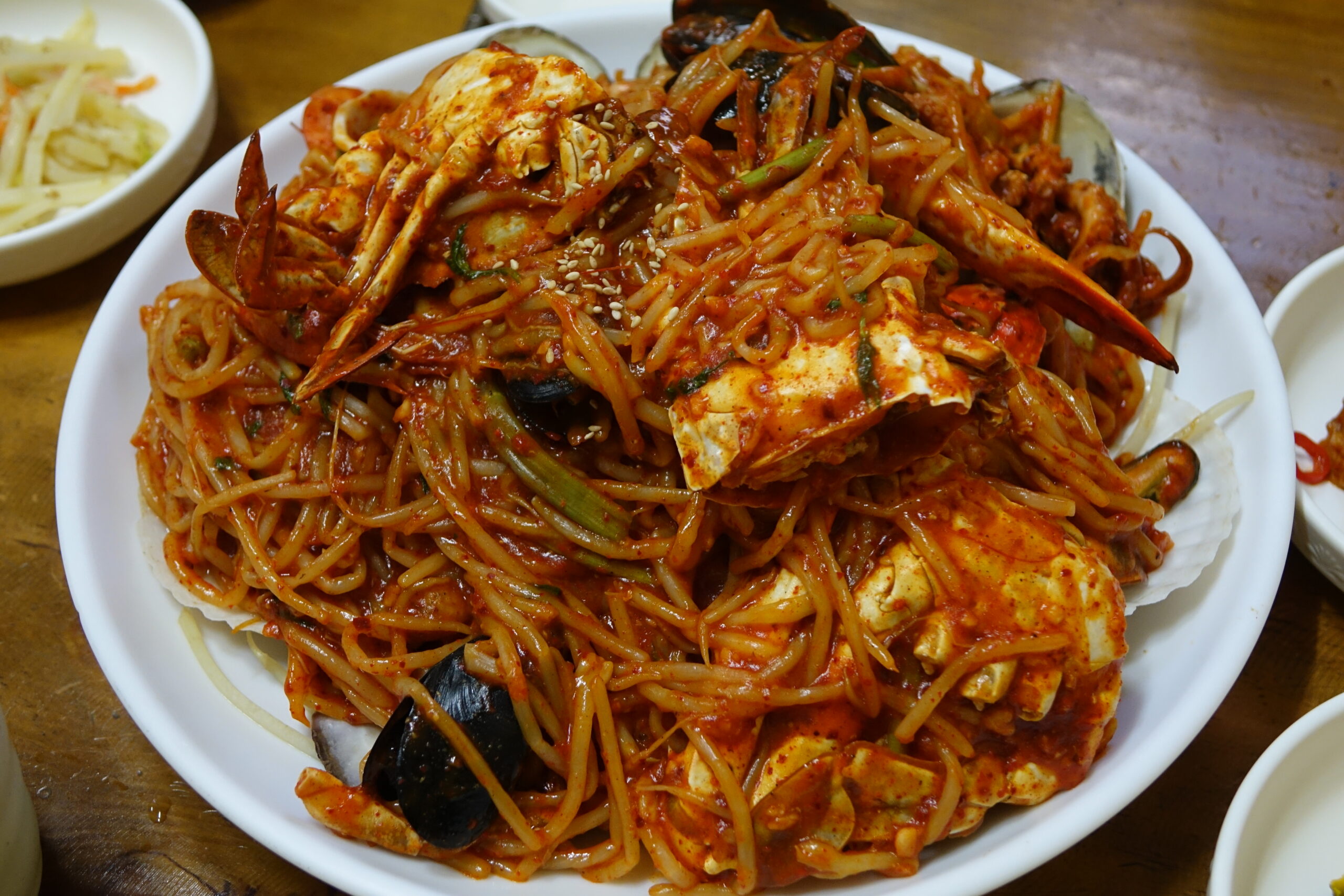
Blue crab is still in there — there is just less of it. Squid, octopus, shrimp and clams fill out the rest. Same sauce, same soybean sprouts, same pan.
Order this when you want variety rather than one thing. It still means shell work — crab and clams mean hands, and dinner takes a while. If you would rather talk than wrestle with your food, the two fish versions above are much easier.
Kkotge-jjim · 꽃게찜 · KKOT-geh-jjim · very spicy
The same dish with the crab turned up and everything else pulled back. Haemul-jjim and kkotge-jjim are one dish on a slider — more variety, or more crab. Order this one when crab is what you actually came for.
It is the messiest thing on this page. Blue crab shells are thin but sharp, the sauce gets everywhere, and you will use your hands throughout. Many shops hand out gloves. Factor in the time.
If you wanted plain steamed crab, you are in the wrong restaurant
Korea does serve crab simply steamed — but it is a different crab, a different restaurant, and it is not called jjim.
Plainly steamed crab means snow crab (대게, dae-ge), red snow crab (홍게, hong-ge) or king crab (킹크랩), sold by weight at crab specialists and usually priced per kilo at the tank. Koreans just call these by the crab’s name. Nobody says “dae-ge-jjim” — you say dae-ge and steaming is simply how it comes.
Blue crab is rarely sold that way. It turns up in this chilli braise, in raw soy-marinated ganjang-gejang, and in soups — not usually as a plain steamed platter. So “kkotge-jjim” on a menu means the spicy version. If you want the clean, sweet, steam-and-dip experience, look for a snow crab or king crab place instead.
Less common, same family
- Ganjaemi-jjim / Gaori-jjim (간재미찜 · 가오리찜) — skate. Firm, slightly cartilaginous. Sold both in the chilli braise and in a milder soy version, so ask.
- Al-jjim (알찜) — pollock roe sac and milt, braised in the same sauce, often over radish. A texture most visitors have no reference for. Order it if you already like roe.
Jjim is a method, not a fixed menu. You will also see it with pork spine, chicken, and dried pollock. This page is the seafood branch of that family.
How it varies — Masan style vs Gunsan style
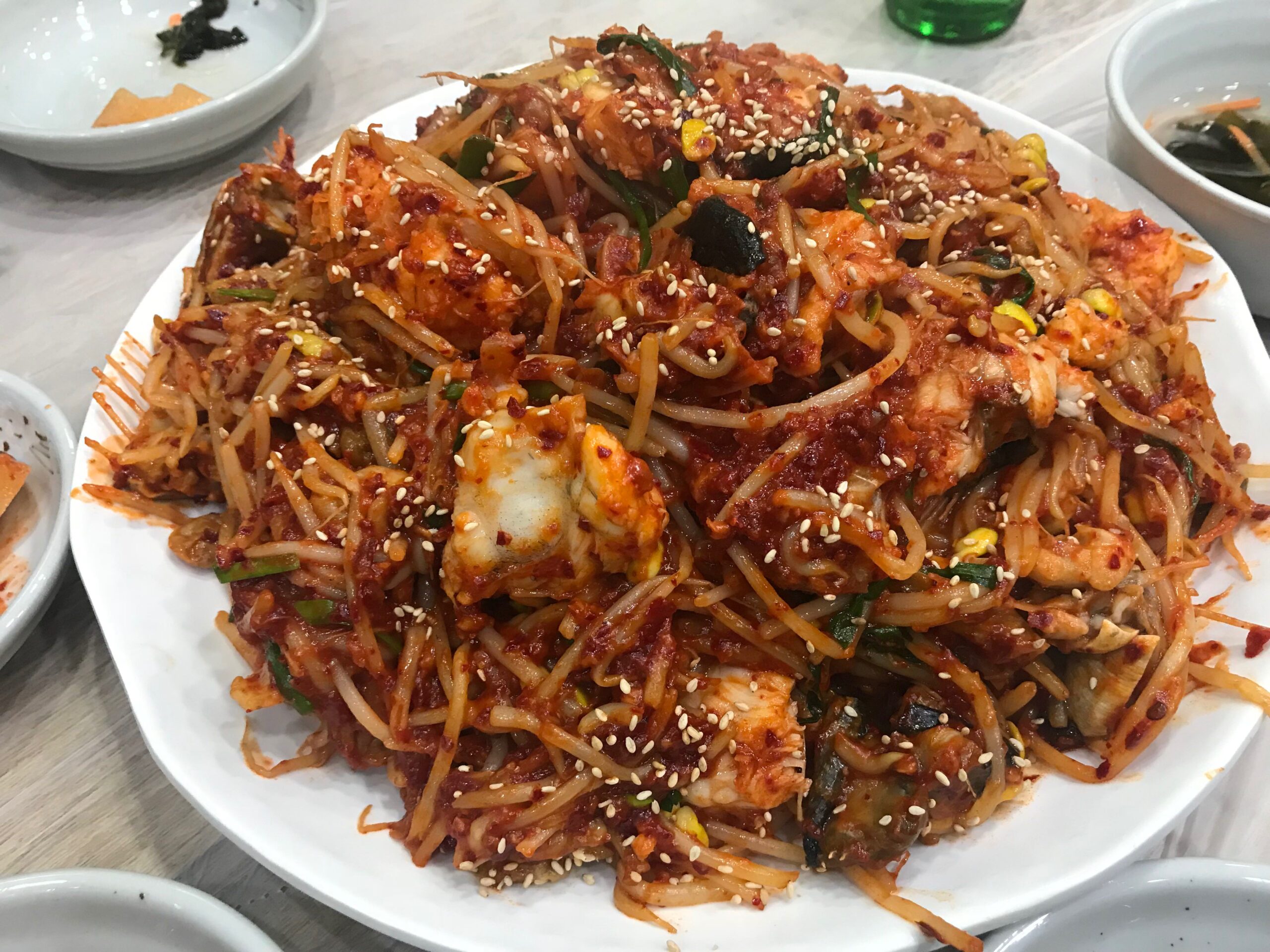
Agu-jjim is strongly associated with Masan, now part of Changwon, about an hour west of Busan. But there is a second tradition, and the plate in front of you tells you which one you are eating.
| Masan style | Gunsan style | |
|---|---|---|
| The fish | Dried monkfish, air-dried in winter wind | Fresh monkfish |
| The greens | Soybean sprouts | Water dropwort (minari) |
| Sea squirts | Yes | No |
| Texture | Chewier, sauce soaked deeper into the fish | Softer, cleaner fish flavour |
Drying takes 20 to 30 days and the labour shows up in the price — one shop owner put the dried version at around 20 percent more. But do not assume a Masan sign means dried fish. Reporting suggests shops in Masan itself now run close to half dried, half fresh. If you want the dried version specifically, you have to ask for it.
The soybean sprouts are not a side dish
Roughly half of what arrives on the platter is kongnamul (콩나물), and that is not padding. Push them aside to get at the seafood and you have made the dish worse.
First, they are not the sprouts you are thinking of. English menus say “bean sprouts,” which in most of the world means mung bean sprouts — thin, white, limp after thirty seconds of heat. Kongnamul are soybean sprouts: longer, sturdier, with the yellow bean still attached at the head. They are added late and keep their snap all the way through the braise.
That snap is the job. Monkfish and crab in this sauce are soft, rich and heavy; the sprouts are the crunch and the cool against it. They also carry the sauce — the chilli clings to them far better than to a smooth piece of fish, so the sprouts are where a lot of the flavour actually lives.
And they take the edge off the heat. A mouthful of fish alone is noticeably hotter than a mouthful of fish and sprouts together. Build each bite from both. That is how the dish is meant to work, and it is the single thing most first-time visitors get wrong.
How to eat it
- It is a sharing dish. Portions are sized for two or more and solo orders are often refused. The smallest size is usually labelled so (소).
- Eat the soybean sprouts in the same mouthful as the seafood — see the section above.
- Order rice to finish. Many shops will fry rice into the leftover sauce at the table for a small extra charge. Whether they do, and what it costs, is up to the shop — ask when you order.
- It is hot. Not the hottest thing in Korea, but well past most people’s everyday threshold. There is no mild version of agu-jjim.
Of everything on this site, this is the group that most rewards a visitor who already likes spicy food. There is no Western equivalent to compare it to, and almost nobody writes about it in English.
Copy-paste Korean
| What you want | Show this | Say it |
|---|---|---|
| Spicy braised monkfish | 아구찜 | AH-goo-jjim |
| Spicy braised cod cheek | 대구뽈찜 | DAY-goo-ppol-jjim |
| Spicy mixed seafood | 해물찜 | HEH-mul-jjim |
| Spicy braised blue crab | 꽃게찜 | KKOT-geh-jjim |
| Steamed snow crab (different shop) | 대게 | DAE-geh |
| Spicy braised skate | 간재미찜 | gan-JEH-mi-jjim |
| The small size, please | 소자로 주세요 | SO-ja-ro joo-se-yo |
| Is it very spicy? | 많이 매워요? | MA-ni MAE-wo-yo? |
| Fried rice at the end, please | 볶음밥 주세요 | BOK-keum-bap joo-se-yo |
Where to go next
- Korean Seafood — the wider seafood map
- Korean Raw Fish by Season
- How to find these restaurants on Naver
1 thought on “Korean Spicy Seafood Jjim: Monkfish, Crab and the Dish That Isn’t Steamed”