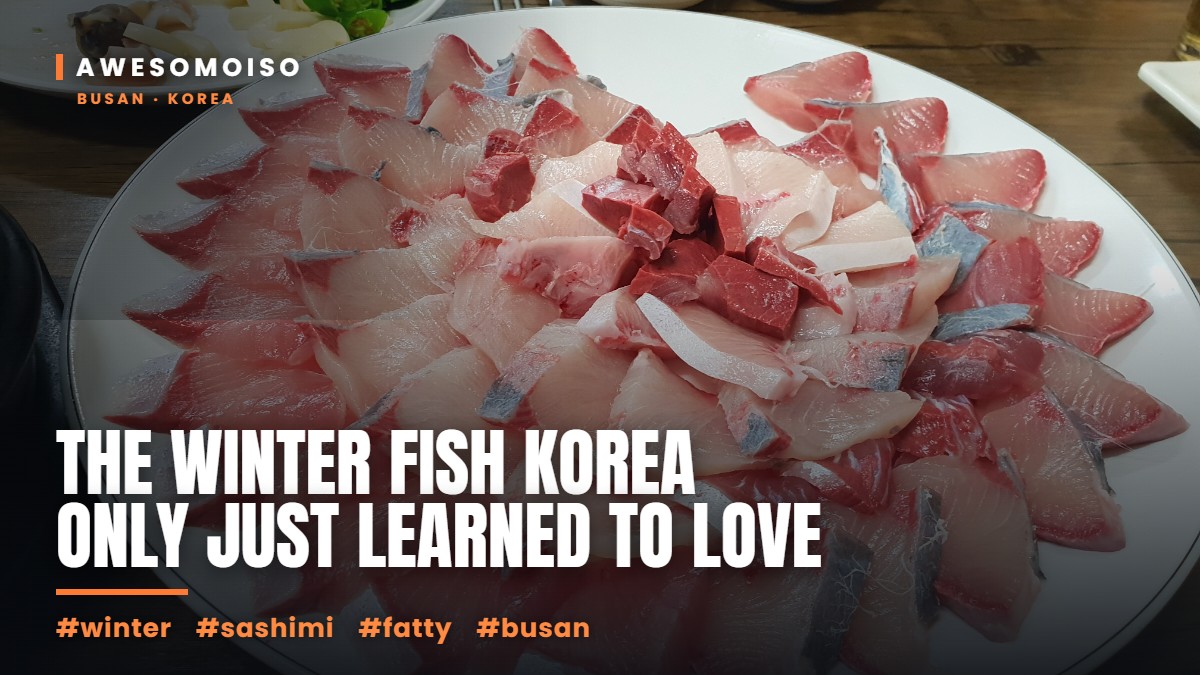
Every winter, Korean food media fills up with one fish. Queues form outside raw-fish restaurants, supermarkets build displays around it, and people travel for it.
What almost nobody tells visitors is that this is recent. Not centuries-old, not a regional tradition reaching back generations. Koreans decided bangeo was great within living memory — and the reason involves Russia, Norway, and a sanctions dispute.
The fish
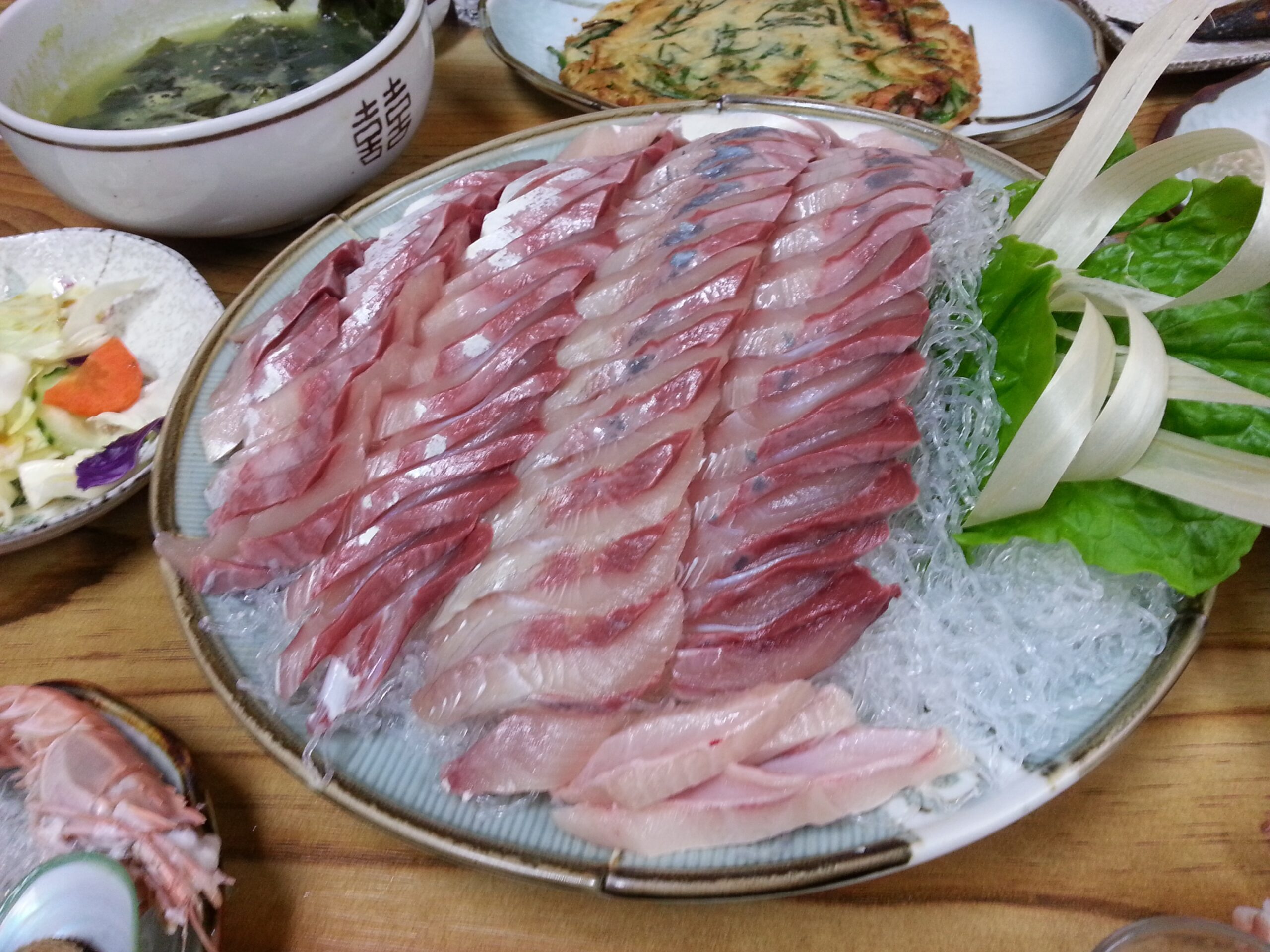
Bangeo (방어) is Japanese amberjack — the fish sold as buri or hamachi in Japanese restaurants. In winter it packs on fat ahead of the cold, and that is the entire point of eating it.
The taste is closer to a fatty tuna belly than to a lean white fish. Rich, buttery, faintly sweet, with the mouth-coating quality of good salmon. The flesh stays firm and bouncy rather than soft — several Korean food writers describe the winter texture as crisp, which sounds odd for raw fish until you eat it.
After March that firmness goes. Out of season it is a different and much duller fish, which is a large part of why it took Korea so long to come around.
Why this is new — the salmon story
Korea’s raw fish tradition is built on hwareo-hoe (활어회) — fish killed moments before serving, prized for a tight, chewy, resistant bite. Flounder and rockfish, swimming in the tank, pointed at and pulled out. Chewiness was the quality everyone was chasing.
Japan went the other way, towards seoneo-hoe (선어회) — fish aged under refrigeration until the texture softens and the savoury flavour deepens. Soft and fatty was simply not what Korean diners were looking for. A fish like bangeo sat outside the preference.
Then the supply chain did something nobody planned.
In 2014, Russia banned Norwegian seafood in retaliation for Western sanctions over Ukraine. Norway’s salmon had to go somewhere, and a great deal of it came to Asia. Farmed salmon fell from close to $8 per kilo in early 2014 to around $5 in 2015. Korean imports of Norwegian salmon jumped 42.4 percent in a single year to a then-record 13,285 tonnes, and all-you-can-eat salmon restaurants spread across the country.
A generation of Korean diners learned to enjoy soft, fatty, oily raw fish — because it was suddenly the cheapest raw fish available. Once that taste was established, a fish that had been sitting in Korean waters all along started to look very different.
The numbers follow. In 2017 a major Korean supermarket chain expanded its bangeo buying and stretched the selling window to November–February; the following year its bangeo sales over the same period rose 75 percent. Wholesale prices at Seoul’s Noryangjin market went from about ₩10,000 per kilo in December 2020 to ₩17,750 in December 2025. By the mid-2020s, trade coverage was calling bangeo the single most in-demand seafood in the country.
If you are a visitor who has never heard of this fish, you are not behind. Most Koreans were not eating it either, until recently.
Dae-bangeo — and why nobody agrees what it means
Dae-bangeo (대방어) means “big bangeo,” and bigger genuinely is better here: more fat, more distinct cuts from a single fish, a richer slice. It is the version people queue for.
But the threshold is not settled. These are all current, all in use:
| Source | So (small) | Jung (medium) | Dae (large) |
|---|---|---|---|
| Ministry of Oceans and Fisheries | under 2kg | 2–4kg | 4kg+ |
| Common market usage | under 3kg | 3–5kg | 5kg+ |
| Enthusiast consensus | — | — | 7–8kg+ |
So “dae-bangeo” on a sign tells you very little. The government floor is half the weight enthusiasts insist on. The useful question in a restaurant is not whether it is dae-bangeo but how many kilos the fish actually is — ask, and expect the shop to know, because they bought it by weight.
When to come
- Season: November to March. Best from December to February.
- Warming winters have pushed the start later. Korean coverage now commonly says December rather than November.
- After March, skip it. The fat and the firm texture both drop off.
Three fish that look almost identical
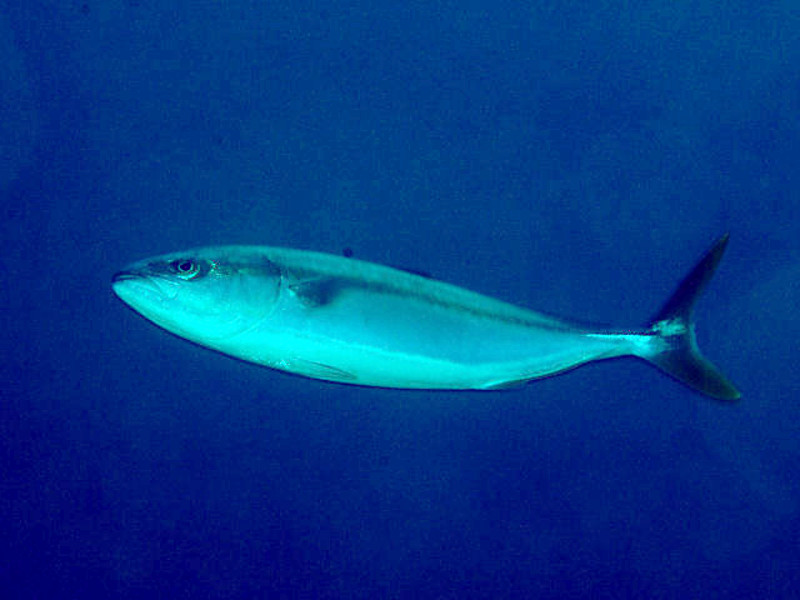
This is where visitors get caught. Three different species circulate under overlapping names, in Korean restaurants and Japanese ones:
| Korean | Japanese | English | Peak season |
|---|---|---|---|
| 방어 bangeo | buri / hamachi | Japanese amberjack | Winter |
| 부시리 busiri | hiramasa | Yellowtail amberjack | Late summer |
| 잿방어 jaetbangeo | kanpachi | Greater amberjack | — |
The one that matters in winter is bangeo versus busiri. On the plate, busiri is the paler, leaner, springier fish — excellent in late summer, and the subject of a blunt Korean saying that winter busiri tastes like radish. Korean reporting notes the two are regularly confused at point of sale, and that in winter busiri can even cost more than bangeo.
Two tells, if you can see the whole fish:
- Tail fin — bangeo’s is angular, almost squared off; busiri’s is rounder.
- Yellow line — busiri carries a yellow band running from the eye back to the tail. Bangeo does not.
On a plate of sliced fish, you cannot tell. Ask: 방어예요, 부시리예요? A shop that is proud of its fish will answer immediately.
What it costs
There is no single price, and anyone quoting one is guessing. It moves with the day’s catch, the weight of the fish, and whether you are at a market stall or a restaurant.
What we can report, with dates: Noryangjin wholesale was around ₩10,000/kg in December 2020 and about ₩17,750/kg in December 2025 (roughly US$7 to US$13 at the time). That is wholesale, not what you pay sitting down — a restaurant plate is a multiple of it. Interestingly, imported bangeo has at times run well above domestic, so “imported” here does not mean cheap.
Practical approach: in a dense raw-fish district the prices converge, so you do not need to compare — walk in. Outside one, read the menu board first and ask the weight and the total before they cut the fish.
Can you eat it?
| Vegan | No |
| Vegetarian | No |
| Pescatarian | Yes |
| Halal | Fish is widely accepted as halal, but a Korean raw-fish restaurant is not a halal kitchen. Soju and beer are served at the table, and the same boards and knives handle other items. We have not verified halal certification at any of these restaurants. |
| Raw fish risk | This is raw fish. Not advised in pregnancy or with a compromised immune system. |
How it is eaten
- It is a sharing order. A whole large fish is portioned for a table; solo servings exist but you will see far fewer cuts.
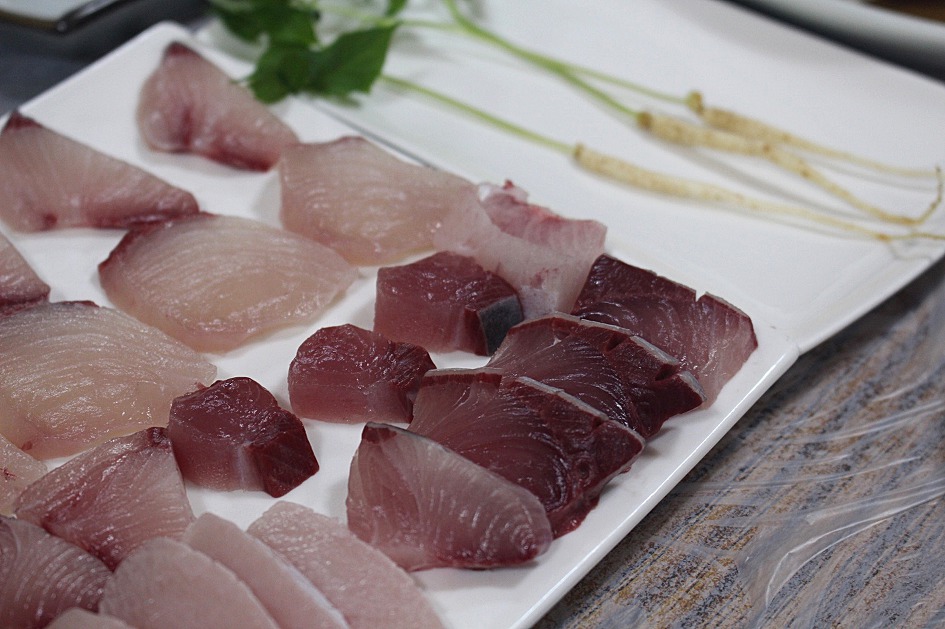
- Different parts of the same fish arrive on one plate — belly, back, collar. They are not mistakes. Eat them in sequence and the difference is obvious.
- Wasabi and soy, or ssamjang and lettuce. Both are normal in Korea; the leaf wrap is the more Korean way and it is not a lesser option.
- Expect a soup at the end. Many shops finish with maeuntang, a spicy stew made from the frame. Whether it is included or charged extra is up to the shop — ask when you order.
From someone who eats this
Written by the person who runs this site — Korean, living in Busan.
This is a fish I actively like. The oily, nutty richness of a winter bangeo still makes my mouth water thinking about it, which is not something I would write about most fish on this site.
Aged, not straight off the knife
Eaten immediately it has a slightly odd note to it. Not spoiled — just a particular edge that I do not think flatters the fish. Aged, it is much better. That is the opposite of the usual Korean instinct, where the prize is fish killed minutes ago, and it is part of why bangeo sat outside the mainstream for so long.
So if a shop offers an aged version, take it. Places that specialise in sukseong-hoe (숙성회, aged raw fish) are where this fish makes the most sense.
⚠️ Two things a first-timer should know
- The dark bloodline meat. Along the spine there is a strip of dark red muscle — Koreans call it hyeolhap-yuk (혈합육, also said as 혈압육). It is strong, and it goes off faster than the pale flesh. Depending on how fresh the fish is, this is where a bad experience comes from. Try a very small piece first and decide. There is no obligation to eat it.
- Worms — two different ones, and they look different. Bangeo sasangchung (방어사상충, Philometroides seriolae) is the one that lives in the muscle: bright red, long and thin. Anisakis (고래회충) is white or pale yellow, short, and coiled. Korean seafood and health media consistently report that the red muscle worm cannot parasitise humans and cannot penetrate the stomach wall, and that most of it is removed during preparation — we have not been able to verify that against a public-health authority or a peer-reviewed source, so treat it as the widely-reported position rather than settled fact. Anisakis is the one that is medically established: it can burrow into the stomach wall, deworming tablets do not treat it, and removal is endoscopic.
Neither of these is a reason to avoid bangeo. They are a reason to look at the plate for two seconds before you start.
⚠️ On wasabi — this one we did check. You will hear that wasabi handles the parasite. It does not, at the amounts used in eating. The Tokyo Metropolitan Government’s food-safety guidance states plainly that wasabi, soy sauce and vinegar will not kill anisakis in the quantities normally used in cooking, and the same goes for citrus and vinegar marinades. What is recognised is freezing and heat — Tokyo’s figure is 24 hours or more at −20°C, frozen through to the centre. Eat it with wasabi because you like wasabi. Do not count it as protection.
Perspective, and then it is your call. Koreans are not a relaxed people about food safety. If this were genuinely risky, we would not spend every December waiting for this fish. For most people it is a “so that is a thing” and nothing more — but raw fish is always a personal calculation, and if you are pregnant or immune-compromised, this is not your dish.
Copy-paste Korean
| What you want | Show this | Say it |
|---|---|---|
| Yellowtail sashimi | 방어회 | BANG-eo-hwe |
| Large yellowtail | 대방어 | DAE-bang-eo |
| How many kilos is it? | 몇 킬로짜리예요? | myeot KIL-lo-jja-ri-ye-yo? |
| Is this bangeo or busiri? | 방어예요, 부시리예요? | BANG-eo-ye-yo, BU-si-ri-ye-yo? |
| Portion for two, please | 2인분 주세요 | i-in-bun joo-se-yo |
| How much in total? | 전부 얼마예요? | JEON-bu EOL-ma-ye-yo? |
Where to go next
- Korean Raw Fish by Season — what is good when
- Korean Seafood
- Spicy Seafood Jjim — the cooked side of the same fish counter
- Finding these places on Naver
1 thought on “Bangeo: The Winter Fish Korea Only Recently Decided Was Good”