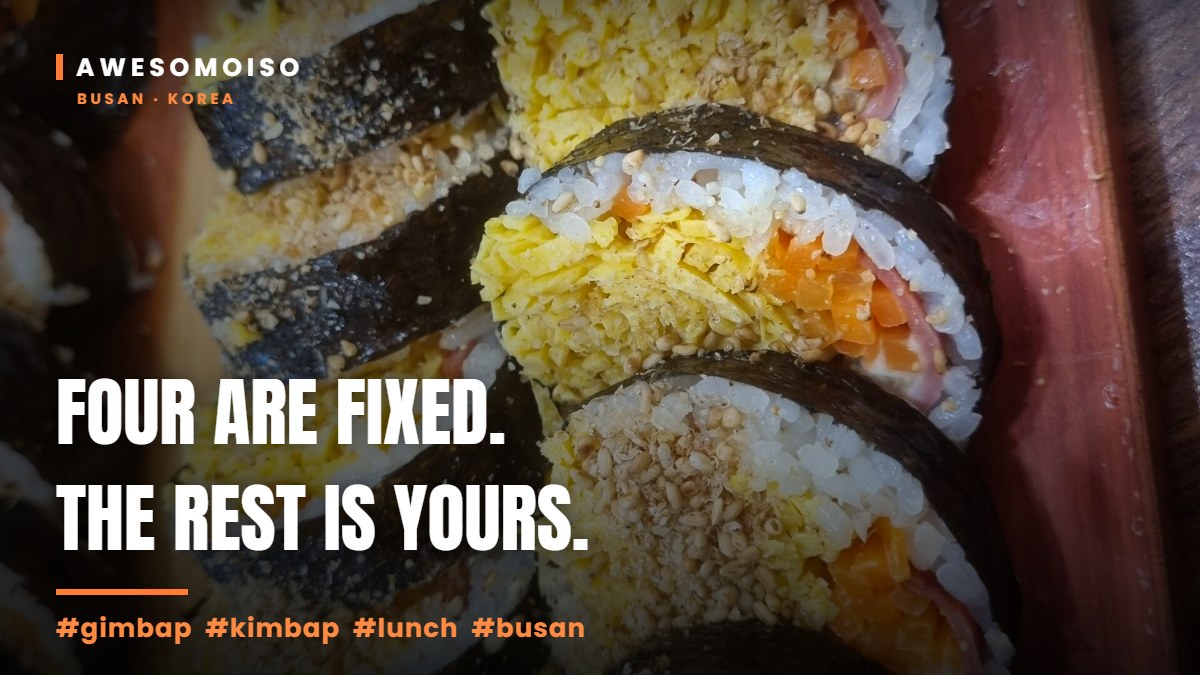
Gimbap (김밥) is rice and fillings rolled in a sheet of seaweed and cut into rounds. That description also fits Japanese norimaki, which is why foreigners keep asking whether it is sushi. It is not, and the reason has almost nothing to do with the shape.
The useful way to read a gimbap menu is this: four things hold the roll together, and everything else is a dial the shop turns. Once you see which four, the whole counter makes sense — including the twelve varieties on the board that all look identical from outside.
The four that hold it together
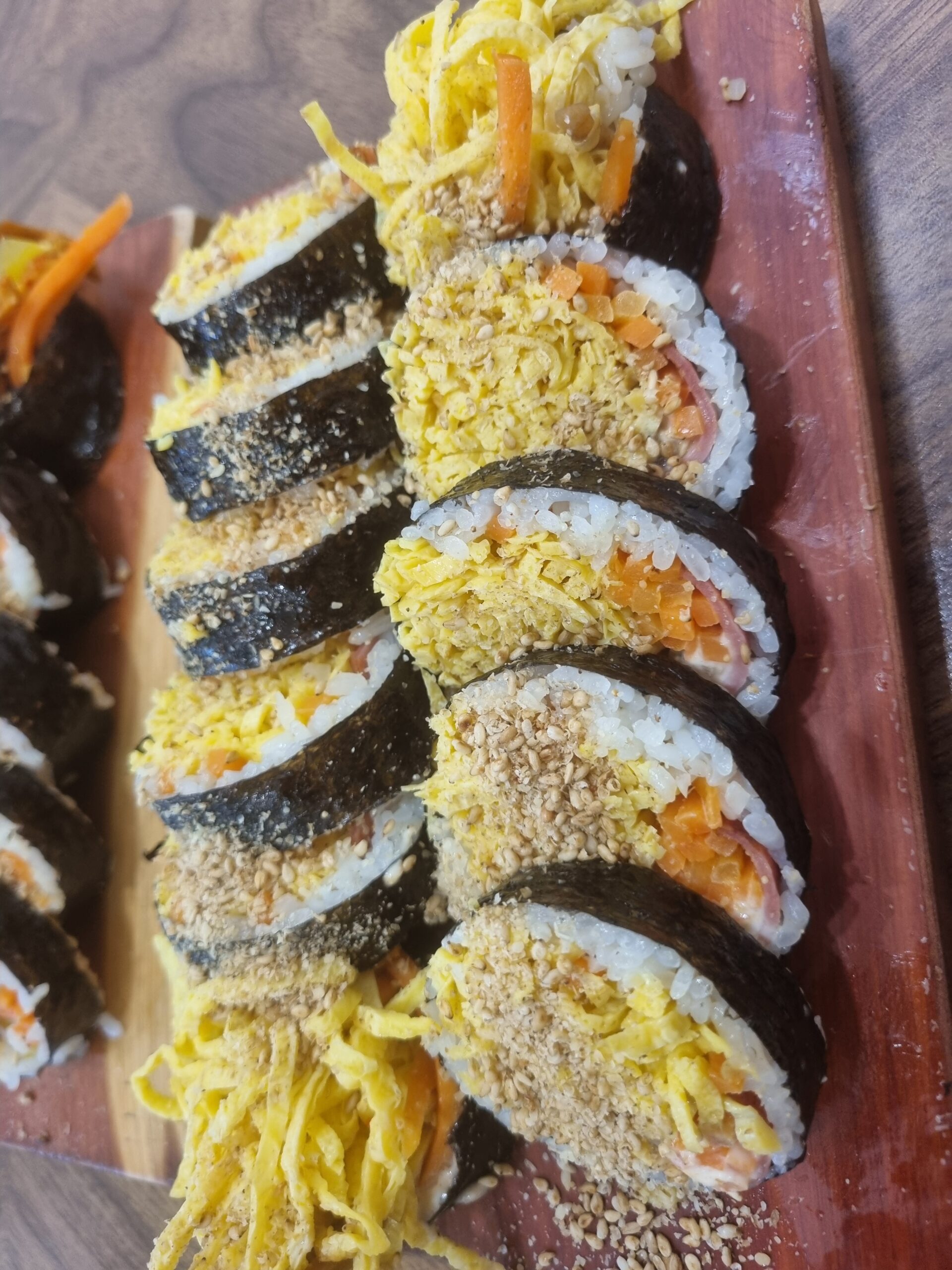
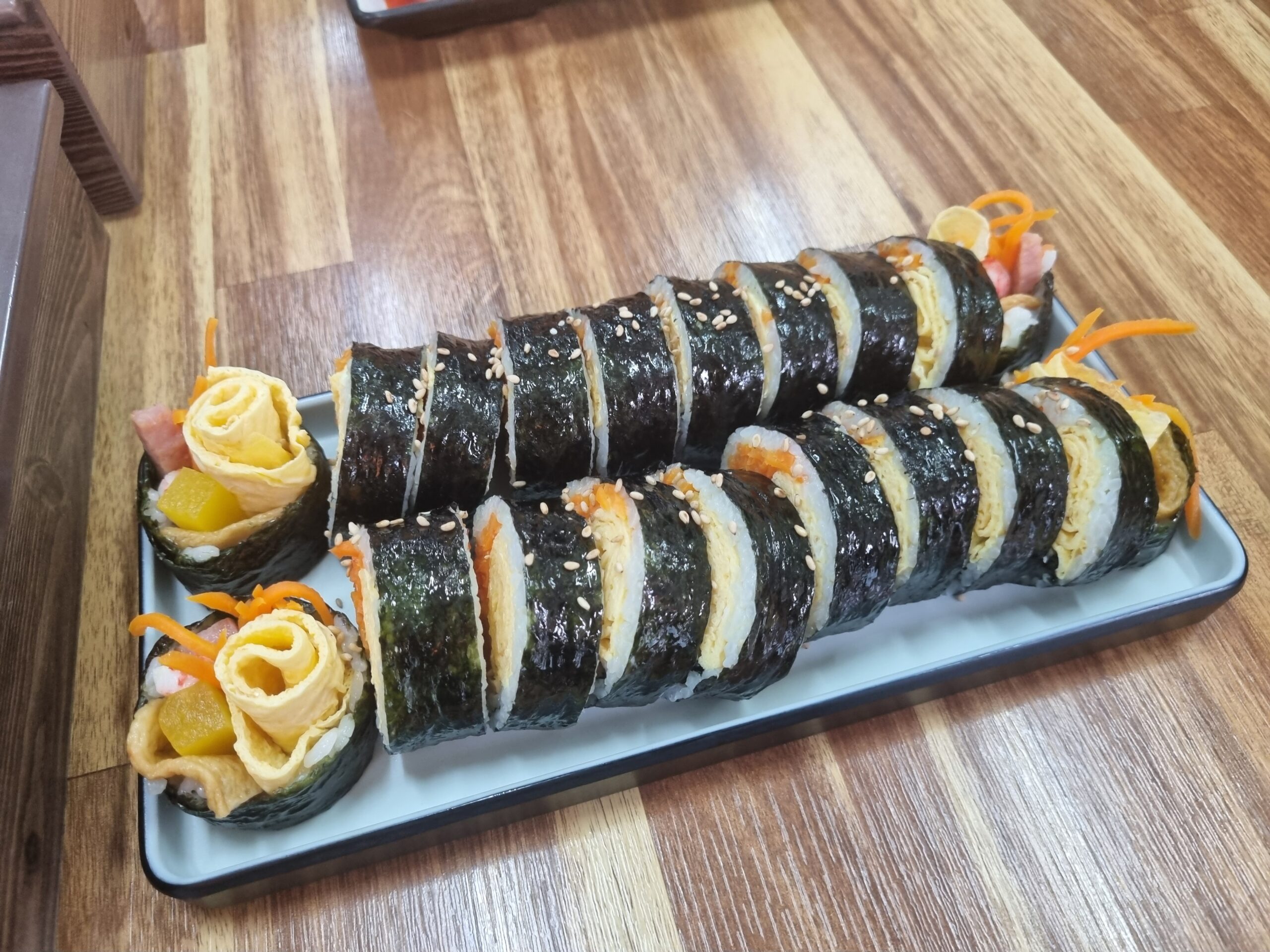
Across nearly every roll you will be handed in Korea, four elements do the structural work:
- Gim (김) — the seaweed sheet. Toasted, usually brushed with oil and salt. It is the wrapper and also a flavour: roasted, faintly marine, a little savoury.
- Bap (밥) — plain white rice, cooked drier than usual and seasoned. The same short-grain white rice Koreans eat at every meal, with slightly less water in the pot so the grains stay firm and separate. How it is then seasoned is the single biggest difference between one shop and another, and the next section is about that.
- Danmuji (단무지) — pickled yellow radish. Sweet, sharp, and loud. It is the acid and the crunch. Pull it out and the roll goes flat in a way that is hard to predict until you try it.
- Gyeran (계란) — egg. Either a thick folded omelette cut into batons, or thin sheets shredded into ribbons. Soft, mild, slightly sweet; it is the cushion everything else sits against.
Those four give you the taste a Korean means when they say “gimbap”: toasty, savoury, sweet-sour, soft. If a roll has only those four, it still reads as a complete gimbap. Nothing is missing.
Everything else is a slider
Beyond the four, the roll is open. Shops add ham, imitation crab stick, fish cake, tuna with mayonnaise, cheese, bulgogi, pork cutlet, kimchi, canned corn, spinach, carrot, burdock root, perilla leaf, anchovy. They also change the amount — a shop can simply put in more egg, or more fish cake, and that is a different roll.
This is the part most English explanations miss. The varieties on a Korean menu board are not twelve different dishes. They are the same roll with one dial moved:
| On the board | What actually changed |
|---|---|
| 야채김밥 yachae | Vegetables only — the meat dial turned to zero |
| 참치김밥 chamchi | Mayonnaise-bound tuna added |
| 치즈김밥 chijeu | A slice of processed cheese added |
| 김치김밥 kimchi | Kimchi added — sour and hot, the only one that is actually spicy |
| 돈까스김밥 donkkaseu | A strip of fried pork cutlet added |
| 소고기김밥 sogogi | Seasoned beef added |
| 꼬마김밥 kkoma | Nothing added — the roll is simply made thin and small |
That flexibility is the dish’s actual design. A gimbap shop is not cooking twelve recipes; it is holding one structure and swapping what goes in the middle.
⭐ The rice, part one: it has to be dry
Before the seasoning question, there is a texture question, and Korean cooks treat it as the thing that decides whether a roll works at all.
Gimbap rice is cooked deliberately drier than table rice. Less water goes into the pot. The target is goseul-goseul (고슬고슬) — grains that stay distinct and firm, with only enough tack to hold a shape when pressed.
Wet rice fails in three visible ways, and once you know them you can spot a bad roll before you bite it:
- It soaks the seaweed. Gim goes limp and loses the crisp, toasted quality that is half the point of the wrapper.
- It collapses under the knife. The cut face smears instead of showing clean layers of egg, radish and carrot.
- It eats pasty. The separate textures inside — crisp radish, soft egg — get buried in a single gluey mouthful.
Too dry fails too: the rice crumbles and the roll will not hold together. But between the two errors, wet is the worse one, and it is the common one.
⭐ The rice: sesame oil base or vinegar base
Here is the difference that actually separates a Korean roll from a Japanese one, and it is invisible from the outside.
Japanese norimaki uses sushi rice — sumeshi / shari — folded with vinegar, sugar and salt. The rice itself tastes sweet-sour. In Korea, the common seasoning is sesame oil and salt. The rice tastes toasted and round rather than sharp, and the sourness in the roll comes from the pickled radish instead.
That is the usual split, and it is a real one. But treating it as a national border is wrong, and this is where most English write-ups overreach:
- Both bases exist in Korea, and both are fine. Plenty of Korean shops season the rice with vinegar, or with vinegar and sesame oil. Older Korean recipes used vinegared rice as a matter of course (more on that below). Nobody considers a vinegared roll a fake.
- A sesame-oil roll eats nuttier, softer, more savoury. It sits closer to a lunchbox than to a sushi counter.
- A vinegar roll eats lighter and brighter, and the rice grains stay more distinct.
- Many shops do not advertise which they use. If it matters to you, ask — the phrase is at the bottom of this post.
⚠️ One thing neither base does: make the roll safe to carry around warm. Sesame oil is a flavour, not a preservative, and the acidity of sushi rice is not a substitute for refrigeration either. Gimbap is cooked rice handled by hand and then left at room temperature, which is exactly the situation food-safety authorities warn about in summer. Buy it to eat soon, and keep it cool if you cannot.
How it got here — the honest version
Gimbap’s origin is argued about, often badly. Three things can be said without picking a side.
1. Wrapping rice in seaweed is old in Korea. Joseon-era new-year custom included bokssam (복쌈), rice wrapped in a leaf or in gim and eaten on the first full moon to “wrap up” a year’s luck. It is recorded in period almanacs such as the Dongguk Sesigi. A 1936 Korean cookbook also describes gimssam — gim brushed with oil, dusted with salt and sugar, and toasted. The oil-and-salt treatment of seaweed is not new.
2. The rolled, sliced, multi-filling form is documented as arriving later. The Encyclopedia of Korean Culture describes today’s gimbap as Japanese gimchobap (김초밥, vinegared seaweed roll) that entered during the colonial period and was localised. Korean newspapers of the 1920s–30s carry recipes for it, using vinegared rice.
3. What it became is Korean. By the 1940s the recipes use Korean seaweed and Korean fillings — braised beef, kimchi. Through the 1950s–60s it settles into the lunchbox roll with egg, spinach, carrot, pickled radish. From the 1980s the dedicated gimbap shops arrive and the varieties multiply. Somewhere across that stretch the vinegar quietly stopped being standard and sesame oil took over. No source pins a year or a person to that switch, and anyone who gives you one is guessing.
So: an old habit of wrapping rice in gim, a modern rolled form that came in from outside, and decades of Korean kitchens changing what goes in it and how the rice is seasoned. “Who invented it” is the least interesting question you can ask about this roll.
What arrives with it
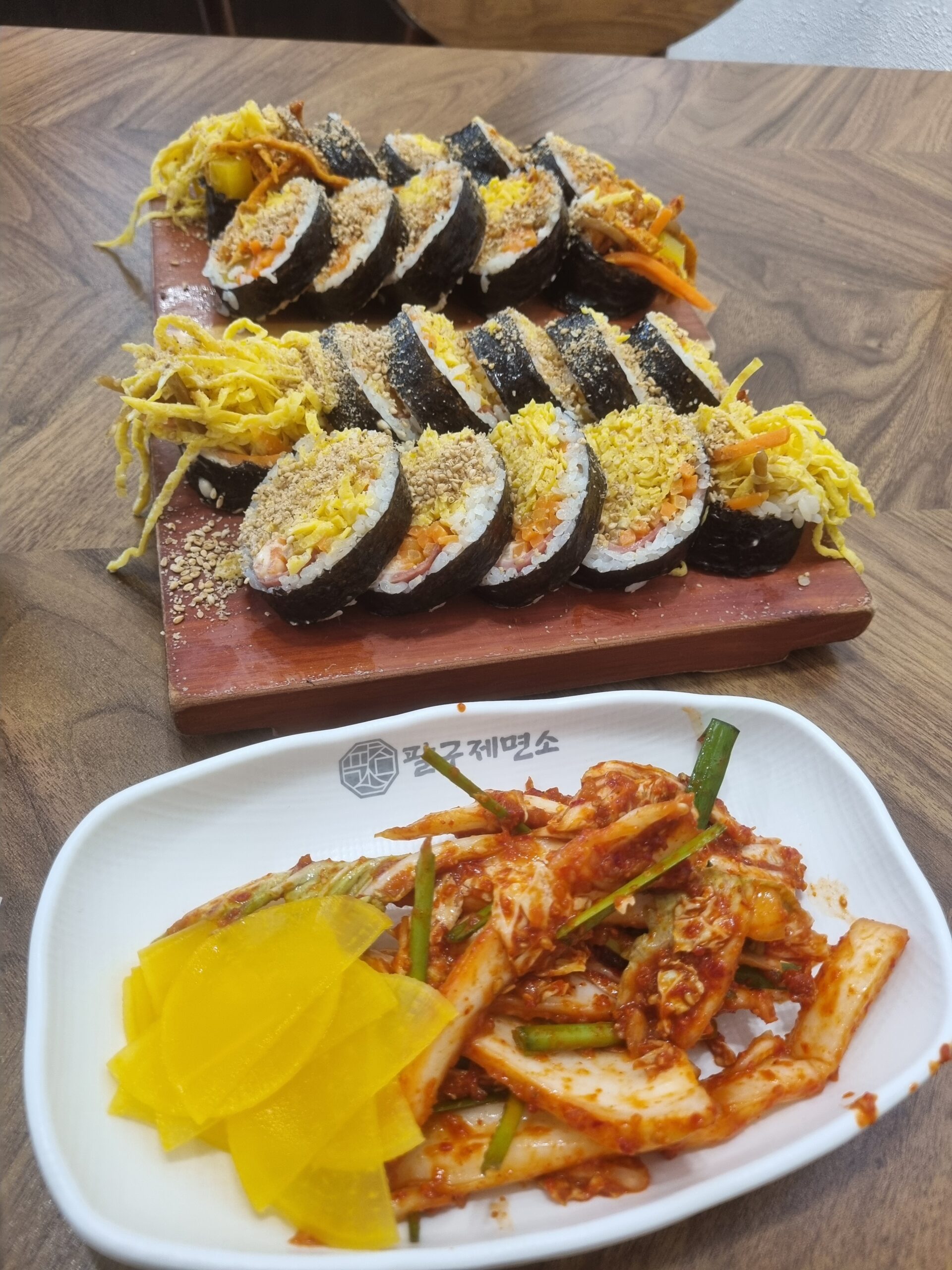
Order gimbap at a shop and it rarely comes alone. Expect a small plate of pickled radish slices and kimchi, and often a cup of thin broth — usually the water fish cake was cooked in. None of that is charged for. If you are unsure what is free and what is not, we wrote that out separately: if you didn’t order it, it’s free.
The exception worth knowing: Chungmu gimbap
If the four-component rule has an exception, it is 충무김밥 (Chungmu gimbap), from Tongyeong on the south coast. The rolls are thumb-thick and contain nothing but rice. The fillings are served beside them instead — seasoned squid and a radish kimchi — and you alternate bites.
It is the same idea taken apart: the structure is still gim and rice, and the dial has been turned all the way to the outside of the roll. Worth ordering once if you see it, because it tastes nothing like the lunchbox version.
Vegan, Vegetarian, Pescatarian, Halal
The default roll is not vegetarian. Ask for 야채김밥 (yachae-gimbap, vegetable gimbap) and you remove the meat, but not necessarily the egg or the fish.
| Standard roll | 야채김밥 | |
|---|---|---|
| Vegan | No — egg, usually ham | Usually no — egg is normally still in it |
| Vegetarian | No — ham and/or fish cake | Often yes, but confirm the fish cake and crab stick are out |
| Pescatarian | Usually no — pork ham is common | Yes |
| Halal | No — the ham is pork | Not reliably. See below |
Halal, specifically. Removing the ham does not make the roll halal. Fish cake (어묵) and crab stick (맛살) are common and their ingredients vary by brand; some seasonings contain alcohol-derived components. A small shop cannot tell you what is in them. Treat gimbap as a dish to ask about rather than assume about.
⚠️ Allergens and cross-contact
Ingredients and cross-contact are different problems, and both apply here.
- Sesame — in the oil on the rice and the seeds on the outside. Hard to avoid in Korean gimbap.
- Egg — one of the four. Removing it means asking for a roll most shops do not make.
- Fish and shellfish — crab stick and fish cake are made from fish paste. “Crab” stick usually contains no crab, but does contain fish.
- Wheat and soy — in fish cake, ham, and most seasoning sauces.
- Cross-contact — this is the real risk. A gimbap shop rolls everything on the same mat and cuts every roll with the same knife, wiped between rolls at best. A vegetable roll cut on a board that just cut a tuna roll is not allergen-free. If your reaction is severe, a gimbap counter is not a safe room.
What it costs
A plain roll sat around ₩3,500–4,500 (roughly US$2.50–3.50) through 2026 — the Seoul average measured by the Korea Consumer Agency was about ₩3,900 in mid-2026, and rice, egg and seaweed all rose that year. Tuna, cheese, cutlet and “premium” rolls run higher, sometimes well past ₩6,000.
Prices move and every shop sets its own. The board on the wall is the only number that is true where you are standing. If you cannot read the board, photograph it and translate from the photo.
From someone who eats this
The owner of this site is from Busan and eats gimbap the way most Koreans do — without thinking about it. His summary, which is the reason this post is organised the way it is:
“Gimbap has four things with real potential in it: the gim, the rice, the pickled radish and the egg. Everything after that is variation. More vegetables, more meat, more ham — fine. Load it with egg, load it with fish cake, also fine. That it takes variation is the point of the dish. Sesame oil base is good. Vinegared-rice base is good too.”
Two things follow from that, and they are worth carrying into a shop:
- Do not shop for the “authentic” version. There is no roll that is more correct than the others. A shop that puts in a mountain of egg is not doing it wrong; it is doing its version.
- Judge it on the four. Is the gim crisp or limp? Is the rice seasoned at all? Is the radish sharp and cold? Is the egg soft rather than rubbery? A shop that gets those right will be fine whatever you order. A shop that gets them wrong cannot be rescued by tuna.
Copy-paste Korean
| English | Korean |
|---|---|
| One gimbap, please | 김밥 한 줄 주세요 |
| Vegetable gimbap, please | 야채김밥 주세요 |
| No ham, please | 햄 빼주세요 |
| No egg, please | 계란 빼주세요 |
| No fish cake or crab stick, please | 어묵이랑 맛살 빼주세요 |
| Is the rice seasoned with sesame oil, or with vinegar? | 밥에 참기름으로 간했어요, 식초로 간했어요? |
| I have a sesame allergy | 참깨 알레르기가 있어요 |
| To go, please | 포장해 주세요 |
3 thoughts on “Gimbap: Four Things Are Fixed, Everything Else Is a Slider”