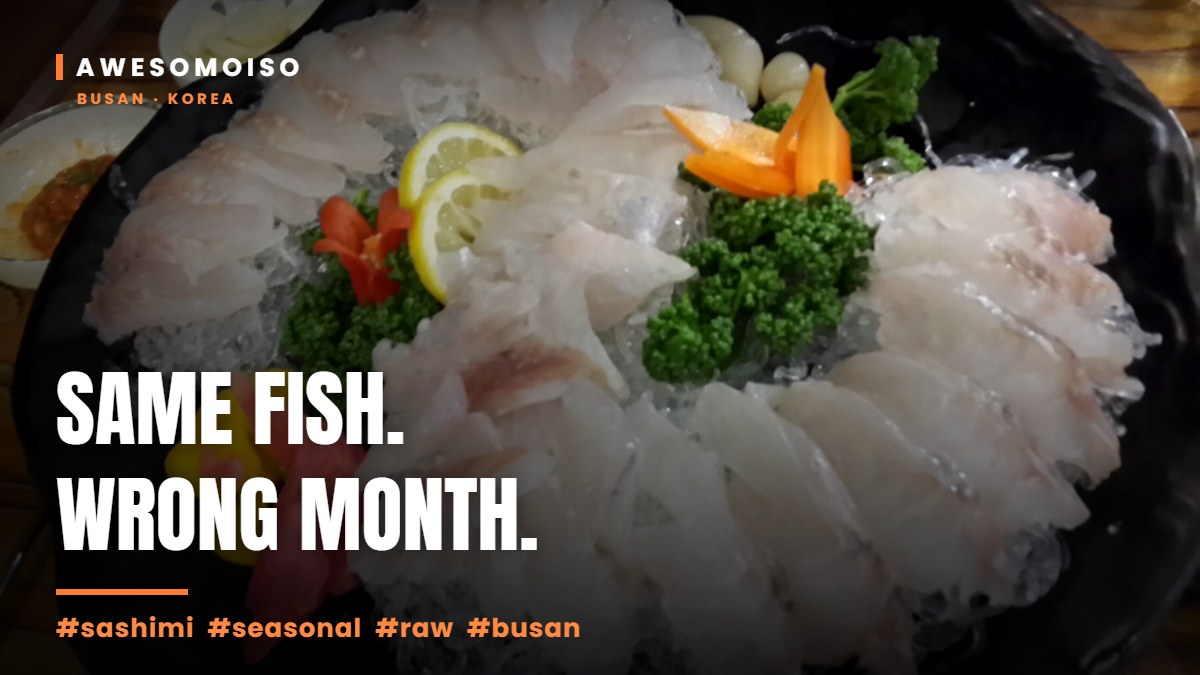
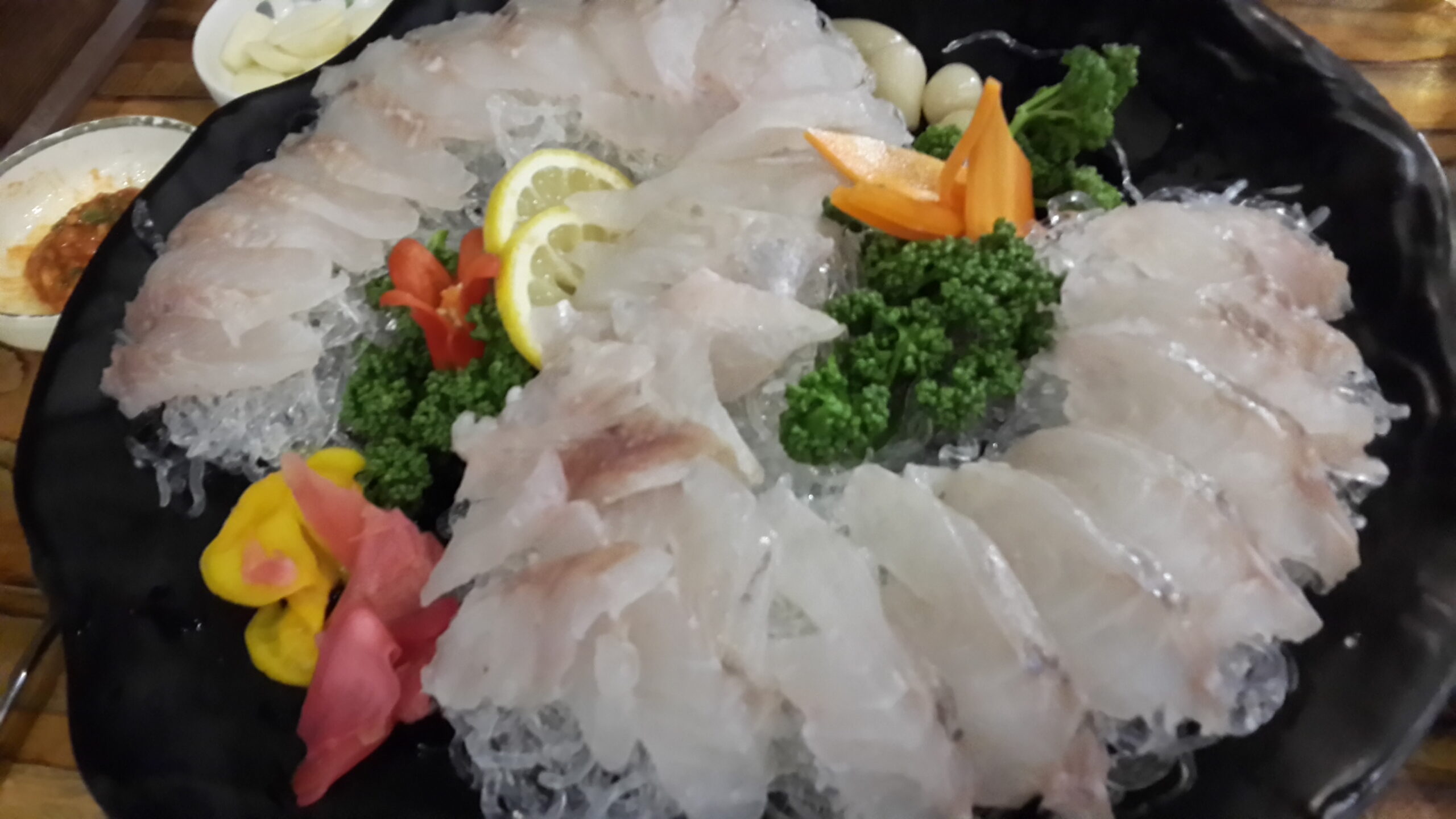
Korean raw fish is called hoe (회), and it is not Japanese sashimi with a different name. The cuts are thicker and chewier on purpose — texture is the prized quality here, not fattiness. It arrives with chilli-vinegar paste, lettuce leaves and garlic, and you wrap it.
It is also the Korean food most tied to the calendar. Ask a Korean when to eat hoe and you will not get a month; you will get “depends what you want.” This page is that answer, written out.
First, the honest version of “in season”
Seasonal charts for Korean seafood are everywhere online, and most of them are copied from each other. Here is what is actually true:
- A season is a window, not a month. It shifts by a few weeks with water temperature, the catch, and where you are on the coast.
- In season does not mean cheap. It often means the opposite — peak flavour draws demand, and demand moves the price up. Winter yellowtail is the clearest example.
- Farmed fish barely has a season. Olive flounder, the most common hoe in Korea, is available and good all year.
- The government picks a “seafood of the month” — the Ministry of Oceans and Fisheries names two or three species each month — but the list changes from year to year, so treat any fixed twelve-month table as a guide rather than a schedule.
The single most useful question at a Korean fish market is not “what is in season?” It is “what is good today?” — and the person at the tank will tell you.
The seasonal map
Grouped by season rather than by month, because that is how it actually behaves. Species marked ★ have appeared on the Ministry’s own monthly list.
| Season | Raw (hoe) | Worth eating cooked |
|---|---|---|
| Winter Dec–Feb | Bangeo 방어 (yellowtail) — the winter fish, fatty and rich Gwangeo 광어 (olive flounder) Chamdom 참돔 (red sea bream) | Oysters 굴 · Gwamegi 과메기 (half-dried herring/saury) · Snow crab 대게 ★ · Monkfish 아귀 ★ |
| Spring Mar–May | Dodari 도다리 ★ (flounder) — the spring one Sungeo 숭어 ★ (mullet) Byeongeo 병어 (pomfret) | Jjukkumi 주꾸미 (baby octopus) · Anchovy 멸치 ★ · Cuttlefish 갑오징어 · Kijogae 키조개 ★ |
| Summer Jun–Aug | Mineo 민어 ★ (croaker) — the summer luxury Nongeo 농어 (sea bass) Hanchi 한치 (squid) | Abalone 전복 ★ · Octopus 문어 ★ · Sea squirt 멍게 · Sea urchin 성게 |
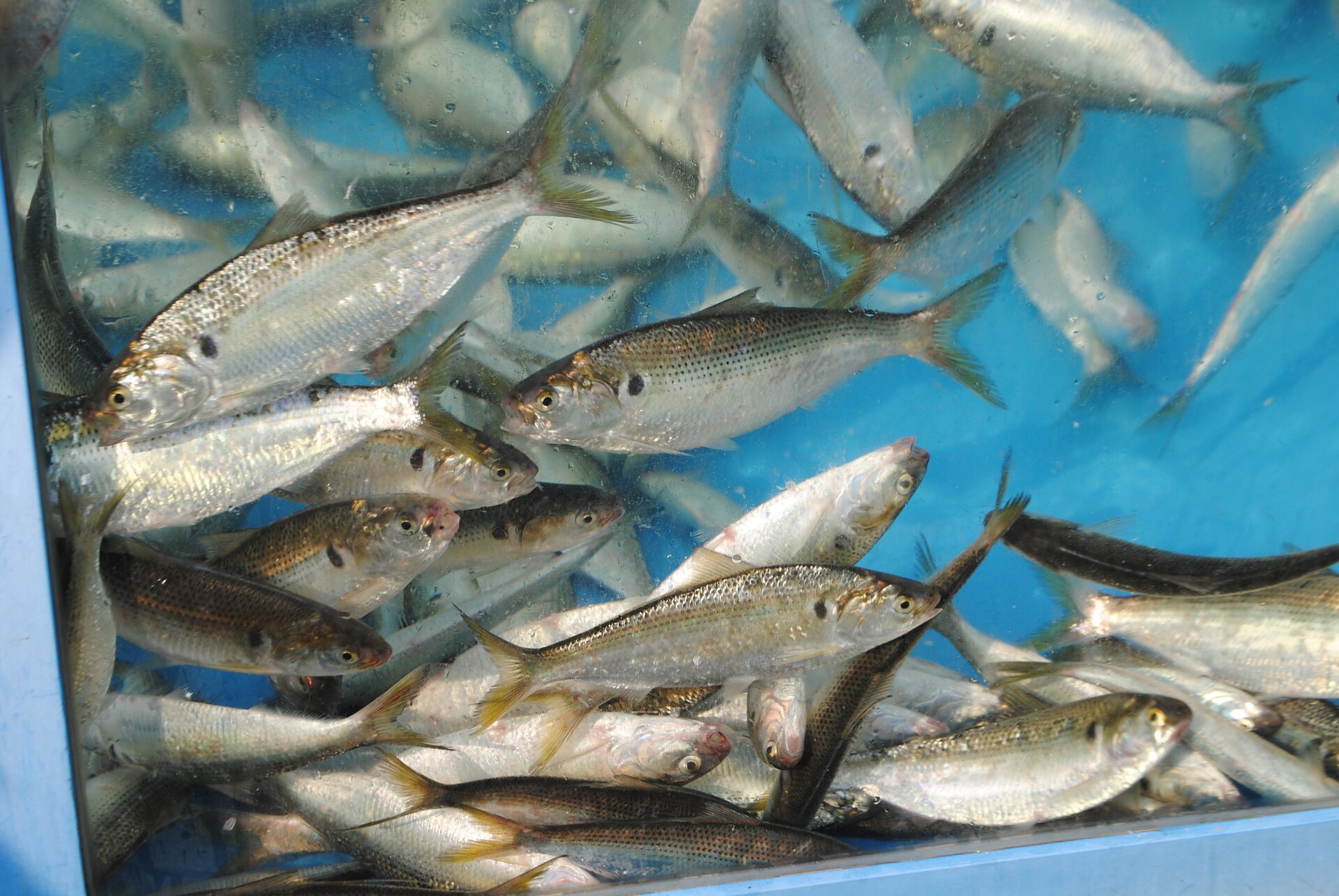
| Autumn Sep–Nov | Jeoneo 전어 (gizzard shad) — the autumn one Jeongaeni 전갱이 (horse mackerel) Gamseongdom 감성돔 (black sea bream) | Daeha 대하 (prawn) · Blue crab 꽃게 · Samchi 삼치 (Spanish mackerel) · Oysters return |
The four to remember, if you remember nothing else: bangeo in winter, dodari in spring, mineo in summer, jeoneo in autumn. Those four are genuinely tied to their season in a way the rest are not.
What you will actually order
Here is the part the seasonal charts leave out, and it matters more than the calendar.
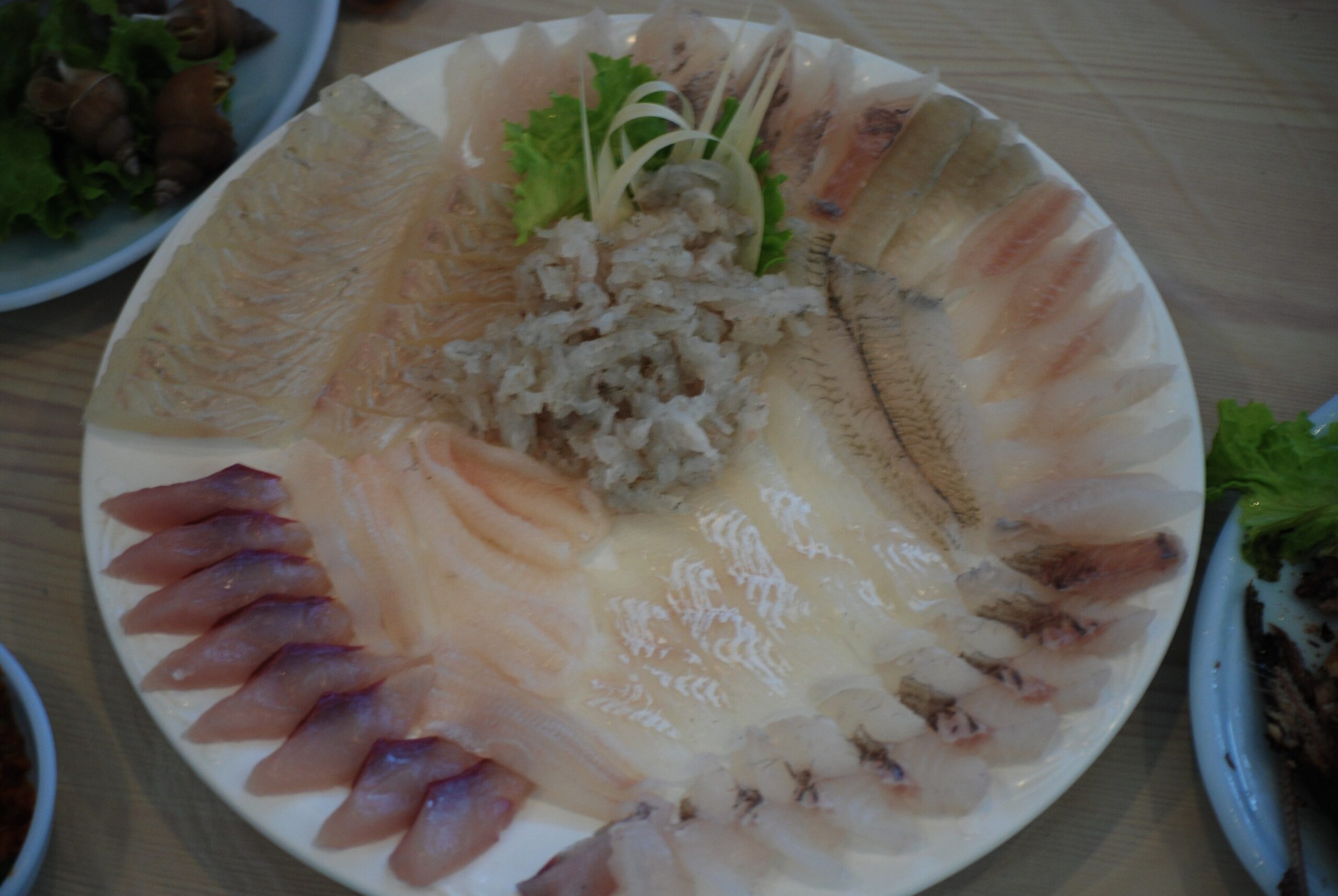
The standard order is a japeo (잡어) platter — assorted ordinary white fish, priced on the menu, sized for two. Expect roughly ₩35,000–40,000 for that platter. This is the normal way to eat hoe, not a budget compromise.
Named premium species are usually sold at market price — siga (시가) — with no figure printed on the menu. That is standard practice and not a trick, but order siga without asking and the bill is whatever that day’s price was. Ask first. This is where seasonal fish usually sits.
| On the menu | Korean | What it means |
|---|---|---|
| Assorted platter | 잡어 ja-beo | Priced, for two, the usual order |
| Mixed platter | 모둠회 mo-dum-hoe | Also priced, often larger |
| Market price | 시가 si-ga | No fixed price. Ask before ordering. |
Two more line items worth asking about before the food arrives: a per-person table charge is common at raw-fish restaurants, and the closing soup may be billed separately. Both amounts are set by the shop rather than by custom, so there is no figure to quote — just ask when you order.
The closing soup is half the meal
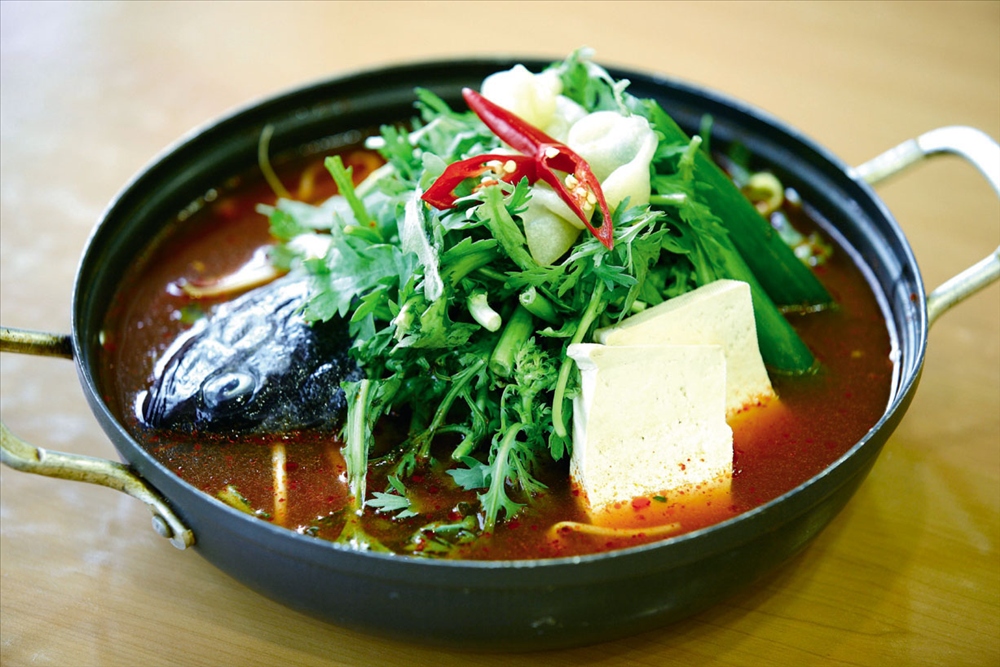
A hoe meal has two halves. You eat the raw fish; then the bones go back to the kitchen and return as a soup — maeuntang (매운탕). Leaving before this is leaving halfway through.
If you cannot eat chilli, ask for jiri (지리) — the same soup made clear and unspiced. Not every shop offers it, but many will make it on request. Ask before the bones go to the kitchen, not after.
Buy it downstairs, eat it upstairs
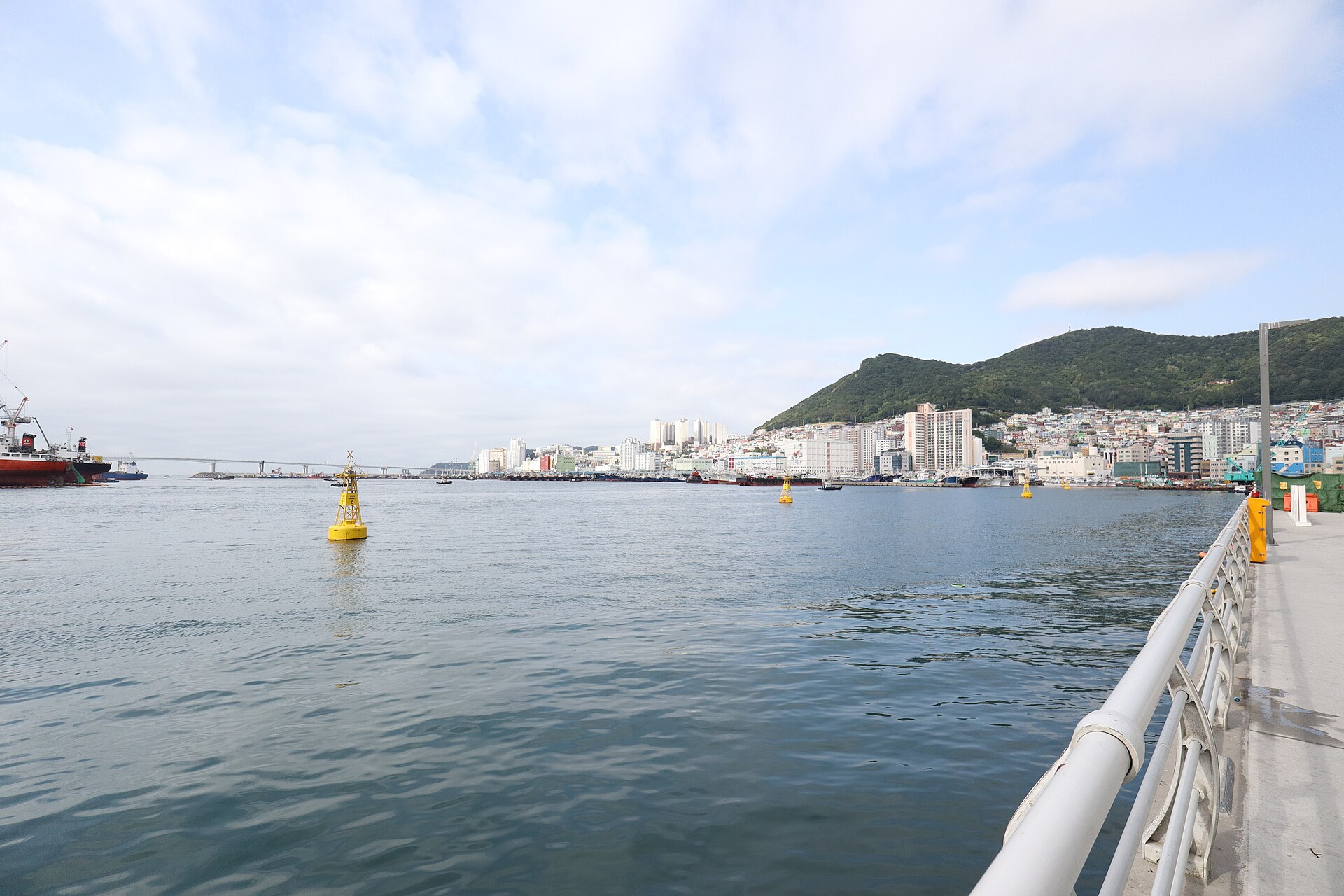
Busan’s fish markets run on a system worth understanding, because it is a better experience than a restaurant and most visitors never try it.
- Pick your fish from the tanks on the ground floor. Tell the vendor how many people and roughly what you want to spend. You do not need to know species names.
- Agree the total before anything is netted. Weight, price, and whether preparation is included.
- Take it upstairs to a chojangjip (초장집) — a restaurant that charges a table fee and serves your fish with sauces, vegetables and side dishes.
- Ask what the table charge covers — side dishes, rice, the closing soup — before you sit down.
- Finish with maeuntang from your own fish’s bones.
The fish is alive when you choose it. That is the part people remember — not the price. Whether it works out cheaper than a restaurant depends entirely on what you pick and what the table charge covers, so do not go for the savings; go for the experience.
Prices at the tanks move with the day’s catch and vary stall to stall, so we are not quoting figures. Agree the total first and the rest is easy.
How to tell a good shop from a bad one
- Look at the tanks, not the menu. Fish should be moving and the water should be clear.
- A priced japeo platter on the menu is a good sign — it means there is a normal entry point.
- A menu that states whether the closing soup is included is a shop that is not going to surprise you.
- Avoid cloudy tanks and sluggish fish. This one needs no expertise.
- In a dense cluster of raw-fish shops, prices converge. You do not need to compare every stall — look at the tanks and go in.
Why a fish has a season at all
“In season” is not one mechanism. Five different things put a fish on the list, and they do not all mean the flesh is at its best. Knowing which one applies tells you whether to trust the label.
| What drives it | What it does to the fish | Example |
|---|---|---|
| Fat stored for cold | Fat rises as the water drops, and fat is flavour. This is the one where “in season” really does mean “better.” | Bangeo, mackerel |
| Before or after spawning | ⚠️ Cuts both ways. Roe makes some species desirable; spawning also strips flesh and leaves it thin. | Jeoneo, blue crab |
| Water temperature and feeding | Changes texture and savouriness more than fat. A quieter difference you notice in the bite. | Nongeo, flounder |
| Migration and catch volume | Nothing changes in the fish. There is simply more of it, landed fresher and sold cheaper. | Jjukkumi, blue crab |
| Growth and yield | Shellfish filling out. You are buying meat-to-shell ratio, not flavour. | Snow crab, oysters |
So the fourth row is the useful warning. Some “seasonal” items are seasonal because the boats are out, not because the animal is better. And a farmed fish mostly ignores all five — olive flounder and rockfish are steady all year, which is why they are the default order rather than a seasonal one.
The practical rule: a good fish out of season beats a poor one in season. Season narrows the shortlist. The individual fish in front of you decides.
The expensive end — and the name problem
Premium here is not one quality. It splits into fat and firmness, and they are opposite preferences, so price alone tells you nothing about whether you will enjoy it.
| If you want… | Order | Why it costs more |
|---|---|---|
| Fat, rich, buttery | Dae-bangeo 대방어 | Winter fat, and size — one big fish yields several distinct cuts. Full guide → |
| Firm, dense, chewy | Doldom 돌돔 · Neungseongeo 능성어 | Slow-growing, hard to land at size, low yield once trimmed. |
| Delicate sweetness | Wild chamdom 참돔 | Wild-caught premium — ⚠️ wild is not automatically better than well-handled farmed. |
| A summer speciality | Mineo 민어 · Gaetjangeo 갯장어 | Short season, and gaetjangeo needs skilled knife work to deal with the bones. |
| Rarity | Jabari 자바리 · Bukbari 붉바리 | Scarce supply. The steepest prices on any menu. |
⚠️ The name is where the money goes missing. Dageumbari (다금바리) is used commercially for more than one fish. The one that justifies the price is jabari (자바리); other grouper species are sold under the same word. Ask which species, and whether it is wild or farmed, before the knife comes out — not after.
This is the same trap as bangeo and busiri, and it works the same way: once the fish is sliced, you cannot tell.
What you are actually paying for
Three different numbers get called “the price,” and comparing across them is how visitors overpay.
- Price per kilo of whole fish — what the tank sells. Head, bones and guts are in that weight; the meat you eat is a fraction of it.
- Price of the prepared platter — already trimmed. Never compare this against a per-kilo number.
- What lands on the bill — the fish, plus a per-person seating charge at many places, plus the closing soup if it is charged, plus drinks.
Ratios travel better than figures. Taking olive flounder as 1: rockfish and mullet sit around it, doldom runs several times higher, and the rare groupers run several times higher again. Those gaps hold even as the actual numbers move every season — so use the ratio to judge whether a menu is reasonable, and ask for today’s figure rather than trusting any number you read online, including ours.
From someone who eats this
Written by the person who runs this site — Korean, living in Busan.
You are probably not choosing a fish at all
Picking your own fish out of a tank is a fish-market thing. It happens at a hoe centre (회센터) — the market buildings where fish is sold by the kilo. That is where choosing a species, and paying by weight, actually applies.
At an ordinary neighbourhood raw-fish restaurant, you do not choose. You order, and the owner prepares whatever matches that order. And in the city — izakaya, sushi bars, Japanese-style drinking places, which is where a lot of people meet raw fish — the menu is simply small, medium or large (소/중/대). There is no species to pick.
So the realistic expectation for a visitor is a size, not a fish. A hoe centre is worth doing once for the experience. If that is your plan, look up what is in season and how to judge that particular species before you go — it changes through the year and it is not something to improvise at the tank.
How I eat it
Chogochujang, sesame oil and ssamjang mixed together. Not one of the three — all of them, in one dish. That combination is a Korean habit rather than something a Japanese restaurant would put in front of you, and it is how most of the table will be eating.
My own addition: a little wasabi into the chogochujang. That is not standard and nobody taught me to do it. It cuts the sweetness of the red paste. Try it on one piece before you commit the dish.
The thing I actually use to pick a shop
A full restaurant. That is it.
Busy means turnover, and turnover means the fish was delivered recently. A quiet raw-fish restaurant is serving you something that has been sitting. This is not a hoe-specific rule — it is the single most reliable signal I use for restaurants generally in Korea, and it needs no language and no research.
- Full at a normal mealtime — good sign.
- Empty at a normal mealtime — walk on. There will be another one.
- Cloudy tank, sluggish fish — walk on, wherever you are.
The closing soup — just ask
Some shops charge separately for the maeuntang at the end, around ₩5,000; others include it. I have been billed for it and I have had it come free. It is too random to plan around — so ask when you order, not when the bill arrives.
Copy-paste Korean
| What you want | Show this | Say it |
|---|---|---|
| What is good today? | 오늘 뭐가 좋아요? | o-neul MWO-ga jo-a-yo? |
| How much in total? | 총 얼마예요? | chong EOL-ma-ye-yo? |
| Assorted platter, please | 잡어 주세요 | ja-beo joo-se-yo |
| Is the table charge extra? | 상차림비 따로예요? | sang-cha-rim-bi TTA-ro-ye-yo? |
| Clear soup instead of spicy | 지리로 해주세요 | JI-ri-ro heh-joo-se-yo |
| Two people | 두 명이요 | du MYEONG-i-yo |
Where to go next
- Three Busan Dishes the Port Created
- Korean Pork, All 17 Ways
- Not sure what suits you? Try the Korean Food Matcher
Seasons shift and species are called different things in different markets. If a vendor tells you something different from this page, believe the vendor.
4 thoughts on “Korean Raw Fish by Season — What to Eat, and How to Buy It at the Market”