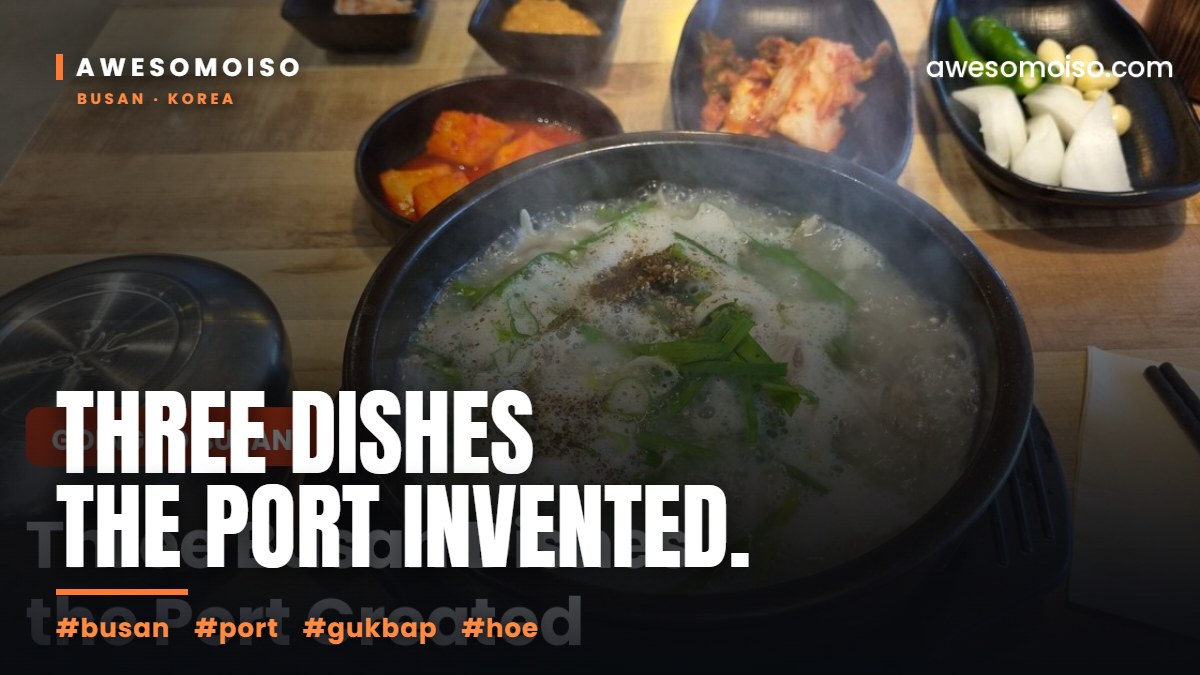
Busan did not invent these three dishes on purpose. A pork soup came from refugees and surplus bones, a raw fish market came from the harbour itself, and hagfish became food because a leather trade was throwing the meat away.
That history is not why you should eat them. It is why they are cheap, or expensive, in ways that do not match how they look — and why two shops serving the same dish can hand you two different meals.
1. Dwaeji Gukbap (돼지국밥) — Pork Bone Soup with Rice

What it is. A cloudy pork bone broth with sliced pork and a bowl of rice. Busan’s ordinary lunch, eaten at any hour. It arrives nearly unseasoned: you finish it yourself at the table.
Tastes like a clear, lighter tonkotsu ramen broth — but you add rice instead of noodles.
A good bowl smells of slow-simmered pork bone: rich and clean. A barnyard or gamey smell is a fault, not authenticity — if it smells of the animal, that is a badly run kitchen, not a traditional one.
| Core | Pork (shoulder, belly or head meat), rice, scallion, chives |
|---|---|
| Broth | Pork bone, simmered for hours |
| You add | Salted shrimp paste (saeujeot), red chilli paste (dadaegi), pepper |
| Vegan | Vegetarian | Pescatarian | Halal |
|---|---|---|---|
| No | No | No | No — pork |
The saeujeot served alongside is fermented shrimp. If you have a shellfish allergy, leave it out and salt the soup instead. Not spicy as served — the heat is entirely your choice.
How it varies — four things change shop to shop
- Which cut of pork. Jowl (항정살) and belly (삼겹살) are richer and more tender. Head meat (머릿고기) is gelatinous and much stronger tasting. Plain boiled cuts are leanest. This is the single biggest difference between two bowls.
- Korean pork or imported. Shops using domestic pork say so on the wall (국내산). It is a real difference in flavour and in price.
- Rice in the soup or in its own bowl. Some shops pre-soak the rice in hot broth (토렴) and serve it already in. Others hand you rice separately.
- Bean sprouts or not. Some bowls come with them, some do not.
If your first bowl tasted heavy and gelatinous, you were probably served head meat. That is the shop’s choice, not the dish going wrong. Order a jowl or belly bowl next time and it will taste like a different soup.
How to pick a shop. Look for a stated cut on the menu and a 국내산 sign. Both mean the shop has decided something and will tell you what.
Price. ₩8,000–11,000 per person, around $6–8. The cheapest full meal of the three by a wide margin.
Want the long version? We have a full guide to this one dish — why it arrives under-seasoned, and what to do with the tray that comes with it: Dwaeji Gukbap — The Bowl Busan Actually Eats.
2. Hoe (회) — Korean Raw Fish

What it is. Raw white fish, sliced thick, eaten wrapped in lettuce and perilla with a chilli-vinegar paste. Not a plate of sashimi — a shared table meal that runs in two halves.
Firmer and chewier than Japanese sashimi — Korean cuts favour texture over fattiness.
This is deliberate. Thickness and spring are the prized qualities here, not melting fat. If you came expecting fatty tuna, this will read as plain. That is the point of it.
| Core | Flounder, sea bream or rockfish; lettuce, perilla, garlic, green chilli |
|---|---|
| Dips | Chogochujang (chilli vinegar), ssamjang, wasabi soy |
| Second half | The bones go back to the kitchen and return as soup |
| Vegan | Vegetarian | Pescatarian | Halal |
|---|---|---|---|
| No | No | Yes | Ask — alcohol and shellfish on the table |
Raw fish. Not advised in pregnancy or with a compromised immune system. The side dishes almost always include shellfish.
How it varies — and this one shows up on your bill
- Japeo platter, or a named species at market price? The standard order is japeo (잡어) — an assorted platter of ordinary white fish, around ₩35,000–40,000 and sized for two. This is the normal way to eat hoe, not a budget compromise. Named premium species — red sea bream and the like — are usually sold at market price (시가) with no figure printed on the menu, and what is worth ordering shifts with the season. Nothing shady about it, but order one without asking and your bill is whatever the day’s price was. Ask first. (We will cover which species are worth it, and when, in a separate piece — it is a season-by-season question and deserves its own page.)
- Is the closing soup included or extra? After the raw fish, the bones are made into a soup. Many shops charge for it; others include it. The amount is set by the shop — there is no standard figure, which is exactly why we are not printing one. This is the most frequent surprise on a sashimi bill in Busan. Ask when you order, not after.
- Spicy soup or clear soup. The default is maeuntang — red and chilli-based. If you cannot eat chilli, ask for jiri (지리): the same soup made clear and unspiced. Not every shop will, but many will. Say it before the bones go to the kitchen.
- Market stall or sit-down restaurant. Buying the fish at a market counter and eating it at tables upstairs is cheaper and often fresher. A proper restaurant costs more and gives you side dishes and service. The market route adds a per-person seating charge (자릿세 / 상차림비) on top of the fish price. Every shop sets its own, so ask before you sit down.
If the bill came out higher than the menu price, it was probably the closing soup or the seating charge. Both are normal practice, not a scam — ask the amounts up front and there is no surprise. You are also allowed to decline the soup.
How to pick a shop. Look at the tanks, not the menu: fish moving, water clear. A japeo platter listed with an actual price is a good sign, not a cheap one. A shop that states whether the closing soup is included tends to be upfront about the rest too.
Price. ₩35,000–40,000 for a japeo platter, about $26–30, for two. Premium species are market price; ask before ordering. A per-person seating charge and the closing soup may be added on top, and both amounts are the shop’s own — ask, don’t assume.
3. Gomjangeo (꼼장어) — Grilled Hagfish

What it is. Hagfish grilled at the table, usually glazed in a sweet-hot chilli sauce. A drinking dish, not a lunch. Busan’s own, for a reason most menus do not print: hagfish skin was processed for leather near the port during the colonial period, and the discarded meat became food.
Firm and springy, closer to squid than to eel, under a sweet-hot glaze.
Hagfish is not eel. It looks eel-adjacent on the plate and the two are unrelated. The texture is the draw — it pushes back when you bite.
| Core | Hagfish, onion, garlic chives, perilla leaves |
|---|---|
| Sauce | Gochujang, chilli flakes, garlic, sesame oil, soy sauce |
| At the end | Fried rice in the same pan |
| Vegan | Vegetarian | Pescatarian | Halal |
|---|---|---|---|
| No | No | Yes — hagfish is a fish | No — shared grill, alcohol, soy |
The sauce contains soy sauce, so it is not gluten-free. Grills are shared between orders. Medium-hot — and a salt-only version exists, see below.
How it varies — three menu lines, three different dishes
- Seasoned red (양념구이) or plain salt (소금구이). Most shops default to the red glaze. Salt-grilled is far milder and actually lets you taste the fish — ask for it even when the menu leads with the sauced version. Which one costs more varies by shop and by district. At the specialist clusters the two are often priced the same, so the red version is not the budget choice — it is just the default.
- Straw-fire (짚불) or standard grill. A straw-fire style, associated with Gijang, burns rice straw for heavy smoke. Most city shops use a normal grill. Different enough to read as two separate dishes.
- Specialist row or general grill house. At Jagalchi there is a run of shops that cook only this — the concentration is the point, and it is close to being a neighbourhood dish there. A general grill house with hagfish as one line on a long menu usually preps it in advance.
If yours was overwhelmingly sweet and red, that was the sauce, not the fish. Salt-grilled is a different experience, and often the same price.
Where. Jagalchi is the safest bet — a whole row of specialists. Gijang is also commonly named for the straw-fire style, though we have not verified it ourselves. And you do not have to reach either: coastal neighbourhoods across Busan (Namcheon-dong and similar) have their own shops.
How to pick a shop. Fish kept live and prepared to order. Walk past anything pre-cooked and reheated in sauce.
Price. ₩25,000–38,000, $18–28. Roughly three times a bowl of dwaeji gukbap. This is a night-out dish, not street food, and the price surprises people who expected otherwise.
One rule about prices in Busan
Every figure on this page is a range, and that is not us hedging. The same dish is priced shop by shop and district by district, and the extras — a seating charge, the closing soup, which grilling style costs more — are each shop’s own decision.
But there is a pattern worth knowing. Where shops of one kind are clustered together — a specialist row, a market floor — prices converge. Walk into the hagfish row at Jagalchi and you are unlikely to be the one person overpaying, because the shop next door is charging the same. Step outside a cluster and that protection goes away.
So: in a cluster, pick on the smell and the tanks. Outside one, read the menu first. And treat any single price you read online — including ours — as a ballpark, not a quote.
The three, side by side
| Dwaeji gukbap | Hoe | Gomjangeo | |
|---|---|---|---|
| Eaten | Any hour, alone | Shared, evening | Shared, with drinks |
| Price | ₩8–11k / person | ₩35–40k / japeo, for two | ₩25–38k |
| Spicy | Only if you add it | Dip only | Medium-hot (salt version milder) |
| Pescatarian | No | Yes | Yes |
| Added charges | None | Seating charge · closing soup · 시가 species | None |
| Ask for | Jowl or belly cut | Jiri if no chilli | Sogeum-gui if no chilli |
| First-timer? | Start here | Go with someone | Go with drinkers |
If you only try one
Dwaeji gukbap. It is the cheapest, it is everywhere, you can walk in alone, and it is the one Busan actually eats daily. The other two are occasions.
And if you cannot eat chilli, the useful thing on this page is two words: jiri (지리) for clear fish soup, sogeum-gui (소금구이) for salt-grilled instead of sauced. Both are normal requests.
More on Busan food: What to Eat in Busan — and What to Skip · Eomuk · Milmyeon
Photo credits: LWY (Flickr), ebifry and creepyblues via Wikimedia Commons, all CC BY 2.0.
12 thoughts on “Three Busan Dishes the Port Created”