What Is It? · Busan · Part 3
A cold noodle invented because the right flour had run out — in a neighbourhood that used to be a cattle shed.
Part 3 of a series on what to actually eat in Busan. Overview: What to Eat in Busan — and What to Skip. Previous: Part 2 — Dwaeji Gukbap.
Korea has several cold noodle dishes. This is the one Busan invented and the one Busan actually eats — and I want to be straight with you in the first line, because a lot of guides are not: you can get milmyeon outside Busan. What Busan gives you is the origin, the density and the price.
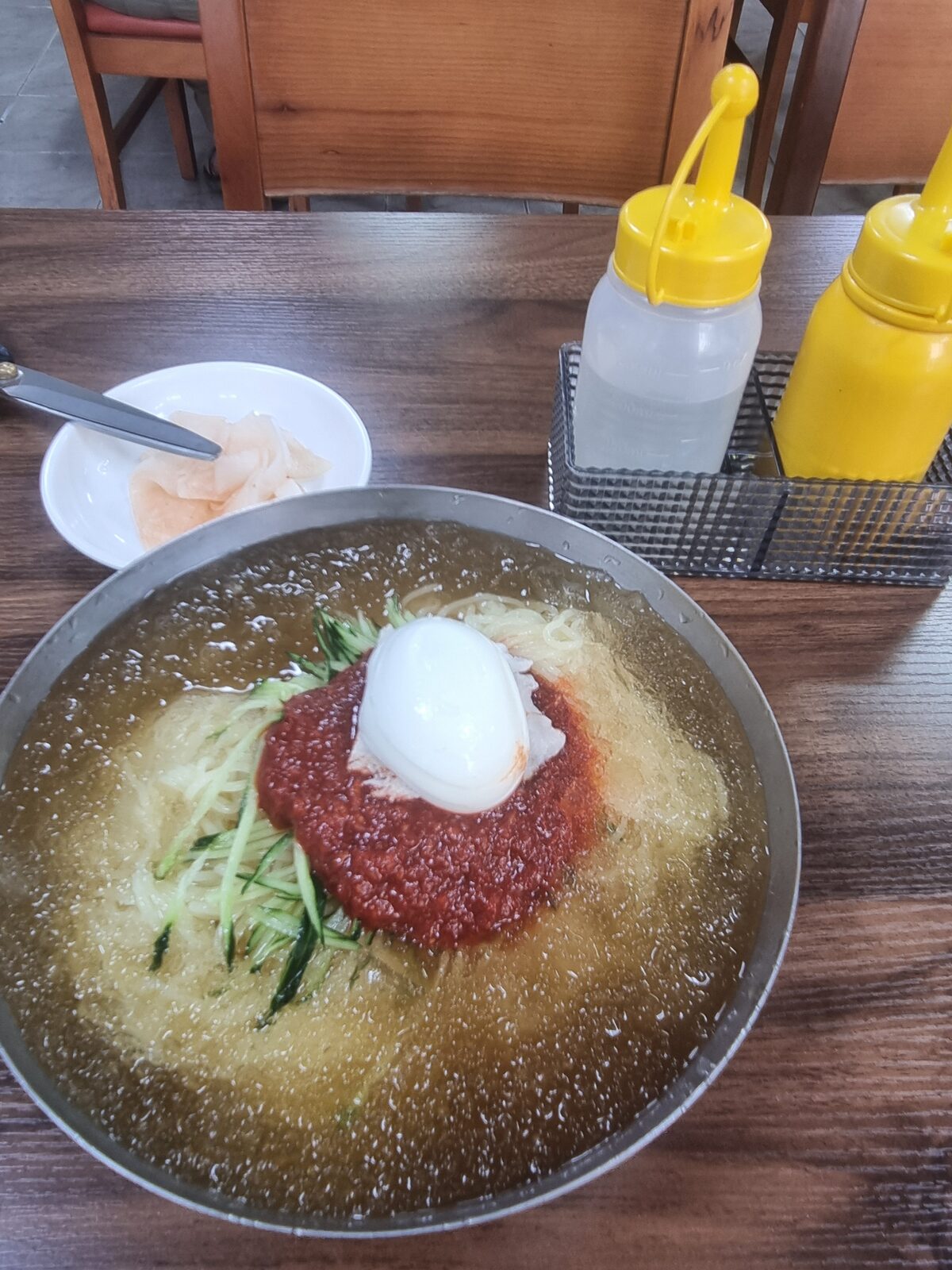
Milmyeon is a bowl of chewy wheat-and-starch noodles in an ice-cold broth, with a few slices of boiled pork, half a boiled egg, a wedge of pickled radish and a spoonful of red seasoning paste on top. It costs seven to nine thousand won. In August, in Busan, it is close to a public utility.
Its name is a confession. Mil means wheat; myeon means noodle. It is called “the wheat one” because it is the substitute.
All dollar figures use ₩1,340 = US$1, the rate in September 2026.

What it’s a substitute for
The dish it replaced is naengmyeon — the famous cold noodle of Pyongyang and Hamhung, in what is now North Korea. Real naengmyeon is made with buckwheat, and it is a northern dish because buckwheat is a northern crop.
When the war pushed hundreds of thousands of northerners down to Busan, the people who knew how to make naengmyeon arrived. The buckwheat did not.
What did arrive, in enormous quantities, was American relief wheat flour.
| The problem | Wheat noodles go hard and claggy when you chill them. Cold noodles have to survive ice water |
| The fix | Cut the wheat flour with starch |
| The result | ⭐ A noodle that stays springy when cold — and is far chewier than the buckwheat original |
The workaround turned out to be its own thing. Milmyeon does not taste like a failed naengmyeon. It has a bounce that buckwheat cannot produce, and Busan has spent seventy years preferring it.
⭐ Where it started, and why the address matters
The first shop is still open. It is called Naeho Naengmyeon — note that it still has the old word in its name — and it is in Uam-dong, a working port neighbourhood in the south of the city. It began selling milmyeon in 1959, run by a family that had come down from the north.
The neighbourhood is the part worth knowing.
Under Japanese rule, Uam-dong held the largest cattle quarantine station in Korea — a facility built to inspect Korean cattle before shipping them to Japan. Nineteen long sheds, forty-odd buildings, 1,400 to 1,600 head of cattle at a time.
After liberation, and then during the war, the sheds filled up with people. Refugees were housed in them, alongside tents and shacks. Families divided the stalls with cloth.
The area is still called 소막마을 — somak maeul, “cattle-shed village.” Some of the houses are now protected as national heritage, because they are still standing and people still live in them. Korea’s first bowl of milmyeon was sold two streets away
You do not have to go there to eat this. But it explains the dish better than any description of the broth will.
The broth is the part nobody expects
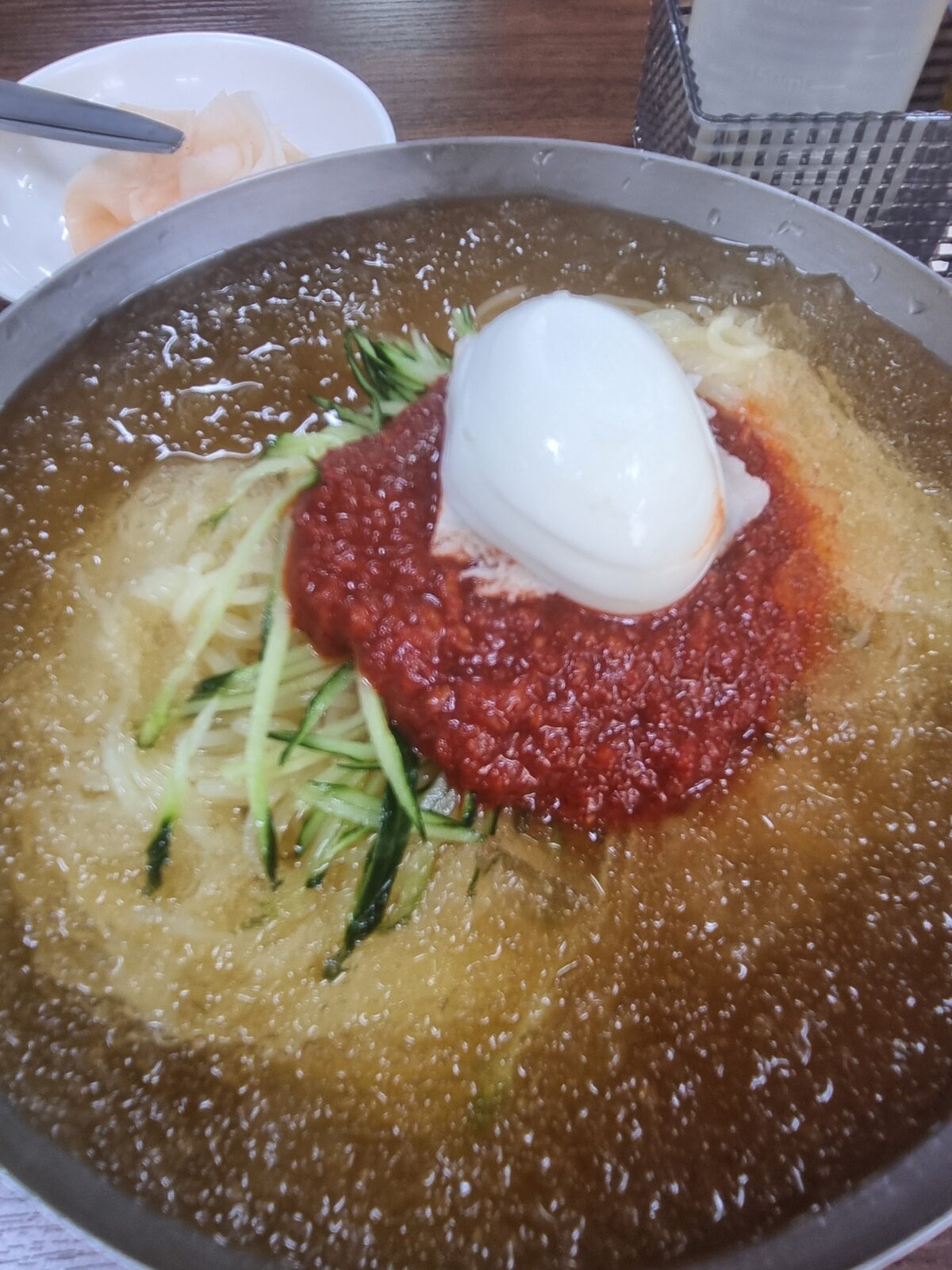
Milmyeon broth is made from bones — pork, beef, sometimes chicken — simmered and then chilled hard. That part is ordinary.
The part that is not ordinary: most shops also steep medicinal herbs in it. Cinnamon, liquorice root, ginger, jujube, and whatever else the family has been using since the 1960s. Every shop guards its own combination.
So the first sip is confusing in a good way. It is cold, faintly sweet, savoury underneath, and carries a warm spiced note that has no business being in an ice-cold soup. If you have had Vietnamese phở and noticed the cinnamon in it, it is that surprise, served cold.
How to order — two versions, and a trap
| What to say | What arrives |
|---|---|
| 물밀면 mul-milmyeon (or just 밀면, milmyeon) | ⭐ Noodles in the cold broth. Start here. |
| 비빔밀면 bibim-milmyeon | No broth in the bowl — the noodles come coated in a sweet-hot red sauce, and a cup of hot broth arrives on the side to drink |
⚠️ The trap, if you already know naengmyeon: a bowl of mul-milmyeon arrives with a spoonful of red seasoning paste already sitting on top. Mul-naengmyeon does not. So the “watery” version here is not the plain version — it is mildly seasoned by default. If you want it clean, ask for the paste on the side; if you want it hotter, stir it all in.
The heat level is low either way. Bibim is sweeter and hotter; mul is a 1 out of 5 at most.
The scissors
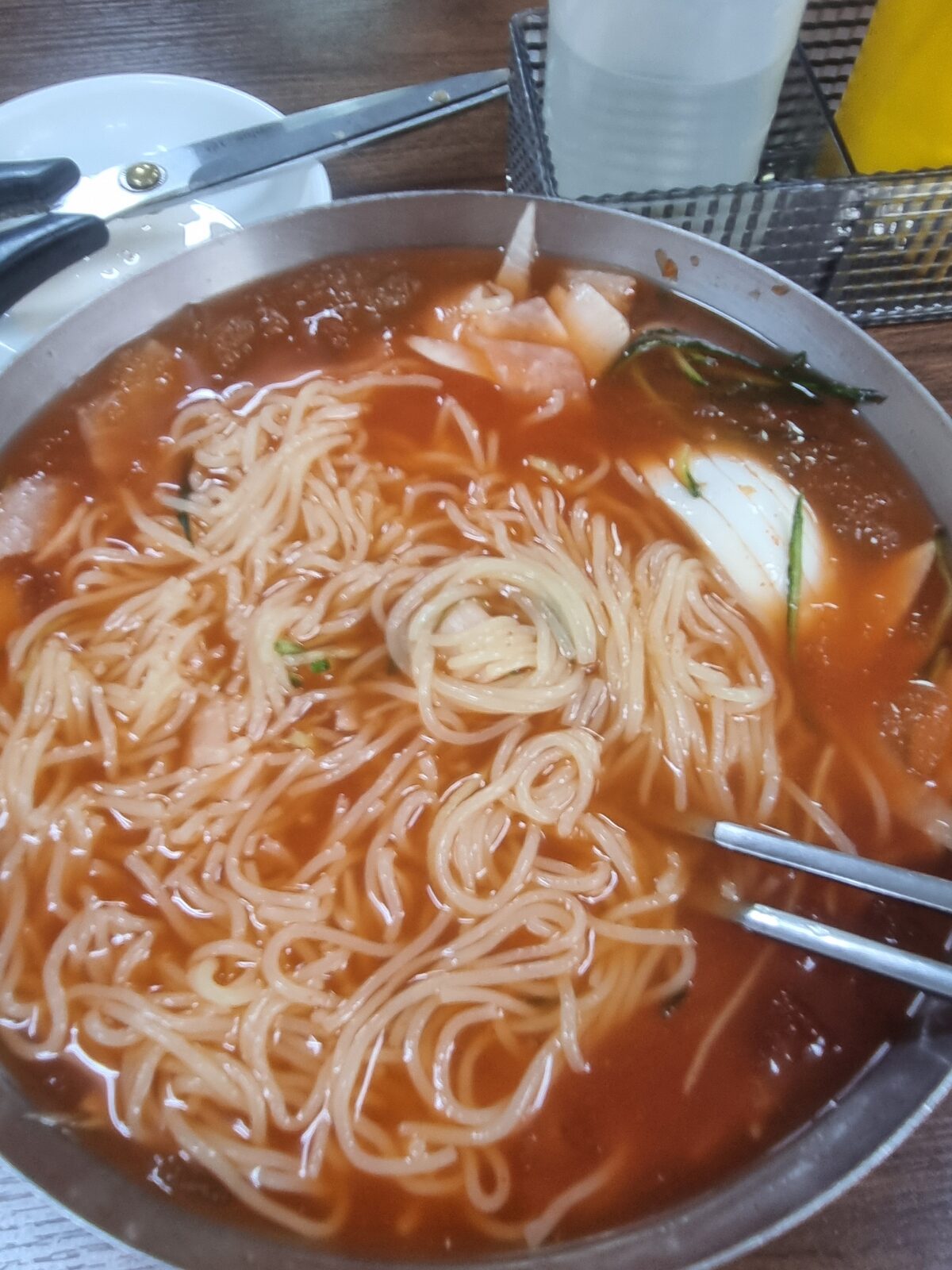
A pair of kitchen scissors will be brought to your table, or will already be in the cup with the chopsticks. They are for the noodles.
Milmyeon noodles are genuinely tough — that is the starch doing its job — and they are served in one long tangle. Cutting them once or twice through the middle of the bowl is completely normal and nobody will think less of you. If the server offers to do it, say yes.
⭐ Water, broth and coffee are self-service
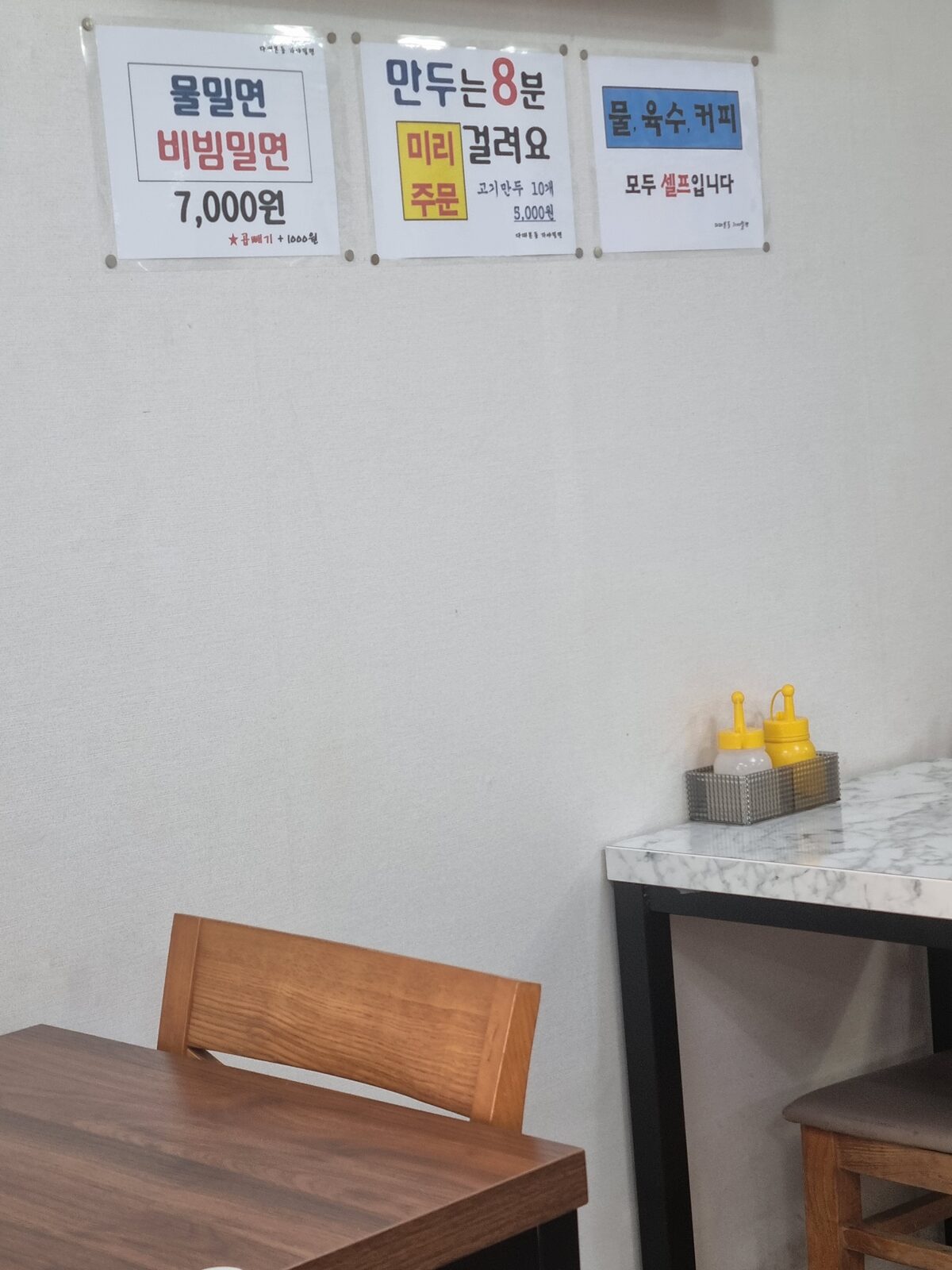
Most milmyeon shops put a sign on the wall saying 물·육수·커피 모두 셀프 — water, broth and coffee, all self-service. Nobody is going to bring them to your table, and nobody is being rude. There is usually a station by the wall with cups, a water jug, a broth urn and an instant-coffee machine.
⭐ The broth urn is the one to know about. It is the same chilled bone broth that is in your bowl, and you can drink as much of it as you like for nothing. In August that is the best free thing in the city.
The vinegar and mustard
Two squeeze bottles usually sit on the table: vinegar and Korean mustard oil (gyeoja, sharp and sinus-clearing rather than hot on the tongue). Both go into the broth, not onto the noodles, and a half-turn of each is plenty. The vinegar in particular is what makes the broth taste like summer instead of like stock.
Milmyeon vs naengmyeon — the short version
| Milmyeon · Busan | Naengmyeon · the north | |
|---|---|---|
| Noodle | Wheat + starch | Buckwheat |
| Texture | Chewy, springy, resists the bite | Softer, grainier, snaps |
| Broth | Bone stock + medicinal herbs, slightly sweet | Beef or beef-and-radish-water, austere |
| Seasoning | Red paste included by default | Served plain |
| Price | ₩7,000–9,000 | ₩12,615 Seoul average (May 2026); ₩15,000–18,000 at the famous Pyongyang-style houses |
That last row is not a small difference. A good naengmyeon in Seoul now costs roughly double a good milmyeon in Busan, for a dish that started as its poor relation.
Vegan, Vegetarian, Halal
| Diet | Suitable? | Why |
|---|---|---|
| Vegan | ❌ Usually not | The broth is typically beef or pork based |
| Vegetarian | ❌ Usually not | Same reason — the noodles are fine, the broth is not |
| Halal | ❌ Not certified | Broth composition varies by shop and is rarely disclosed |
⚠️ Broth recipes differ between shops and most will not have an ingredient list. If this matters to you, ask before ordering — and expect the answer to be uncertain.
⚠️ Allergens and restrictions
| Gluten | ⚠️ Yes, by definition. The noodle is wheat. This is the one dish in the series where that is the whole point |
| Pork | ⚠️ Usually. The broth is typically pork or mixed bone, and the slices on top are boiled pork. Some shops use beef only — you would have to ask |
| Halal | ❌ Assume no |
| Vegetarian | ❌ No. Bone broth |
| Egg | Half a boiled egg is standard. Easy to leave |
| Fish | ⚠️ The red paste sometimes contains fish sauce |
| Spice | Mild. Ask for the paste on the side if you want none |
⚠️ Can you get it outside Busan? Yes — so here’s the real argument
Plenty of English-language guides tell you milmyeon exists only in Busan. That is not true, and you should hear it from me rather than find out later.
| Where else | What’s actually there |
|---|---|
| Seoul | Dining Code lists 78+ milmyeon restaurants in Seoul, several run by Busan families for thirty years |
| Rest of Korea | Over 100 shops trade under the “Gaya Milmyeon” name nationwide. Gyeongju has its own long-running one |
| Supermarkets | CJ sells a packaged “Busan milmyeon” in Korean supermarkets; frozen versions ship anywhere in the country |
| ⚠️ Abroad | Korean grocery chains in the US stock it. If you live near one, you could buy milmyeon today without leaving your city |
So why eat it here? Not scarcity. Four better reasons:
| Price | ₩7,000–9,000 here. Seoul shops charge more, and a packet is not a shop |
| Density | In Busan you walk past one. Anywhere else you make a trip |
| The shops | Places here have made this and almost nothing else since the 1950s |
| ⭐ Season | A Busan milmyeon shop at 1pm in August is a specific thing. The queue is part of it |
⭐ This is the honest version of “you can only get it in Busan,” and I think it’s the better reason to go. You are not buying something rare. You are buying the cheapest good version of it, in the city that made it up.
What it costs — and why the range is the information
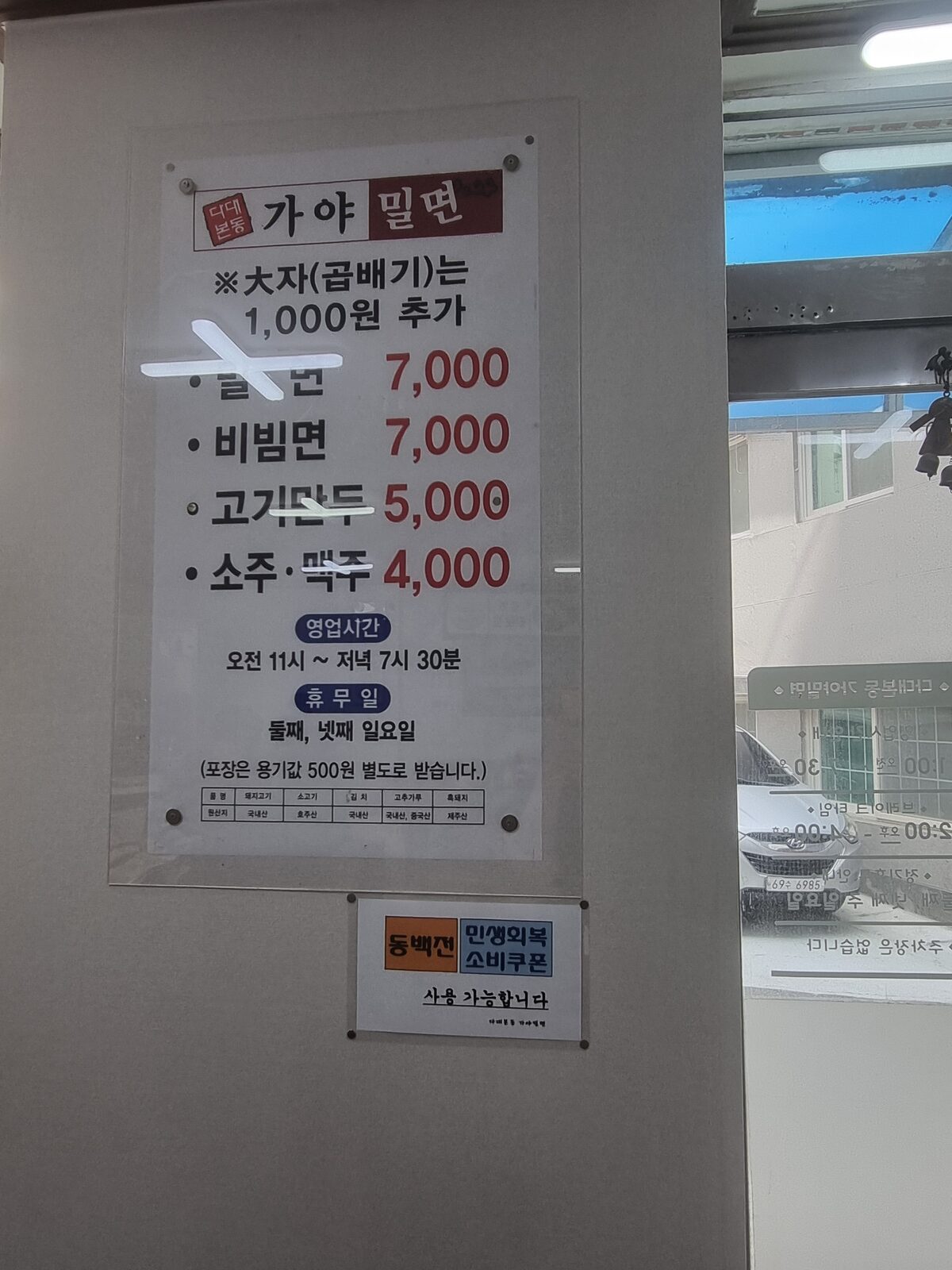
₩7,000 to ₩9,000, and the spread is real. Two shops in the same district can be two thousand won apart.
| ₩7,000 | ⭐ A genuinely good price in 2026. If you see it, that shop is not gouging anyone |
| ₩8,000 | Normal |
| ₩9,000 | Tourist districts, famous names, air-conditioned dining rooms |
| Large portion (gopbaegi, 곱빼기) | +₩1,000 at the shop above. Worth it — standard portions are modest |
⭐ One more thing on that menu board, because it is what this site is for. Korean restaurants are required to print a country-of-origin table, usually in small type at the bottom. The shop above declares pork and kimchi as Korean, chilli powder as Korean and Chinese, and beef as Australian. None of that is hidden — it is just in Korean, in six-point type, where nobody looks.
Prices checked on the ground in Busan, September 2026. Note that the ₩9,000 bowl is not better than the ₩7,000 bowl in any way you can taste. You are paying for the address.
When to eat it
It is sold all year, but it is a summer dish, and Busan summers are brutal — humid, coastal, in the mid-thirties. Between June and September the queues outside milmyeon shops at one in the afternoon are a genuine feature of the city.
The local pairing, and I’d recommend it: order milmyeon alongside dwaeji gukbap or a plate of grilled pork for the table. Cold chewy noodles against hot fatty pork is the combination the city actually eats, and it is why so many gukbap shops sell both.
Verdict
Both of these noodles have travelled. Naengmyeon is in Seoul, Los Angeles and Tokyo; milmyeon is in Seoul and in the freezer aisle. The difference is which one is cheap, everyday and three minutes away from where you are standing — and in Busan, in summer, that is this one, at seven thousand won.
If you are here in summer, this is not optional.
| ← Part 2 | Dwaeji Gukbap — Busan’s Pork Soup |
| ↑ Overview | What to Eat in Busan — and What to Skip |
| Next → | Part 4 — Bibim Dangmyeon (coming) |
Want a specific shop? I’ve reviewed Gaya Milmyeon in Dadae-dong — a ₩7,000 bowl, with directions, hours and what the menu board actually says.
Not sure what to order?
Tell us what you can and cannot eat. We will match you to Korean dishes that actually fit.
Vegan, no pork, shellfish allergy, eating alone, hate chilli — 75 dishes, filtered honestly. We tell you when the answer is “almost nothing”.
Find my dish →