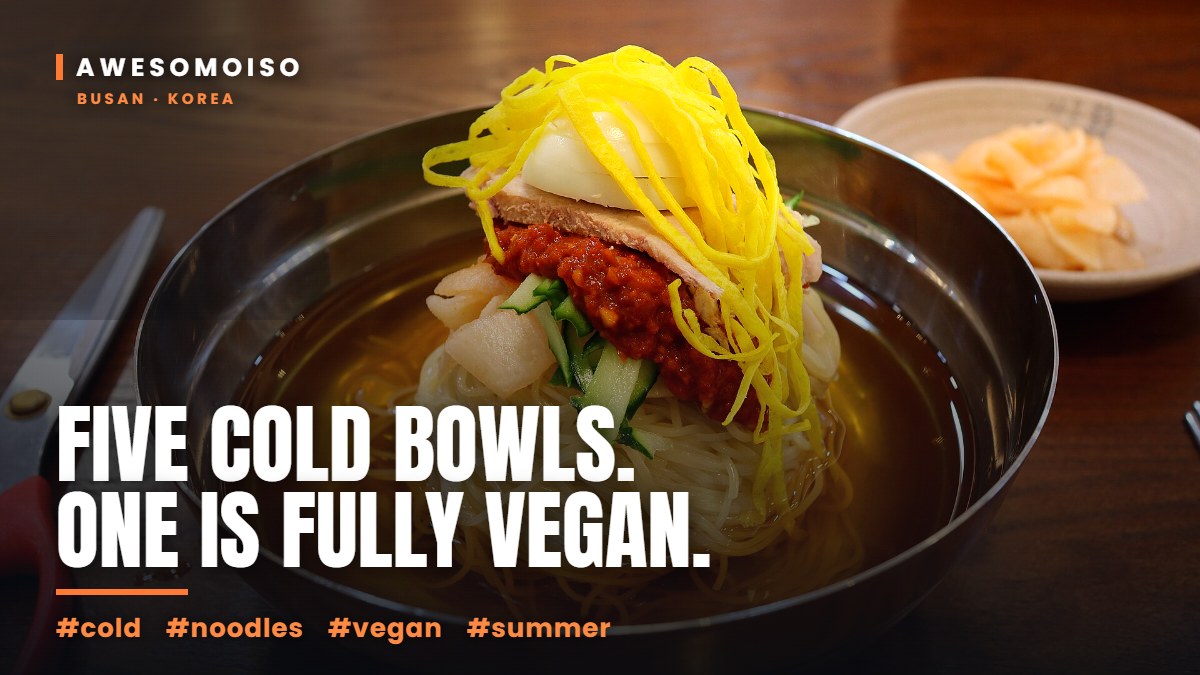
Korea has hot noodle soups and it has cold ones, and the cold ones are a separate world — different grain, different logic, a different reason to be eaten. Visitors who have only had ramyeon miss them completely.
This is part three of a nine-part map of Korean food by ingredient, and the first of two on noodles. Five cold bowls here. The hot and sauced ones get their own page.
What cold noodles are for
Not a salad. Not a light option. They are a cooling course, and several of them are most often eaten after something hot rather than as a meal on their own.
- Eaten in summer, overwhelmingly. Some shops only put them on the menu when it gets warm.
- Served genuinely cold — ice in the broth, sometimes slush. This surprises people.
- You season them yourself. Vinegar, mustard and salt sit on the table and the bowl arrives deliberately under-seasoned.
- Scissors come with them. The noodles are long and chewy on purpose; you cut them in the bowl. Using the scissors is normal, not a failure.
The two cold-broth ones
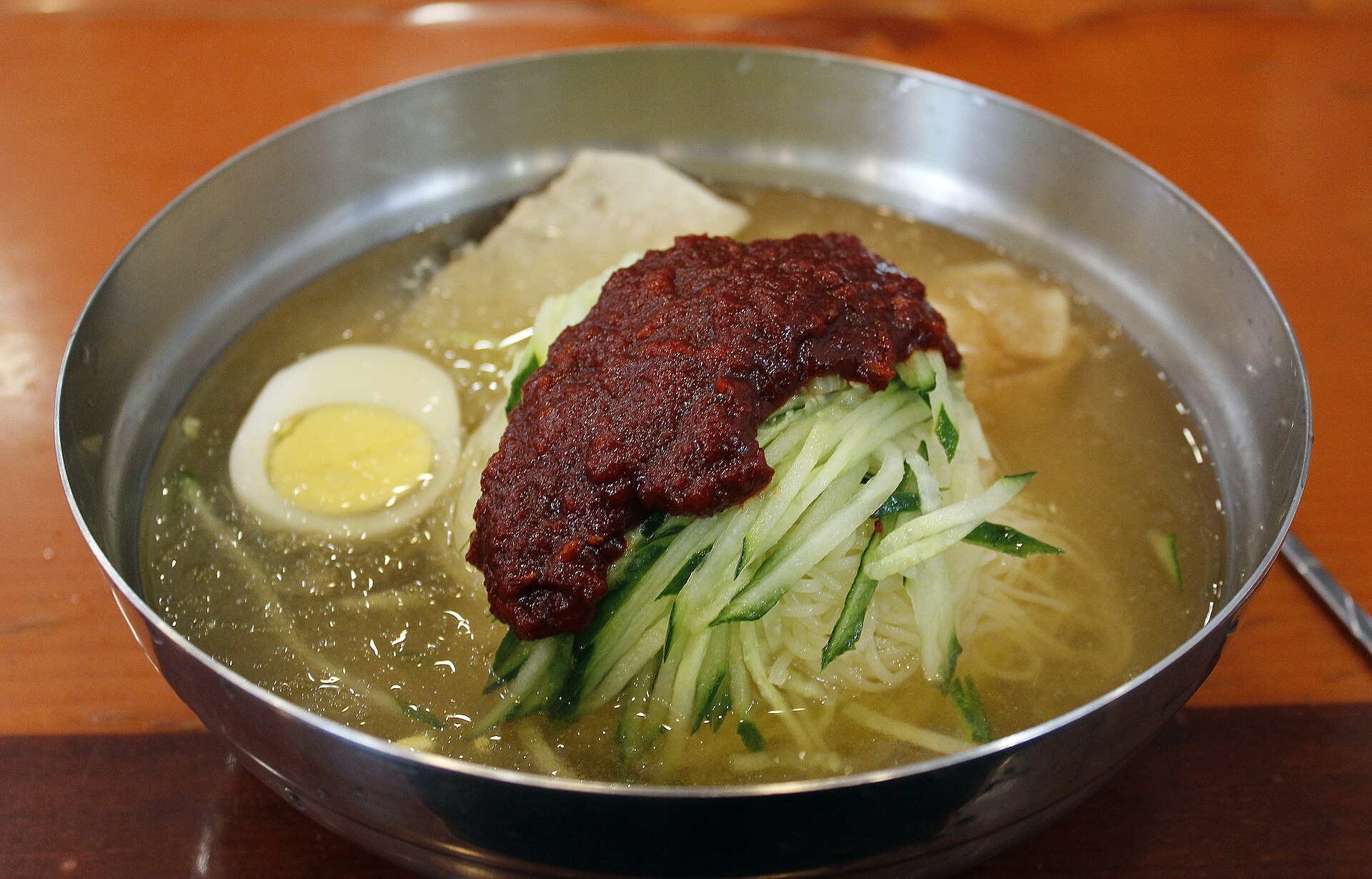
Milmyeon · 밀면 · mil-myeon · barely spicy
Cold wheat noodles in chilled broth, or mixed with chilli sauce. Chewy noodles in an icy, faintly sweet broth with a herbal undertone. It exists because refugees in Busan during the Korean War could not get buckwheat and used wheat flour instead. Full guide to milmyeon →
Taste the broth plain first, then add vinegar, then mustard. Locals do it in that order, which turns one bowl into three stages. Both are on the table; nobody will add them for you.
Mul-naengmyeon · 물냉면 · mul-NAENG-myeon · not spicy
Cold buckwheat noodles in icy broth, originally from Pyongyang. Famously bland on the first spoonful — think cold, tart beef consommé rather than anything assertive. That is the point, and it is why the vinegar and mustard are there.
If your first mouthful of mul-naengmyeon tastes of almost nothing, the kitchen did it right. Season it and taste again.
Most Koreans eat this after grilled beef, at the end of a galbi meal, far more often than as a lunch on its own.
The sauced one
Bibim-naengmyeon · 비빔냉면 · bi-bim-NAENG-myeon · spicy
The same buckwheat noodles, no broth, mixed with a red chilli paste dressing. Sweet, sour and hot at once. Mix it thoroughly before the first bite — the sauce sits on top and the dish does not work until it is worked through.
Same menu, opposite dishes. If one person at the table cannot take chilli and another wants it, this pair solves the table.
The nutty one
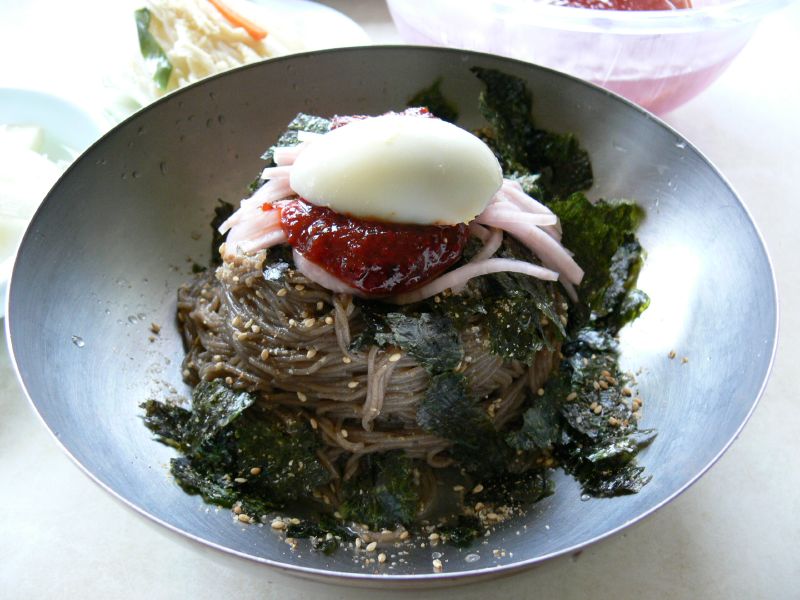
Makguksu · 막국수 · mak-guk-su · medium
Cold buckwheat noodles from Gangwon province, in broth or mixed with sauce. Nuttier and rougher than naengmyeon because the buckwheat content is higher. Some shops pour perilla oil over it, which changes the dish completely.
Most often eaten after dakgalbi in Chuncheon, as the cooling course that closes the meal — the same role naengmyeon plays after grilled beef. Dakgalbi is in the chicken guide →
And the one vegans have been looking for
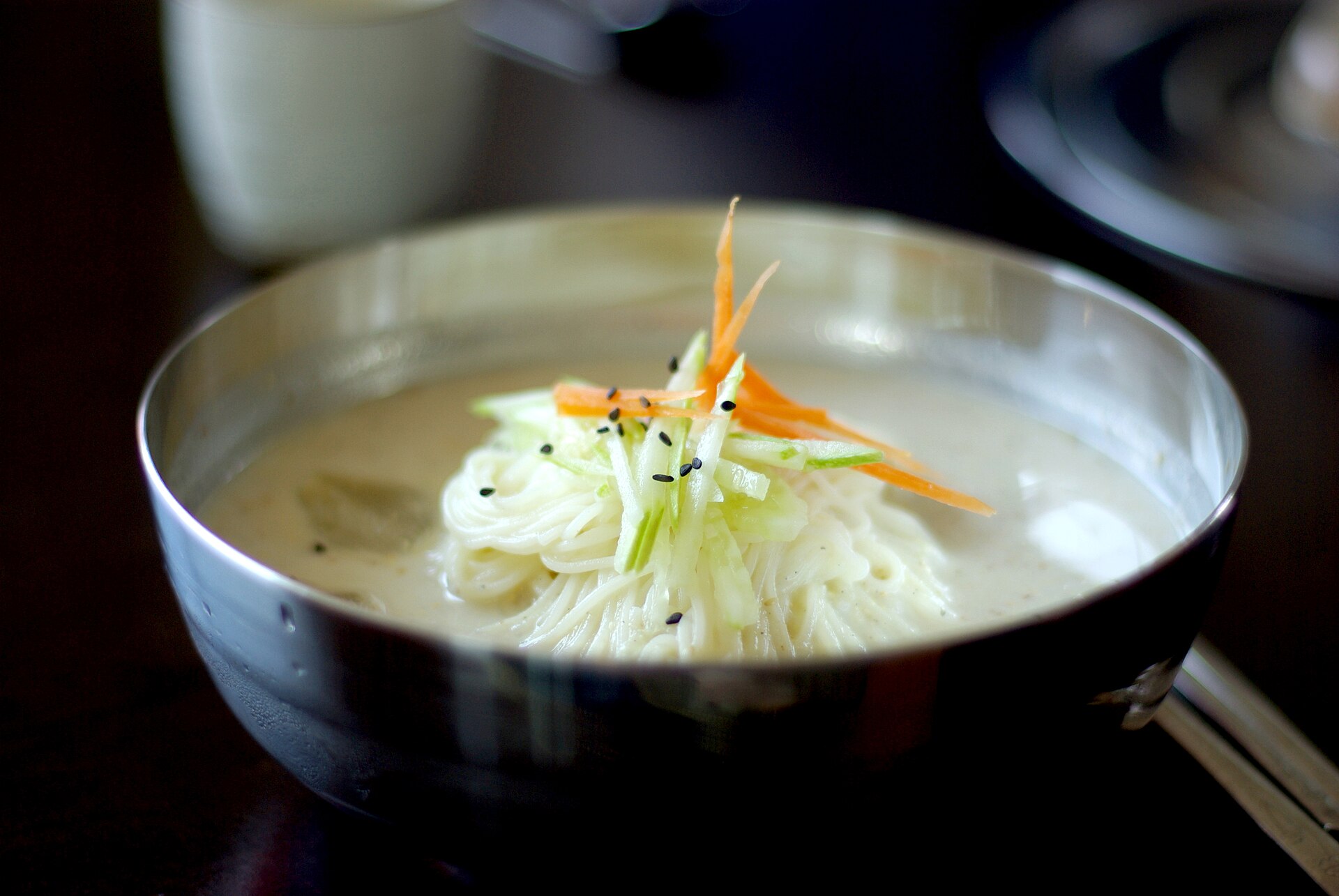
Kongguksu · 콩국수 · kong-guk-su · not spicy
Cold noodles in chilled ground soybean broth. Like cold, unsweetened soy milk poured over noodles — thick, mild, faintly sweet from the beans and nothing else. A summer-only menu at most shops.
This is quite possibly the best vegan meal in Korea, and almost no guide says so.
Korean food is harder for vegans than it looks, because the difficulty hides in the details — most kimchi contains fish sauce or salted shrimp, and anchovy stock turns up in dishes that look entirely plant-based. Kongguksu has none of that in its design. Soybeans, water, wheat noodles.
One thing to check: that it is seasoned with salt and nothing else. The bowl arrives deliberately plain and you salt it at the table, which is exactly what makes it safe — but ask, because shops do things their own way.
- Vegan: usually yes, once you confirm the seasoning. Ask anyway.
- Gluten: no — the noodles are wheat.
- The kimchi served alongside is a separate question. It usually is not vegan.
The recipe has barely moved in 150 years
Kongguksu appears in Siuijeonseo, a Korean cookbook from the late 19th century, listed alongside a sesame version of the same idea. The method recorded there — soak and blanch the beans, pass them through a sieve, season with salt, pour over wheat noodles — is close enough to what arrives at your table today that you would recognise it.
Sources differ on the exact dating of the manuscript, and nobody knows when the dish itself started. What is clear is that it is at least that old, and that salt, not sugar or stock, is the original seasoning.
It is usually eaten as a summer restorative rather than just a cold lunch — plant protein in weather too hot to want meat. That framing is nutritional common sense here rather than a medical claim.
Its winter twin: patjuk
Kongguksu has a seasonal opposite that works the same way. Patjuk (팥죽) is a thick red adzuki bean porridge, eaten hot in deep winter — traditionally on the winter solstice, when the red colour was believed to drive off bad luck.
Two bowls, two beans, two ends of the year. Soybeans cold in the hottest week; adzuki beans hot on the shortest day.
Both are also, by design, meat-free — which is not a coincidence. Legumes were how protein arrived on a Korean table when meat was scarce, and both dishes kept that shape.
What goes with it
Kongguksu arrives with kimchi, and in summer that is often yeolmu kimchi (young radish greens) rather than cabbage — thinner, sharper, and better against the thick bean broth. Sliced cucumber on top is common. Nothing else is needed.
And the argument. In parts of the southwest, people salt it with sugar instead. Neither side considers the other correct, and saying so in the wrong province will get you a lecture.
Which one to order
- In Busan? Milmyeon. It is the city’s own.
- Just finished grilled beef? Mul-naengmyeon. That is what it is for.
- Cannot eat chilli? Mul-naengmyeon or kongguksu. Neither has any.
- Want heat? Bibim-naengmyeon.
- Vegan? Kongguksu, after checking the seasoning.
- Summer, and you want the version locals argue about? Makguksu with perilla oil.
Copy-paste Korean
| What you want | Show this | Say it |
|---|---|---|
| Busan cold wheat noodles | 밀면 | mil-myeon |
| Cold noodles in broth | 물냉면 | mul-NAENG-myeon |
| Cold noodles, spicy, no broth | 비빔냉면 | bi-bim-NAENG-myeon |
| Cold soybean noodles | 콩국수 | kong-guk-su |
| Is it seasoned with salt only? | 소금만 넣나요? | so-geum-man NEON-na-yo? |
| Scissors, please | 가위 주세요 | ga-wi joo-se-yo |
Where to go next
Part three of nine. Hot and sauced noodles are next.
4 thoughts on “Korean Cold Noodles: Five Bowls, and the One Vegans Have Been Looking For”