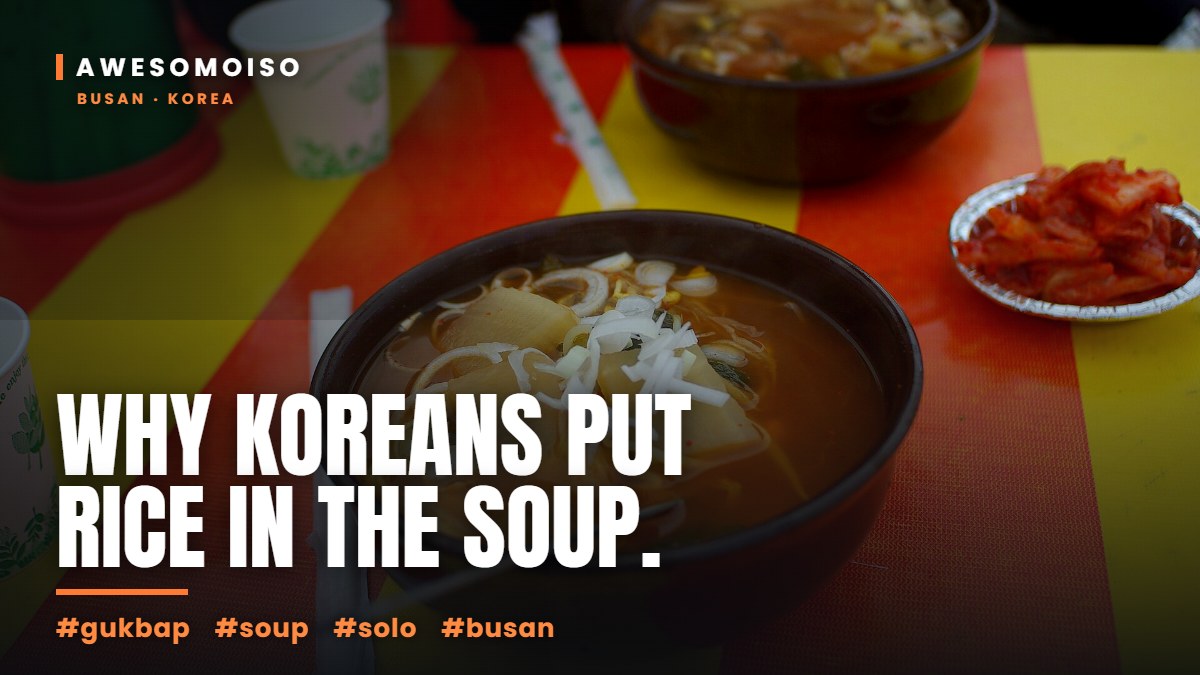
Somewhere in Korea, right now, someone is tipping a bowl of rice into a bowl of soup — on purpose, as the intended way to eat it.
If you grew up elsewhere, that may read as a mistake. Soup is a starter. Rice is a side. Putting one into the other looks like you have given up on the meal.
In Korea it is the meal. It has a name, a history, and more versions than most Koreans could list.

What gukbap actually is
Guk (국) = soup. Bap (밥) = rice. Gukbap is both, in one bowl, eaten with a spoon.
Not soup with rice on the side. The rice goes in, soaks, and what you eat sits somewhere between a soup and a risotto nobody stirred.
- A hot broth stays hot longer with rice in it. This matters in winter.
- The rice carries the broth. Plain rice is bland; rice that has been sitting in beef or pork stock is not.
- One dish, one spoon, one bowl. No sharing, no side plates, no ordering decisions.
It is also the easiest Korean meal to eat alone. Most Korean food is built for a table of people. Gukbap is not.
Where it came from — a food of the road
Gukbap did not come out of a palace. It came out of inns and markets.
In the late Joseon period, roughly the 18th and 19th centuries, the old state-run post stations were breaking down, private roadside inns (jumak) were opening at ferry crossings and along main roads, and money was circulating. Travellers needed to eat fast and cheap.
The earliest gukbap shop recorded in writing is Mugyo Tangban, said to have been frequented by King Heonjong, who reigned from 1827 to 1849.
Back then it was not called gukbap. It was tangban (탕반) or jangguk-bap (장국밥) — brisket and radish simmered down, the meat sliced and seasoned, poured over rice in an earthenware bowl and topped with beef skewers, bellflower root, bracken fern and bean sprouts.
It was a traveller’s meal long before it was a hangover meal.
Toryeom — the part that explains everything
Here is the detail that makes the rest make sense.
A market stall had one fire. You could not cook rice to order and hold a broth at a simmer at the same time. So you did both in advance: rice cooked and left to cool, broth kept boiling.
To serve, you put the cold rice in a bowl, ladle hot broth over it, pour the broth back out, and do it again — four, five, six times, until the rice is hot through. That is toryeom (토렴).
It solved a problem, and then it turned out to taste better:
- Reheats cold rice without boiling it to mush
- The broth works into each grain instead of sitting around it
- Arrives at eating temperature rather than scalding
Not every shop does it any more — toryeom takes time, and many places now hand you rice in a separate bowl and let you tip it in yourself. If a shop still toryeoms, someone there is taking the long way on purpose.
Gukbap is not one dish
Ask a Korean what gukbap means and most will say dwaeji gukbap (pork) or sundae gukbap (blood sausage). Those are the default.
But “rice in soup” is a format, not a recipe, and the list is long:

Mar del Este / CC BY-SA 4.0

향긋한 커피매니아 / CC BY 4.0

abex / CC BY-SA 2.0

stu_spivack / CC BY-SA 2.0
| What is in it | Notes | |
|---|---|---|
| Dwaeji gukbap 돼지국밥 | Pork bone broth, sliced pork | The Busan default |
| Sundae gukbap 순대국밥 | Blood sausage, offal | Stronger. Perilla powder helps |
| Kongnamul gukbap 콩나물국밥 | Bean sprouts, clear and light | The hangover one. Jeonju’s version is famous |
| Seonji gukbap 선지국밥 | Congealed ox blood | Divisive, even among Koreans |
| Haejang-guk 해장국 | Varies by region — bones, blood, cabbage | Literally “soup to chase the hangover” |
| Hwangtae guk 황태국 | Dried pollack | Mild, milky, very gentle |
| Bok guk 복국 | Pufferfish | Licensed chefs only. Clean and clear |
| Galbitang 갈비탕 | Beef short rib | Clear, barely seasoned, no chilli |
| Seolleongtang 설렁탕 | Ox bone, simmered for hours | Milky white. You salt it yourself |
| Naejang-tang / Yang-tang 내장탕·양탕 | Offal, tripe | Divisive, even among Koreans |
Some of these are called tang (탕) rather than gukbap, and arrive with the rice on the side. Functionally it is the same meal — you are still putting rice into soup.
How to eat it without looking lost
- If the rice comes separately, tip it in. All of it. That is the point.
- Taste before you season. Most of these arrive deliberately under-salted.
- The red paste on the table (dadaegi) is heat. Add a little, stir, taste.
- Salted shrimp (saeujeot) is salt, not a topping — and it is shellfish.
- The kimchi and radish are free and refillable.
Nearly all of these are eaten alone, at any hour, without ceremony. If you are travelling solo and tired of ordering food meant for two, this is the category to learn.
Two of these divide Koreans too
Seonji gukbap (congealed ox blood) and naejang-tang (offal) are not universally liked here either. Plenty of Koreans never order them. If they are not for you, that is not a failure of taste — it is the same split that exists among locals.
One thing worth knowing about any offal bowl: a well-run shop smells of broth and perilla, not of the animal. That difference is the kitchen’s work, not the dish’s nature.
If you want to start somewhere safe: galbitang or seolleongtang. Neither is spicy, neither is funky, and both are as much “gukbap” as the rest.
Where to go next: Dwaeji Gukbap — the bowl Busan actually eats · Three Busan Dishes the Port Created · What to Eat in Busan
4 thoughts on “Gukbap: Why Koreans Put Rice in the Soup”