You handle Thai green curry. You order your Mexican food hot. Then something in Korea took you apart, and nobody at the table thought it was unusual.
The problem is not that you cannot take heat. It is that you have no way to tell anyone how much heat you can take. “Not too spicy” means nothing, because it is measured against the person you are saying it to.
First, the good news: it is usually adjustable
Most Korean dishes that are cooked to order can be made less spicy, and it is worth asking. Plenty of places will do it without blinking.
Some chains have built the scale into the menu. At the tteokbokki chain Yupdduk, heat is a dropdown with options running from chakan-mat (“kind flavour”) up through cho-bo-mat (“beginner’s flavour”), deol-maeun-mat (“less spicy”), Original and Spicy — and on the app we looked at, every level costs the same. Heat is a choice there, not a favour.
Now the trap: “mild” is mild for Koreans
Here is the part that catches people. At that same chain, the second rung from the bottom — the one literally called beginner — is widely described as hotter than Shin Ramyun. Reviews of the scale put Original at roughly four times the heat of the gentlest option.
Ordering “mild” does not put you on your own scale. It puts you on theirs.
What actually works: name a ramyun
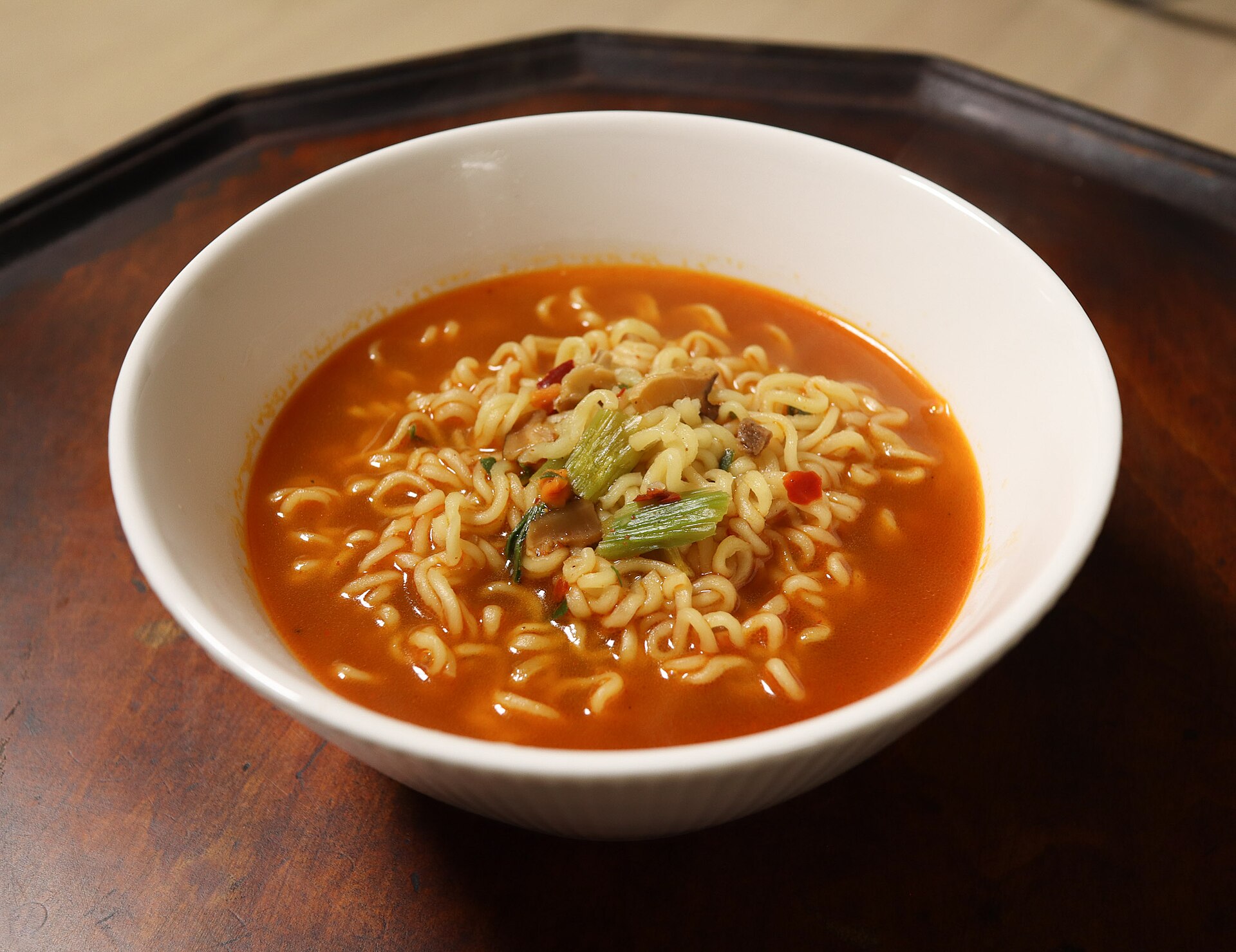
Koreans already have a shared ruler for this, and it is not a number. It is Shin Ramyun. When Koreans talk about how much heat someone can handle, this is the thing they measure against — it sits at about the level most people would call pleasantly spicy. Food writing about spice levels uses it the same way.
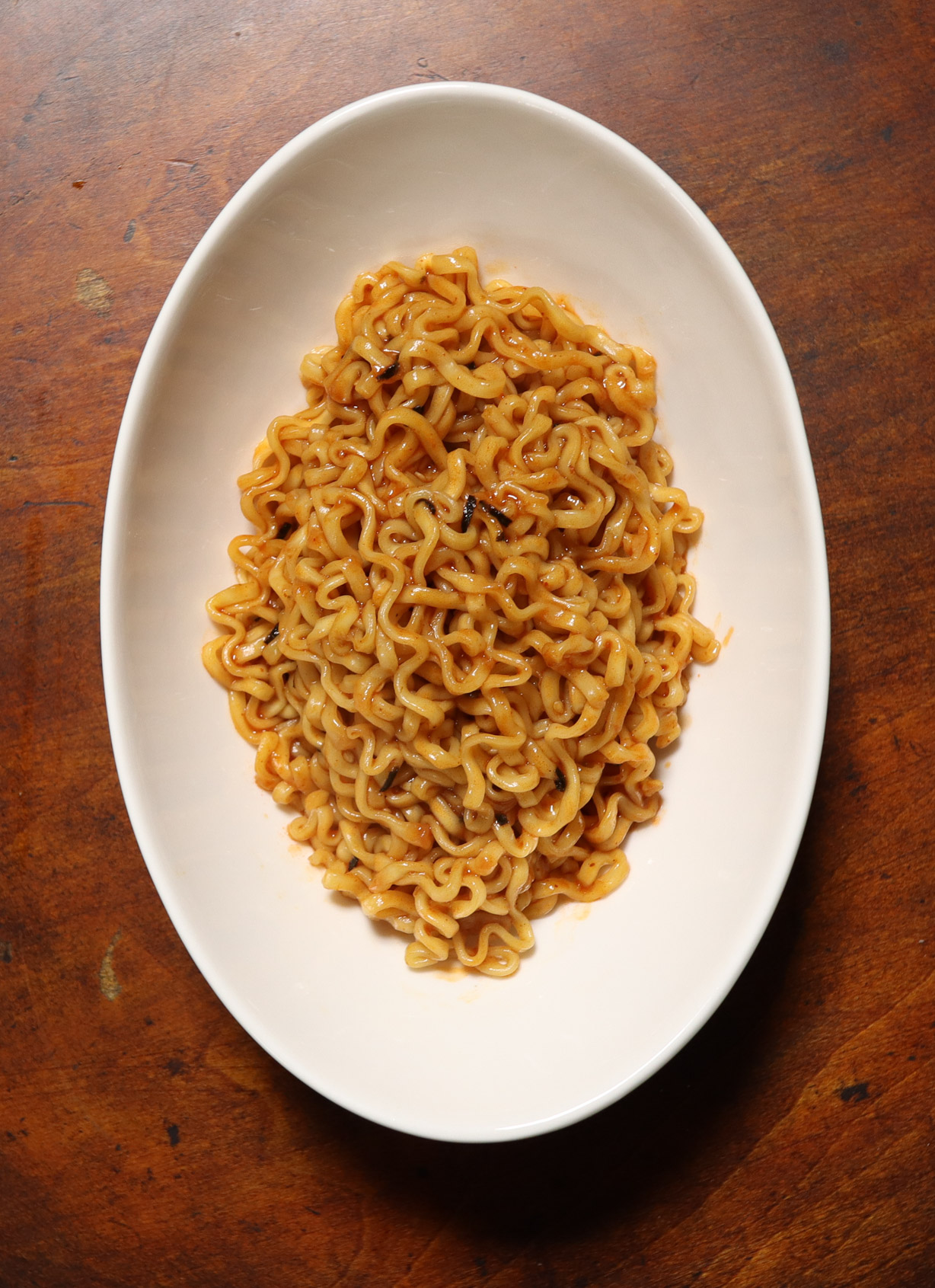
Buldak is the second rung, and it is the one you may already know: it went around the world as a challenge. If you have eaten it and been fine, say so. That single sentence tells a Korean kitchen more than any adjective will.
The ruler has rungs below Shin Ramyun too, and for most visitors those are the useful ones.
| Rung | Name it | What a Korean hears |
|---|---|---|
| Genuinely mild | Jin Ramen Mild (진라면 순한맛) | This is what Koreans mean by mild — it is what parents buy for children. Say this is too spicy and the message lands: no chilli for you |
| Standard | Shin Ramyun | “Pleasantly spicy.” The default ruler. Finding this hot already puts you below the Korean average |
| Hot | Buldak | The one that travelled the world as a challenge. Fine with it? Order freely |
One wrinkle worth knowing: the ruler itself has moved. Shin Ramyun was reformulated upward through the 2010s, reaching roughly 3,400 SHU in 2015 — by one account close to three times the heat of the original recipe. Korean tolerance did not just drift; the reference product was rebuilt under it. Published Scoville figures are also unreliable, since many circulating numbers are measured by whoever posted them. That is the case for naming a product rather than quoting a number.
| What you mean | Say this | How it sounds |
|---|---|---|
| Can this be made not spicy? | 안 맵게 되나요? | an maep-ge doe-na-yo? |
| Shin Ramyun is fine for me | 신라면은 괜찮아요 | Shin-ra-myeon-eun gwaen-chan-a-yo |
| Even Buldak is fine for me | 불늩도 괜찮아요 | Bul-dak-do gwaen-chan-a-yo |
| Shin Ramyun is already too spicy | 신라면 너무 매워요 | Shin-ra-myeon neo-mu mae-wo-yo |
| Even the mild one is too spicy for me | 진라면 순한맛도 매워요 | Jin-ra-myeon sun-han-mat-do mae-wo-yo |
Notice what these sentences do. They do not instruct the kitchen. They tell the kitchen where you are, and let it decide what to do with that. That is the version Korean restaurants respond to.
Three times asking will not help
- The sauce came from a factory. Many franchises cook with a sauce made off-site to a fixed recipe. There is no dial in the kitchen to turn, and staff who say so are not brushing you off.
- The heat is in the name. If the dish is called maeun-something — spicy galbi, spicy tteokbokki — a milder version may still be hot. The chilli is the dish, not a seasoning on it.
- Nobody thinks it is spicy. Plenty of dishes Koreans file as not-spicy still register as spicy to a palate that did not grow up here. If you are sensitive, ask even when nothing on the menu warns you.
Why some spicy food does not feel spicy
You may notice that two dishes with the same amount of chilli land completely differently. Sweetness and fat both soften how heat registers — sugar and fat are long established as things that quiet a capsaicin burn, which is why cheese and a sweet sauce make a fierce dish feel manageable. (The popular explanation involving milk proteins is shakier than it sounds; what is reliable is the effect, not the mechanism.)
This is also why Korean heat sneaks up on people. In our database, nine of the dishes scoring 3 or more for chilli also score 2 or more for sweetness — dakgalbi, jeyuk-bokkeum, tteokbokki, bibim-guksu and others. The first bite reads as sweet. The heat accumulates over the bowl. We wrote about that sweetness separately.
Or skip the negotiation and order differently
We score 91 Korean dishes from 0 to 5 for chilli heat. The spread is not what most visitors expect:
| Chilli heat | Dishes |
|---|---|
| 0 — none | 43 |
| 1 — a trace | 16 |
| 2 — mild | 13 |
| 3 — properly spicy | 12 |
| 4–5 — hot | 7 |
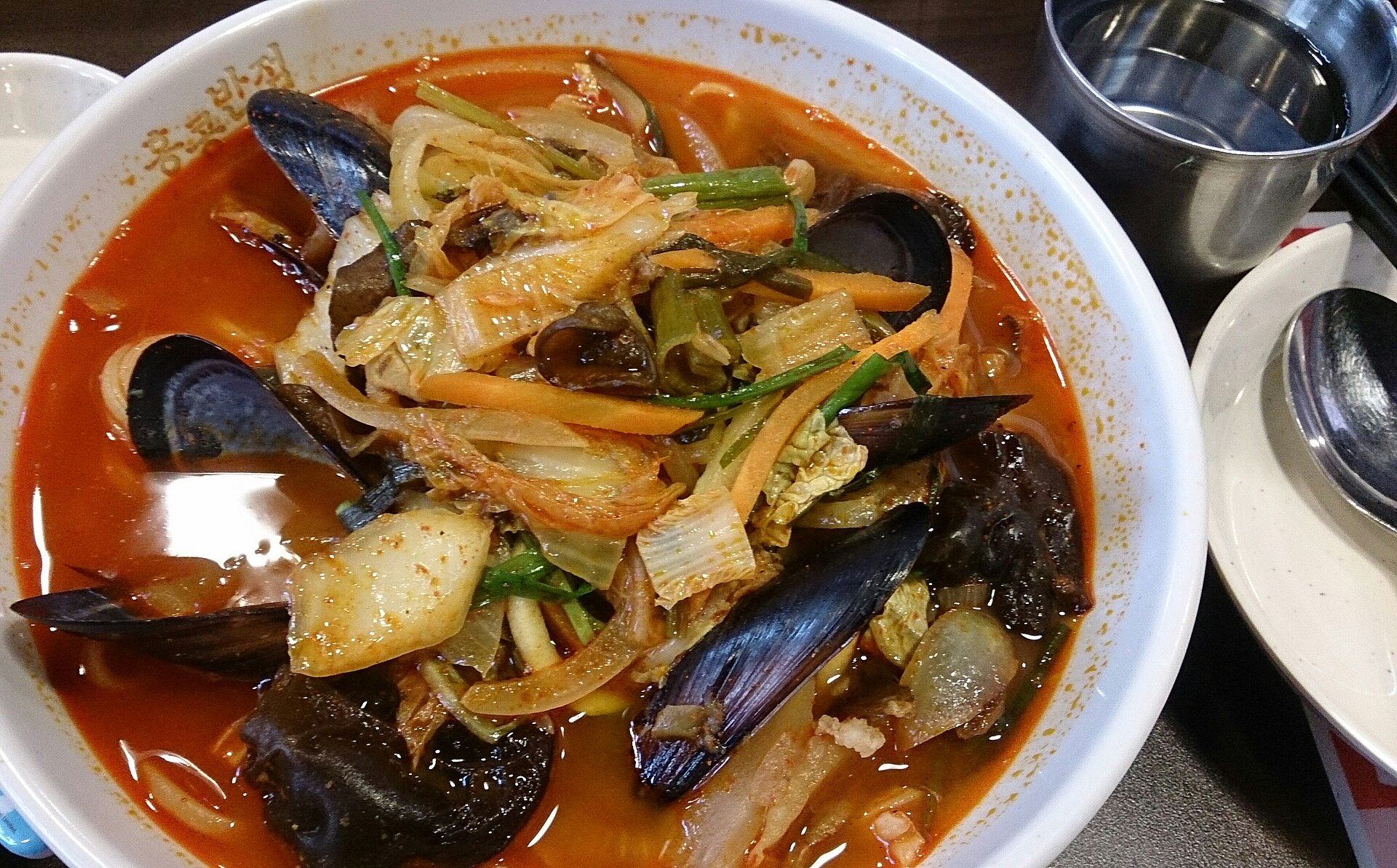
59 of 91 dishes sit at 0 or 1. Only seven reach the top: jjamppong, nakgopsae, dakbal, and the spicy seafood jjim family — agujjim, daegu-ppoljjim, haemul-jjim and kkotge-jjim.
There is also a quieter group worth knowing: dishes where the chilli arrives on the side rather than in the pot. Dwaeji gukbap, sundae gukbap, gul gukbap and the rice-soup family come with a red paste called dadaegi that you stir in yourself, and bibimbap arrives with the gochujang separate. You are not asking anyone for a favour here — that is simply how the dish is served. Leave it out and the bowl is not spicy at all.
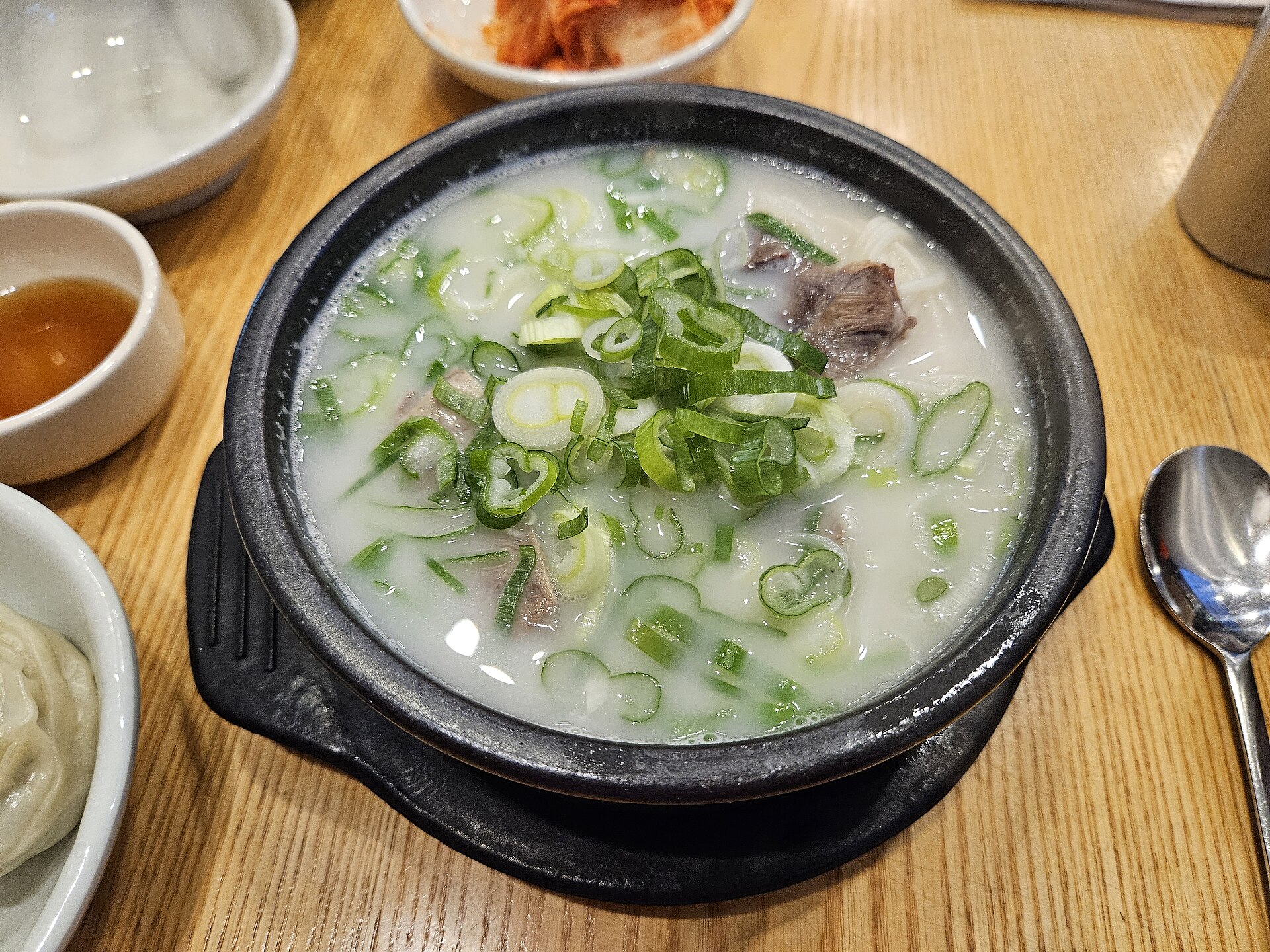
And if you want a guaranteed night off: seolleongtang, galbitang, samgyetang and kalguksu have no chilli in them at all. You season them yourself at the table.
The short version
- Most cooked-to-order dishes can be toned down — ask, and ask early
- “Mild” is mild by Korean measure. At one tteokbokki chain, the level called beginner is hotter than Shin Ramyun
- Name a ramyun instead of an adjective. Shin Ramyun is the ruler Koreans use; Buldak is the rung above it
- It will not help if the sauce is factory-made, if the dish is named maeun, or if nobody involved considers it spicy
- 59 of our 91 dishes are barely spicy at all, and the rice soups hand you the chilli on the side
Want all of these in one place? The Korean Restaurant Card collects every phrase on this site into one page you can show a server.