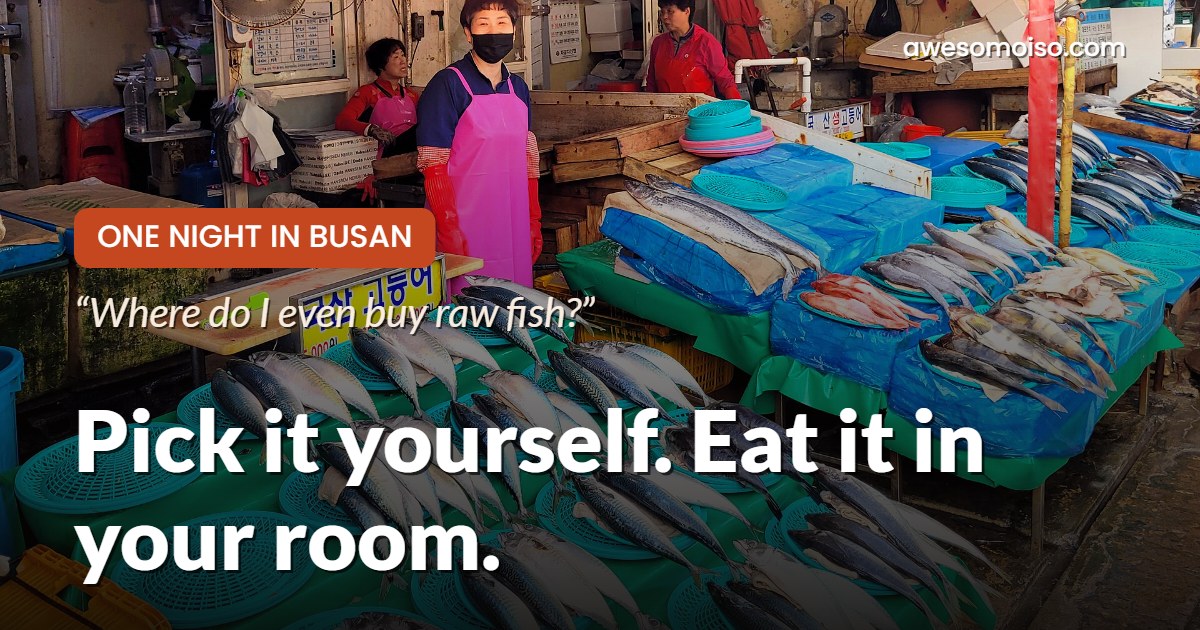
There is usually one evening on a trip when you do not want another restaurant. You have walked all day, the good places have a queue, and the idea of sitting upright under bright lights for another hour is unappealing.
In Busan there is a better answer than room service. Go to a fish market, point at something alive, and carry it back to your room.
This is an ordinary thing to do here. It is also, for most visitors, the part of the trip they end up describing to people back home — not the restaurant they queued for.
Where you can actually do this
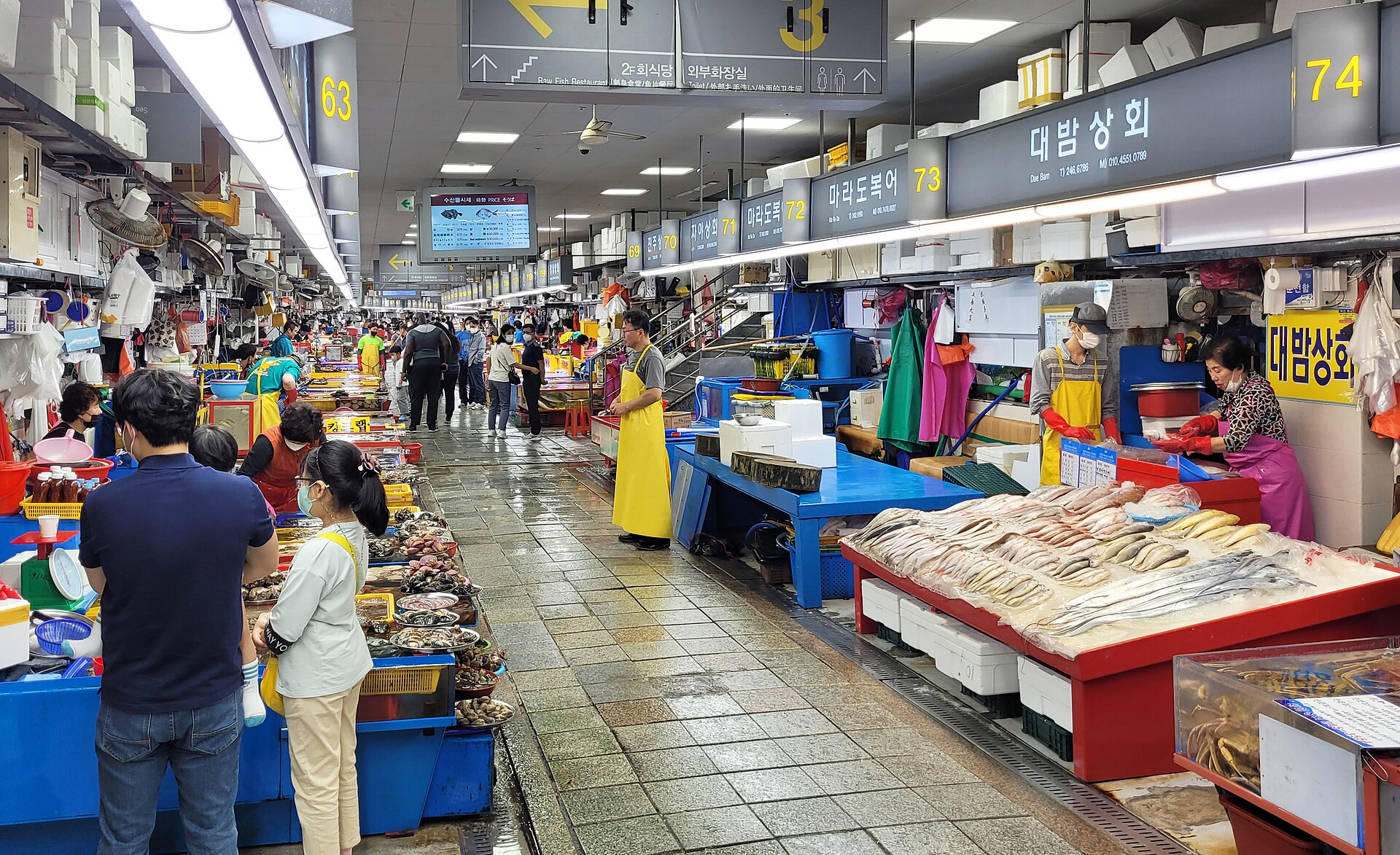
You need a market where fish are sold live and filleted on the spot. In Busan the main ones are:
| Market | How it works |
|---|---|
| Jagalchi & Shindonga (Jung-gu) | Pick downstairs, and the restaurant floors are upstairs. Shindonga alone holds around 186 fishmonger-restaurants |
| Millak Fishermen’s Market (Suyeong-gu, by Gwangalli) | Buy and have it sliced, then carry it out. Reviews put a two-person portion in the ₩40,000–50,000 range |
| Dadae Sea Park (Saha-gu, Dadaepo) | Buy on the first floor, eat on the second and third. Dadaepo Harbour station, exit 2 |
Prices move with the season and the fish, so treat any figure as a rough guide and ask at the counter.
Standing in front of the tanks
This is where most visitors freeze. There are forty tanks and no English, and the thing you are looking at is still swimming.
You do not need to know the fish. You need four sentences.
| What you want to say | Korean | How to say it |
|---|---|---|
| Please pack it to go | 포장해주세요 | po-jang-hae-ju-se-yo |
| I’m eating it at my hotel | 호텔에서 먹어요 | ho-te-re-seo meo-geo-yo |
| What’s in season? | 제철 회가 뭐예요? | je-cheol hoe-ga mwo-ye-yo? |
| I’m thinking about ₩50,000 | 5만원쯤 생각해요 | o-man-won-jjeum saeng-gak-hae-yo |
| How much altogether? | 다 해서 얼마예요? | da hae-seo eol-ma-ye-yo? |
The second one does more work than it looks. Saying you are eating at your hotel explains everything at once: no table needed, no seating charge, and no need to explain anything else. If they offer you the head and bones for soup — they often will — the same sentence politely ends it, because you have nowhere to cook. If it needs saying twice, yori hamyeon an dwaeyo (요리 하면 안 돼요), “I can’t cook where I’m staying.”
Naming a budget is normal here, not rude. The seller will size the order to it. Then ask the total before they start slicing — that one question is the whole of what you need to be careful about. Weight disputes at fish markets do get reported in Korea, and they almost always come from a total nobody pinned down. Watch that the fish you chose is the fish that goes in, and keep the receipt.
Which fish, and one you should not take home
Whatever is in season will be the best value, and the seller will tell you if you ask. In November that usually means flatfish, striped beakfish and yellowtail. Our seasonal guide covers the species in detail, so pick there and point here.
If you want one answer: flatfish
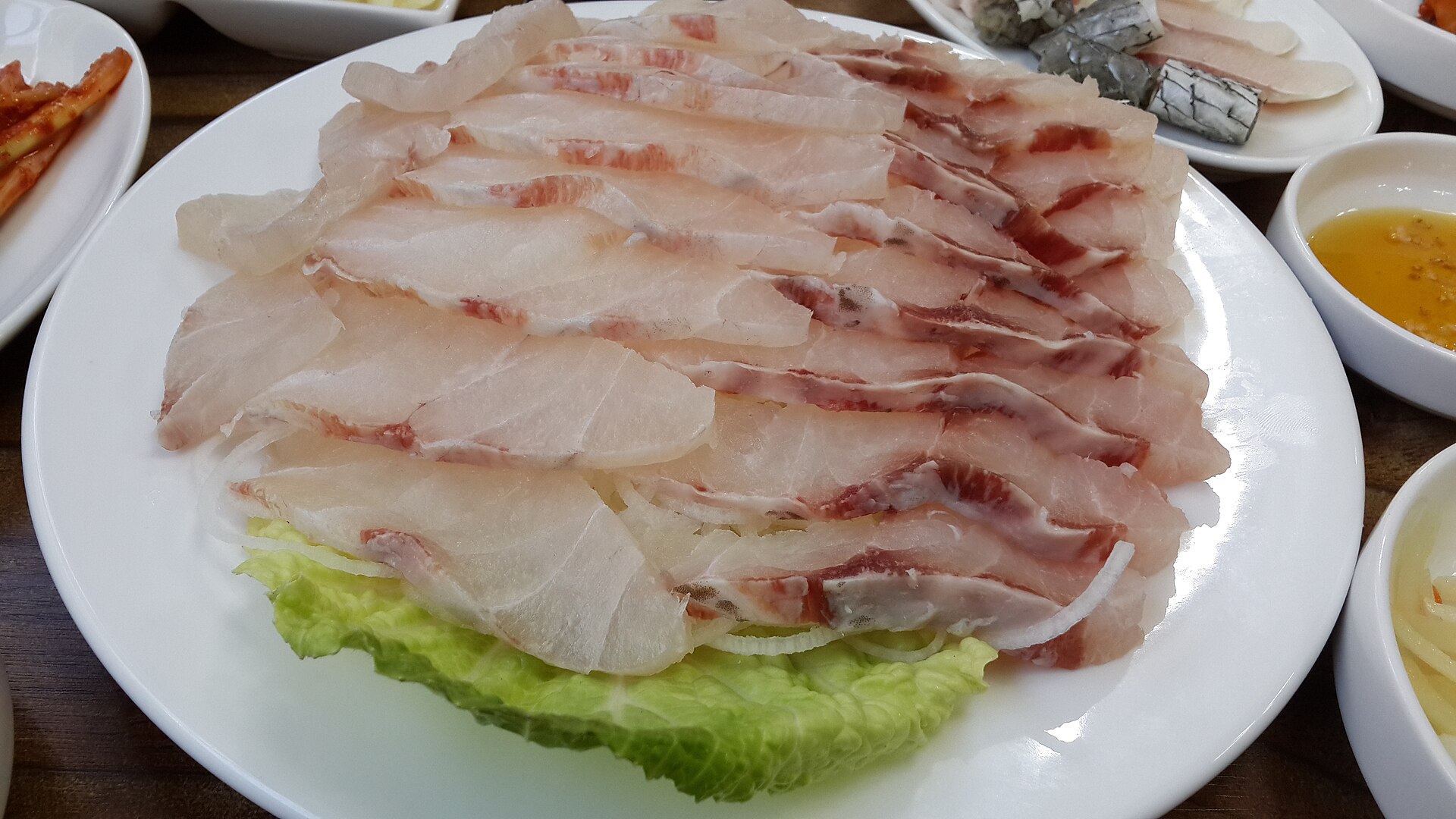
Flatfish (gwangeo) is the beginner’s fish, and late autumn through winter is when it is at its best. Colder water firms up the flesh and the fat comes in. It is mild rather than strong, the texture is the point, and it is on sale at every counter — which also means nobody has to guess at a price for you.
You will see the words wild and farmed used, and you can safely ignore the distinction. Around 90% of the flatfish sold for raw eating in Korea is farmed, mostly on Jeju and in Wando. That is not a downgrade: an aquaculture researcher at Korea’s National Institute of Fisheries Science puts it plainly — wild fish is excellent in its own season, while farmed fish holds a fairly even quality all year. The same interview notes that if you do want flatfish wild, autumn into early winter is exactly when to do it.
So this is a month where the question does not really need answering. Do not go hunting for the word wild, and be wary of paying a premium for it — condition varies fish by fish either way, and what is in front of you in good shape beats a label.
One exception: do not take yellowtail (bangeo) back to your room. Its whole appeal is in how it is aged, and that is a kitchen’s job, not a hotel desk’s. Eat that one at a restaurant.
For a room, you want fish that is meant to be eaten the moment it is cut — the firm white ones.
Stop at a supermarket, not a convenience store
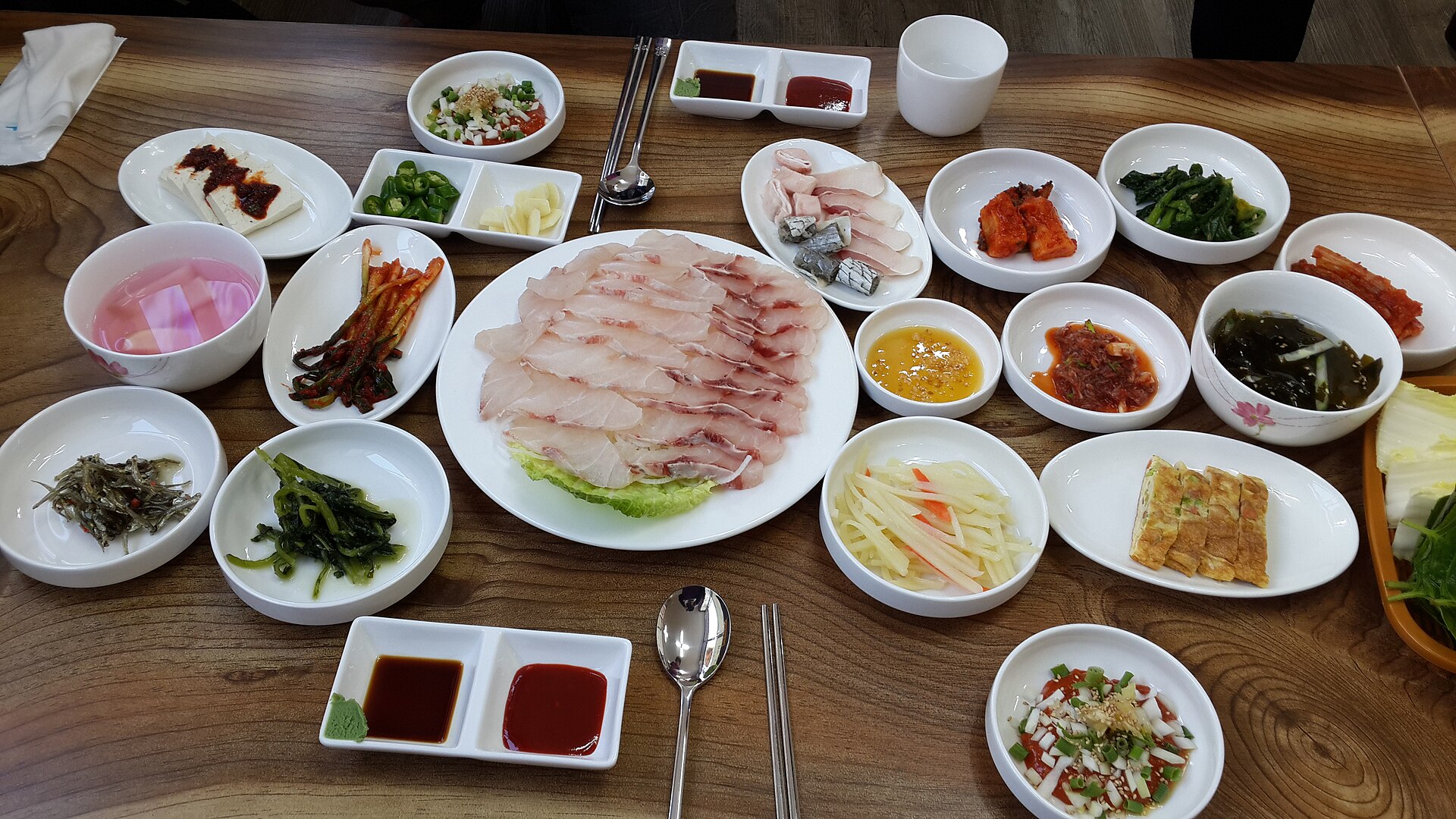
A convenience store will cover bowls, chopsticks, drinks and beer. It will not have the vegetables, and the vegetables are most of what makes this a meal rather than a tray of fish.
| Buy | Why |
|---|---|
| Lettuce and perilla leaves | You wrap each piece. Perilla in particular cuts the smell of raw fish — this is why it is always on the table |
| Ssamjang (soybean paste) | In Busan plenty of people dip raw fish in soybean paste rather than the red sauce. Try both |
| Chojang (red vinegar sauce) | The standard dip. The shop may send some with your fish |
| Roasted soybean powder (kongaru) | The Busan move. Scatter it over the vegetables — it adds a nutty note and helps the sauce cling to the fish |
| Garlic and green chilli | Go inside the wrap, raw |
| Seaweed | Gijang seaweed wrapped in with the fish is a local favourite |
| Instant rice and dried laver | For whatever is left. See below |
In the room
Two things are worth knowing before you spread it all out.
Ask your hotel first. Most large Korean hotels do not restrict outside food and delivery is completely normal, but some do restrict it and charge for it. A question at the front desk takes ten seconds. If you are in a residence or a guesthouse, this is rarely an issue at all — and you will have a proper table.
Cooking in the room is a different matter and is usually not allowed anywhere. That is the real reason to turn down the soup bones: there is nowhere to boil them.
Eat the white fish first and anything richer after. If there is rice and laver, the end of the meal takes care of itself — lay a slice on rice like sushi, or chop what is left, add the red sauce and sesame oil, and you have made hoedeopbap without meaning to.
Finish it tonight
Raw fish sliced today is eaten today. It is not for the hotel fridge and not for tomorrow. Buy the amount you will actually finish — this is the main reason not to over-order, and a two-person portion is smaller than it looks when you are excited at the counter.
Bag the scraps and tie the bag shut before you put it in the bin. One extra bag from the market is all it takes, and it is the difference between a nice evening and a room that smells of fish at breakfast.
If talking to the seller feels like too much
Then order modeum-hoe (assorted sliced fish) on a delivery app instead. One word, no species to choose, no weight to negotiate — and Baemin runs in English. Here is how to set the apps up.
A supermarket also sells pre-sliced packs at a fixed, printed price, which is the simplest option of all. And some ordinary restaurants will pack fish to go, though the choice is narrower and the portions smaller.
All of these work. None of them is the evening we just described — the one where you picked the fish yourself.
The short version
- Buy at Jagalchi, Millak or Dadae Sea Park — markets where fish is sold live and sliced for you
- 포장해주세요 and 호텔에서 먹어요 handle almost the whole conversation
- Name a budget, then ask the total before they slice
- Supermarket, not convenience store — the leaves, pastes and soybean powder are the meal
- Not yellowtail: aged fish belongs in a restaurant
- Eat it the same day, and tie the bag shut
Still not sure what to point at in the tank? Here is how to pick by taste rather than by name.
Save the Korean Restaurant Card before you go — the market phrases above are on it, along with the allergen words.