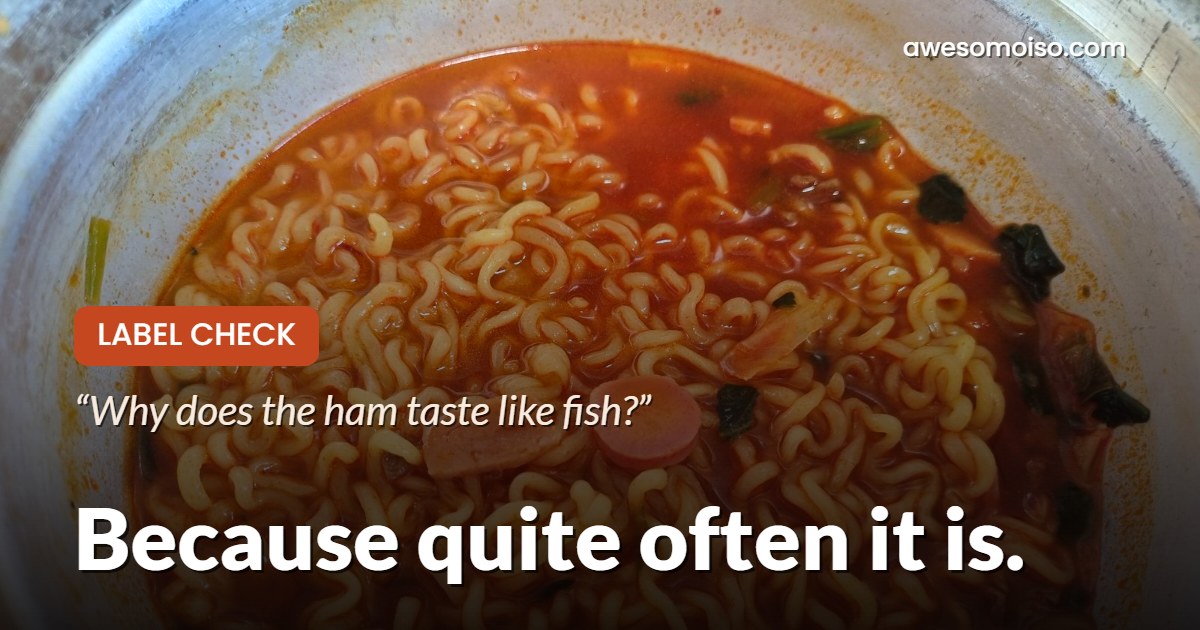
Budae-jjigae — “army stew” — is the dish Korea built out of what was left over near American bases after the war: spam, hot dogs, baked beans, instant noodles, all simmered in a red broth. It is still on menus everywhere, and there are now instant versions of it in every convenience store.
We ate two of them. The thing worth writing down is not whether they are good. It is what the pink “ham” in them actually is.

First, the bag version: Ottogi budae-jjigae ramyeon
Sold in four-packs. We paid about ₩5,710 for four, so roughly ₩1,400 each — not cheap for a packet of instant noodles in Korea, where the floor is well under ₩1,000. Prices vary by shop and by sale, so treat that as a ballpark.

There are three sachets, and the third one matters. The packet says in Korean to add the “budae-jjigae sauce” after cooking, not during. That sachet is where almost all of the flavour lives — a thick, salty, meaty paste. Boil it in with everything else and you have thrown away half of what you paid for.
Cooked properly, the ham note is the whole product. The broth is heavy and savoury and genuinely tastes like the stew. The noodles are ordinary. The dried flakes look the part — pink sausage discs, two shades of ham, cabbage, spring onion — but there are only a few of each.
And there is almost no kimchi sourness, even though dried kimchi is in the ingredients. If the version of army stew you like is the tangy one, this is not it. Which is fixable: add some old kimchi yourself.
This is not a finished bowl of noodles. It is a stew base that happens to include noodles. On its own at ₩1,400 it is poor value. Add ham, sausage, bean sprouts, tofu, rice cakes or kimchi and it becomes a cheap, genuinely good army stew for two.
Then the cup version: Odeng Sikdang budae-jjigae ramyeon
A convenience store cup, about ₩2,000, carrying the name of a restaurant that bills itself as Korea’s first army stew house, trading since 1960. With a name like that we expected the ham to lead.
It does not. The ham note is faint and what comes forward is kimchi. If you have had a Korean instant kimchi noodle cup, that is the neighbourhood this is in — pleasant, mild, and not especially like army stew.
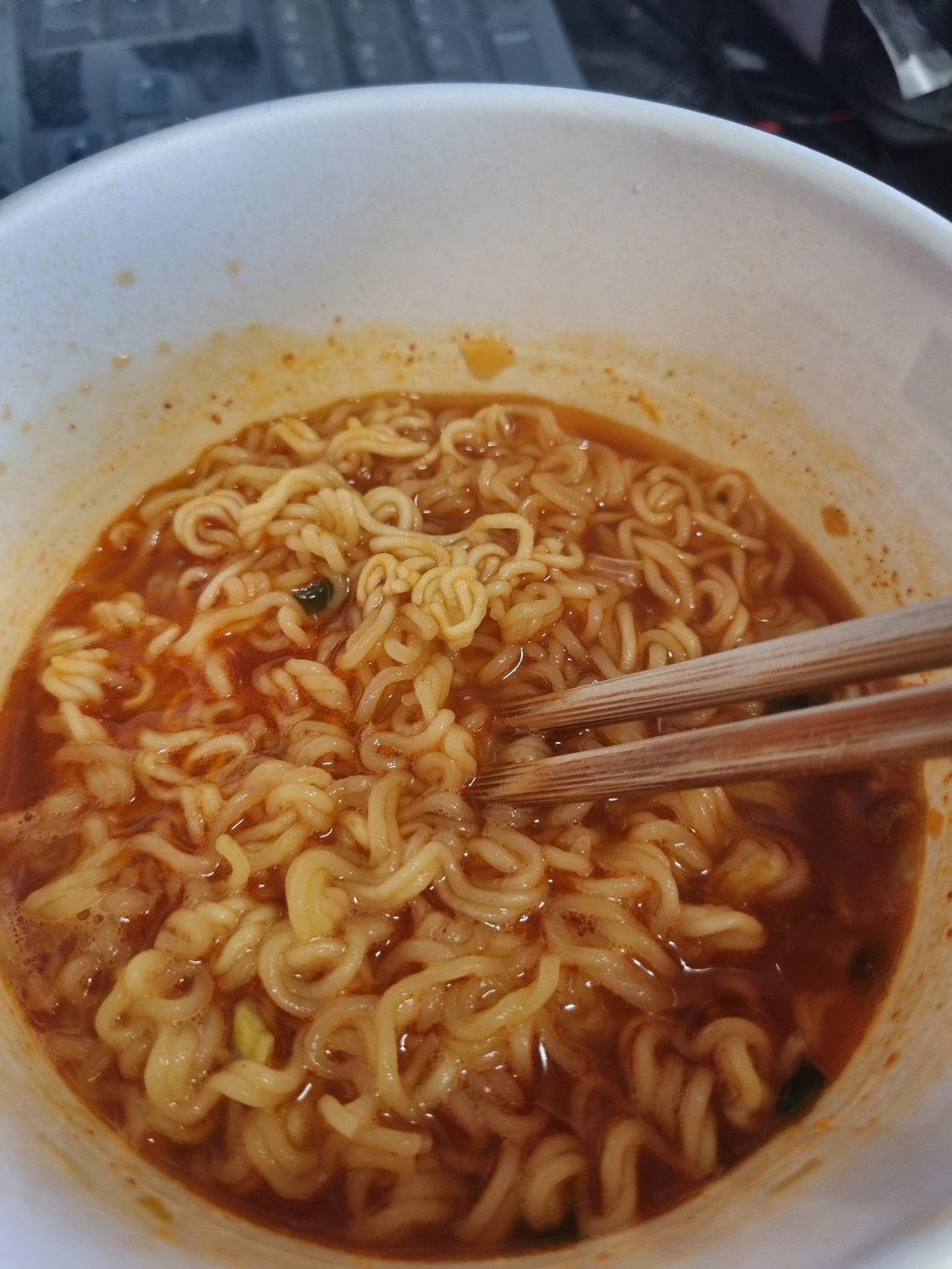
One practical note: the lid says 2 minutes 30 seconds in the microwave. Two minutes was better. The extra thirty seconds pushed the noodles past where we wanted them.
The part that actually matters: the ham tastes like fish
In both products, the pink “ham” pieces taste faintly of fish cake rather than of pork. We noticed it in the bag version and could not explain it. The cup version explains it, because its label is more specific.

The cup lists its pink pieces as a “meat-ham flavoured flake”, and inside that component the ingredients include frozen surimi — minced fish paste, the same base material as Korean fish cake. It is not imitation ham with a fishy aftertaste. It is partly fish, and the label says so.
This is not a trick by one brand. Korean food standards define a category called honhap soseji (mixed sausage) which may contain under 20% fish meat, and pressed ham blended with fish meat is also permitted within limits. The pink sausage Koreans grew up finding in school lunchboxes belongs to this family. Fish cake and pink sausage start from overlapping raw materials.
So if you bite into Korean instant army stew and think “that is not ham, that is fish cake” — you are not imagining it, and you are not being fussy.
If you avoid fish or shellfish, read this bit
The bag version carries a long allergen line: wheat, soy, egg, milk, beef, pork, chicken, tomato, squid and shellfish including oyster and mussel. Underneath, separately, it warns that buckwheat, shrimp, crab, mackerel and peanut may be present.
| Korean label term | What it means |
|---|---|
| 함유 (contains) | It is an ingredient |
| 혼입가능 (may contain) | Made on shared equipment — cross-contact, not an ingredient |
Those two lines are not the same thing, and if you have a serious allergy the second one matters as much as the first.
There is a sharper trap here. In Korea the mandatory allergen list names mackerel specifically, not fish in general. So a product can contain surimi without “fish” appearing in the allergen line at all. If you cannot eat fish, the allergen summary is not enough — you have to read the full ingredient list. We could not determine from the bag label alone whether its squid and shellfish come from the sausage flakes or from the soup powder.
Two other things on the label
Sodium: 1,790mg in one packet, 90% of a day. Drink the broth and that is effectively your daily allowance in one sitting. Saturated fat is 47%. Protein, on the other hand, is 15g — high for instant noodles, and you can taste where it comes from.
And there is eggshell powder in the noodles. That is why the calcium figure is unusually high for a ramyeon, and it is one reason egg appears in the allergen line — which surprises people who assume egg in instant noodles means a flavour sachet.
Which one, and for whom
| Bag (Ottogi) | Cup (Odeng Sikdang) | |
|---|---|---|
| Tastes of | Ham, heavy and savoury | Kimchi, mild |
| Kimchi sourness | Almost none | Leads the bowl |
| Best used as | A stew base to build on | A quick cup on its own |
| Needs a pot | Yes | No |
| Worth it alone | Not really | Yes, for what it is |
- Want to cook something: buy the bag, add ham, sausage, tofu, bean sprouts and old kimchi. It is a good stew base and that is its real job
- Want a cup at midnight: the cup is fine, but expect kimchi noodles rather than army stew
- Avoid fish or shellfish: read the full ingredient list, not the allergen line
- Watching sodium: do not drink the broth
Army stew is worth eating properly at a restaurant too — it is on our guide to Korean pork dishes, and if you would rather have it brought to you, delivery works for this one.
The allergen terms used here are listed in full on the Korean Restaurant Card.