
What Is It? · Busan · Part 3
A cold noodle invented because the right flour had run out — in a neighbourhood that used to be a cattle shed.
Part 3 of a series on what to actually eat in Busan. Overview: What to Eat in Busan — and What to Skip. Previous: Part 2 — Dwaeji Gukbap.
Korea has several cold noodle dishes. This is the one Busan invented and the one Busan actually eats — and I want to be straight with you in the first line, because a lot of guides are not: you can get milmyeon outside Busan. What Busan gives you is the origin, the density and the price.
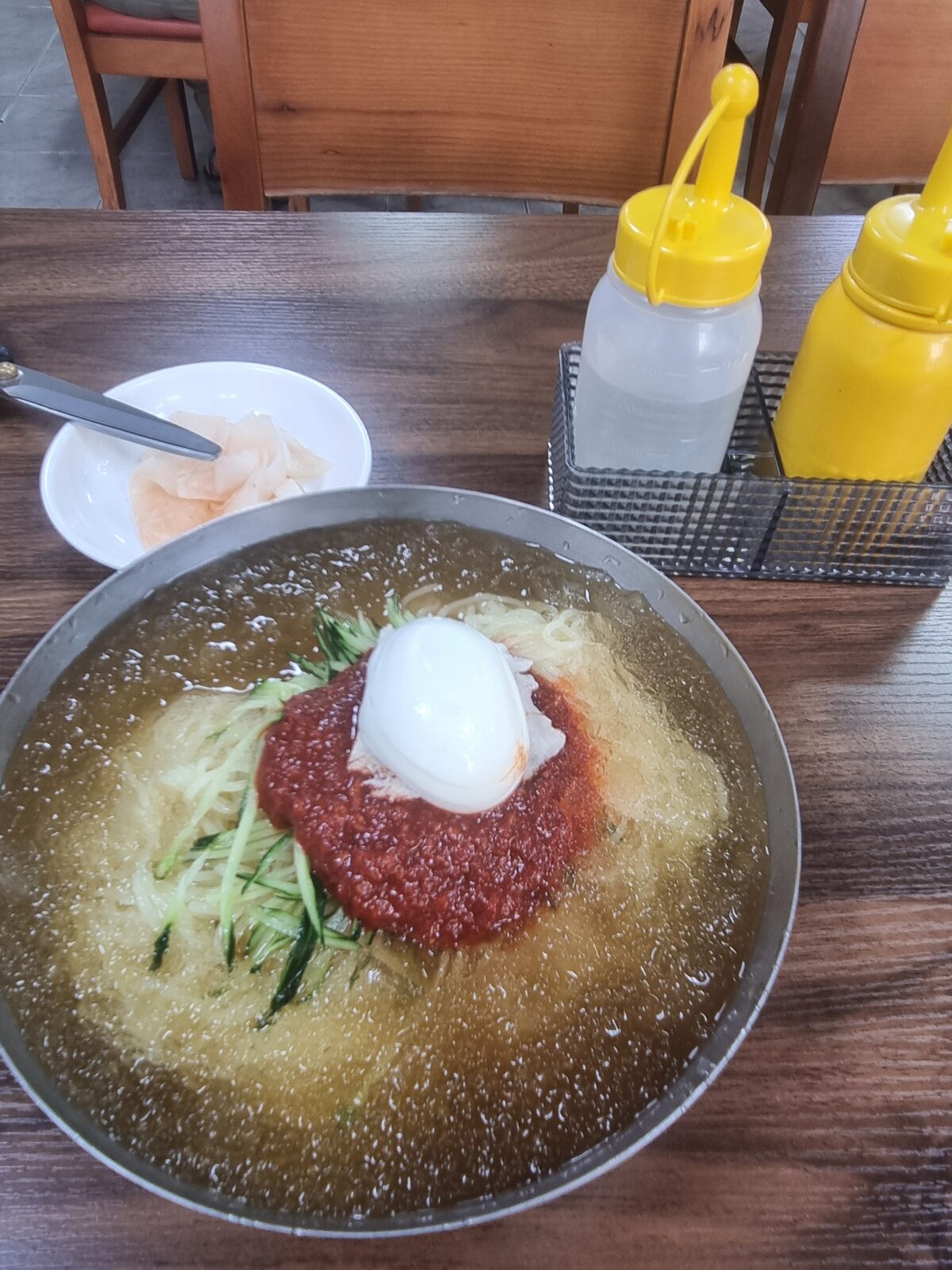
Milmyeon is a bowl of chewy wheat-and-starch noodles in an ice-cold broth, with a few slices of boiled pork, half a boiled egg, a wedge of pickled radish and a spoonful of red seasoning paste on top. It costs seven to nine thousand won. In August, in Busan, it is close to a public utility.
Its name is a confession. Mil means wheat; myeon means noodle. It is called “the wheat one” because it is the substitute.
All dollar figures use ₩1,340 = US$1, the rate in September 2026.
What it’s a substitute for
The dish it replaced is naengmyeon — the famous cold noodle of Pyongyang and Hamhung, in what is now North Korea. Real naengmyeon is made with buckwheat, and it is a northern dish because buckwheat is a northern crop.
When the war pushed hundreds of thousands of northerners down to Busan, the people who knew how to make naengmyeon arrived. The buckwheat did not.
What did arrive, in enormous quantities, was American relief wheat flour.
| The problem | Wheat noodles go hard and claggy when you chill them. Cold noodles have to survive ice water |
| The fix | Cut the wheat flour with starch |
| The result | ⭐ A noodle that stays springy when cold — and is far chewier than the buckwheat original |
The workaround turned out to be its own thing. Milmyeon does not taste like a failed naengmyeon. It has a bounce that buckwheat cannot produce, and Busan has spent seventy years preferring it.
⭐ Where it started, and why the address matters
The first shop is still open. It is called Naeho Naengmyeon — note that it still has the old word in its name — and it is in Uam-dong, a working port neighbourhood in the south of the city. It began selling milmyeon in 1959, run by a family that had come down from the north.
The neighbourhood is the part worth knowing.
Under Japanese rule, Uam-dong held the largest cattle quarantine station in Korea — a facility built to inspect Korean cattle before shipping them to Japan. Nineteen long sheds, forty-odd buildings, 1,400 to 1,600 head of cattle at a time.
After liberation, and then during the war, the sheds filled up with people. Refugees were housed in them, alongside tents and shacks. Families divided the stalls with cloth.
The area is still called 소막마을 — somak maeul, “cattle-shed village.” Some of the houses are now protected as national heritage, because they are still standing and people still live in them. Korea’s first bowl of milmyeon was sold two streets away
You do not have to go there to eat this. But it explains the dish better than any description of the broth will.
The broth is the part nobody expects
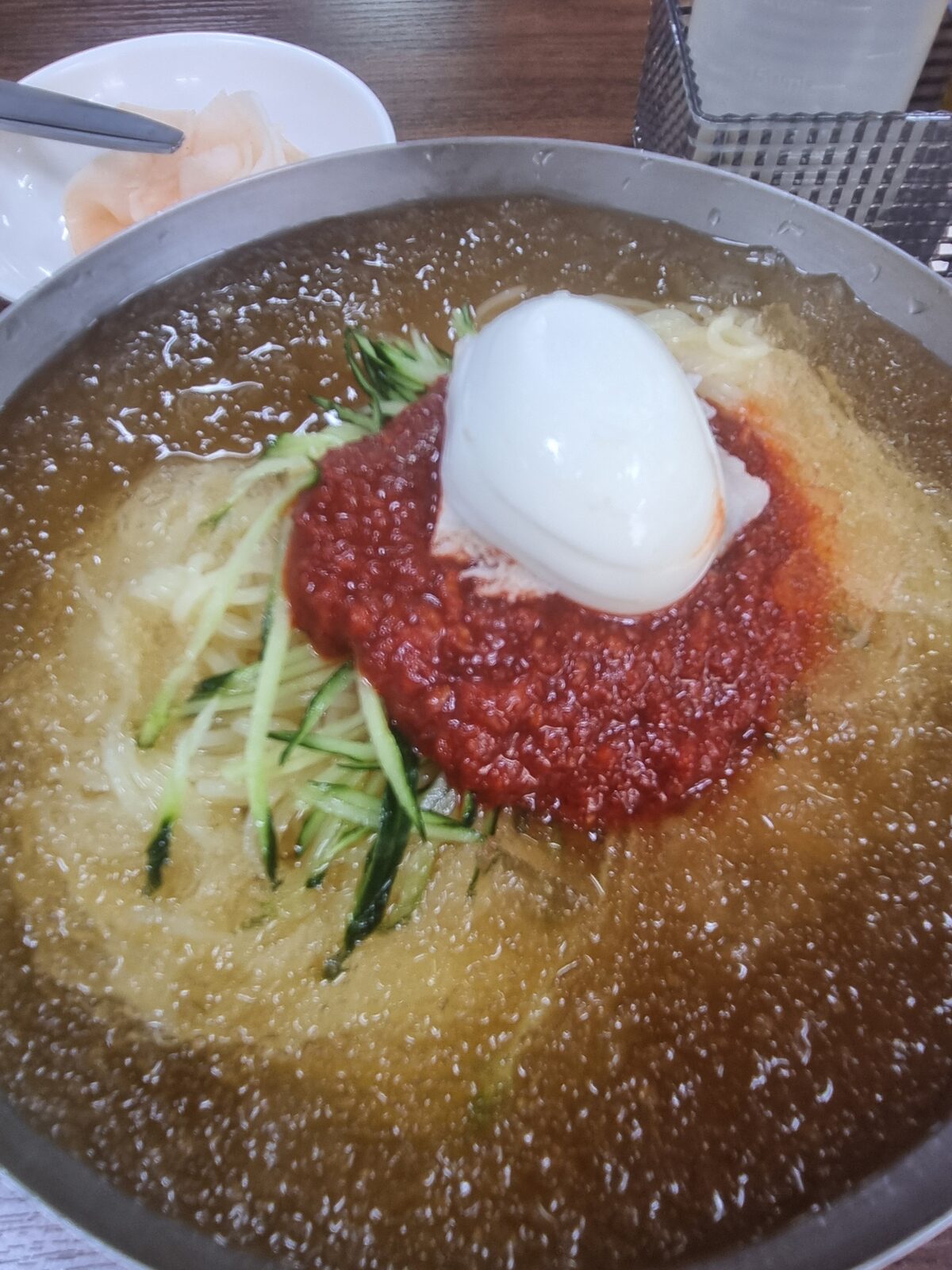
Milmyeon broth is made from bones — pork, beef, sometimes chicken — simmered and then chilled hard. That part is ordinary.
The part that is not ordinary: most shops also steep medicinal herbs in it. Cinnamon, liquorice root, ginger, jujube, and whatever else the family has been using since the 1960s. Every shop guards its own combination.
So the first sip is confusing in a good way. It is cold, faintly sweet, savoury underneath, and carries a warm spiced note that has no business being in an ice-cold soup. If you have had Vietnamese phở and noticed the cinnamon in it, it is that surprise, served cold.
How to order — two versions, and a trap
| What to say | What arrives |
|---|---|
| 물밀면 mul-milmyeon (or just 밀면, milmyeon) | ⭐ Noodles in the cold broth. Start here. |
| 비빔밀면 bibim-milmyeon | No broth in the bowl — the noodles come coated in a sweet-hot red sauce, and a cup of hot broth arrives on the side to drink |
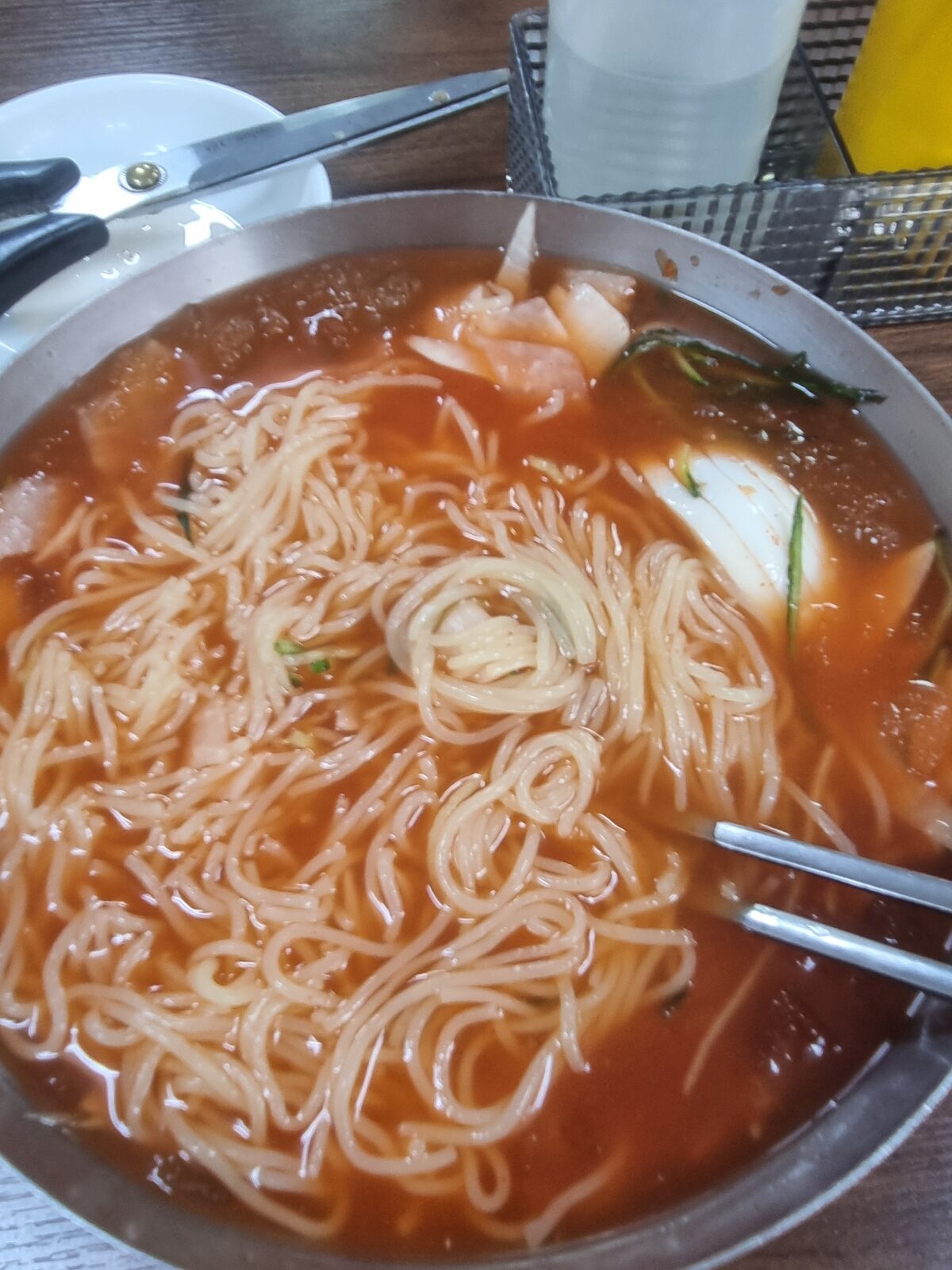
⚠️ The trap, if you already know naengmyeon: a bowl of mul-milmyeon arrives with a spoonful of red seasoning paste already sitting on top. Mul-naengmyeon does not. So the “watery” version here is not the plain version — it is mildly seasoned by default. If you want it clean, ask for the paste on the side; if you want it hotter, stir it all in.
The heat level is low either way. Bibim is sweeter and hotter; mul is a 1 out of 5 at most.
The scissors
A pair of kitchen scissors will be brought to your table, or will already be in the cup with the chopsticks. They are for the noodles.
Milmyeon noodles are genuinely tough — that is the starch doing its job — and they are served in one long tangle. Cutting them once or twice through the middle of the bowl is completely normal and nobody will think less of you. If the server offers to do it, say yes.
⭐ Water, broth and coffee are self-service
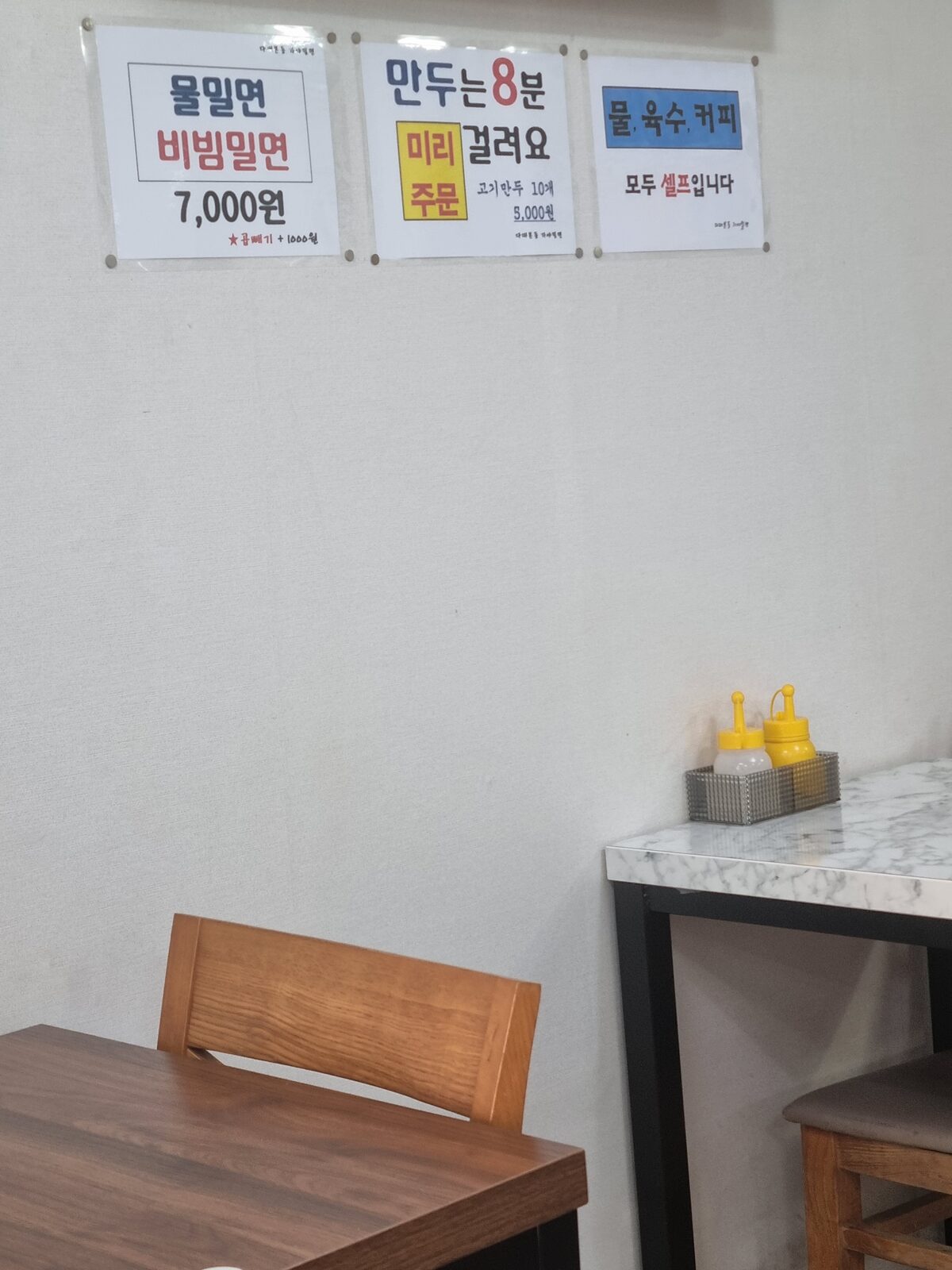
Most milmyeon shops put a sign on the wall saying 물·육수·커피 모두 셀프 — water, broth and coffee, all self-service. Nobody is going to bring them to your table, and nobody is being rude. There is usually a station by the wall with cups, a water jug, a broth urn and an instant-coffee machine.
⭐ The broth urn is the one to know about. It is the same chilled bone broth that is in your bowl, and you can drink as much of it as you like for nothing. In August that is the best free thing in the city.
The vinegar and mustard
Two squeeze bottles usually sit on the table: vinegar and Korean mustard oil (gyeoja, sharp and sinus-clearing rather than hot on the tongue). Both go into the broth, not onto the noodles, and a half-turn of each is plenty. The vinegar in particular is what makes the broth taste like summer instead of like stock.
⭐ Milmyeon vs naengmyeon — almost everything is the same except the noodle
Across most of Korea, “cold noodles” means naengmyeon. In Busan it does not. Here the default cold bowl is milmyeon, and naengmyeon is the one you have to go looking for.
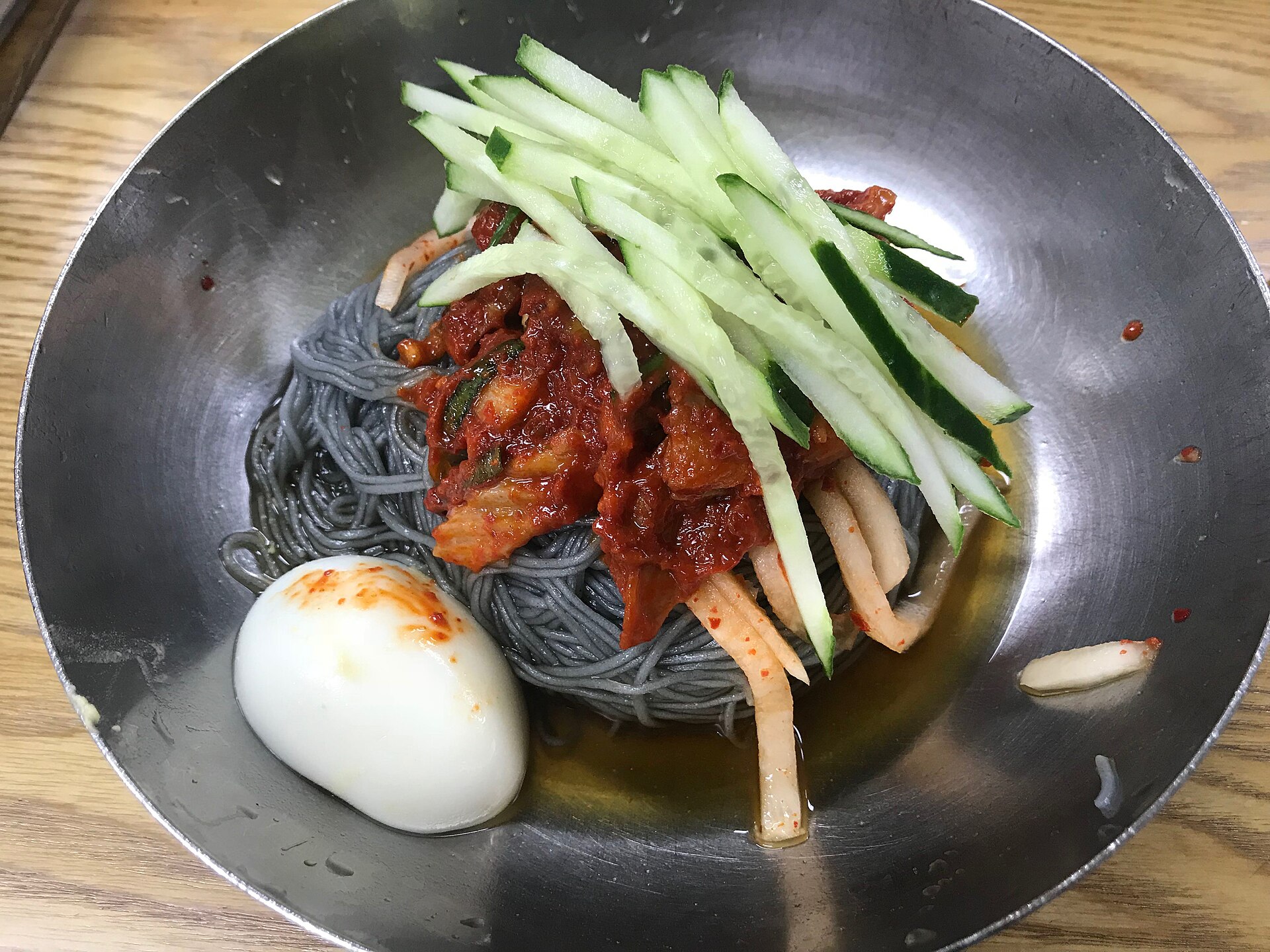
Put the two bowls side by side and the honest finding is this: the broth, the garnish and the seasoning are close enough that most people would struggle to separate them. What actually differs is the noodle. Everything below follows from that one thing.

1. Thickness, and why it is not a small detail
Naengmyeon noodles are thin. Milmyeon noodles are noticeably thicker. That sounds minor written down, and it is not minor in the mouth:
- Chew. A thin strand gives way immediately. A thicker one has to be worked, so milmyeon spends longer in the mouth and registers as a heavier, chewier bowl.
- Fullness. Same bowl size, different feeling at the end. Milmyeon fills you up in a way naengmyeon does not, which is exactly why Busan treats it as a whole meal in summer rather than a finisher.
If you have had naengmyeon and found it slightly thin as a meal, milmyeon is the version of that bowl with the texture problem solved.
2. The buckwheat question — and what Korean dieters do with it
Naengmyeon noodles contain buckwheat (memil, 메밀). Milmyeon noodles are wheat — the name says so. Out of that single ingredient difference comes a whole reputation: naengmyeon is widely treated in Korea as the healthier of the two.
Worth being straight about it: commercial naengmyeon is not pure buckwheat — starch and wheat are normally in there too, and in practical nutritional terms the gap between the two bowls is much smaller than the reputation suggests. We have not found a published analysis that quantifies it.
⭐ But the perception is itself a fact worth knowing. Korean dieters take a small ingredient difference very seriously, and naengmyeon benefits from it. If someone in Korea picks naengmyeon over milmyeon “because it is lighter,” this is the reasoning you are hearing — not a measurement.
3. Price goes the other way
Naengmyeon generally costs more than milmyeon. Not dramatically, but consistently enough that in Busan milmyeon is the cheaper cold bowl as well as the more common one.
Shops set their own prices and they move, so read the board rather than a number from us. The point to carry is only the direction: cheaper noodle, bigger bowl feeling, and it is the local one.
⭐ 4. After grilled meat, Koreans order naengmyeon — not milmyeon
This is the detail that tells you how Koreans actually rank the two, and almost no English write-up mentions it.
At a Korean barbecue table, the meal traditionally ends with a cold noodle bowl. That bowl is naengmyeon, essentially always. Milmyeon shops and barbecue restaurants barely overlap, even in Busan where milmyeon is everywhere.
Why? The likely reading — and we are presenting this as an explanation rather than a documented fact — is the same thickness point from the top of this section. After a table of grilled pork or beef, a thin buckwheat noodle in cold broth lands as a rinse. A thicker wheat noodle lands as a second meal, and nobody wants a second meal at that moment.
Practical version for a visitor:
- Eating cold noodles as lunch, in Busan → milmyeon. That is the local answer and the cheaper one.
- Finishing after grilled meat → naengmyeon, and the restaurant will already have it on the menu.
More on choosing between the mul and bibim versions of either: mul or bibim, decided. For where both sit among every other cold noodle in Korea, see the cold noodles guide.
Vegan, Vegetarian, Halal
| Diet | Suitable? | Why |
|---|---|---|
| Vegan | ❌ Usually not | The broth is typically beef or pork based |
| Vegetarian | ❌ Usually not | Same reason — the noodles are fine, the broth is not |
| Halal | ❌ Not certified | Broth composition varies by shop and is rarely disclosed |
⚠️ Broth recipes differ between shops and most will not have an ingredient list. If this matters to you, ask before ordering — and expect the answer to be uncertain.
⚠️ Allergens and restrictions
| Gluten | ⚠️ Yes, by definition. The noodle is wheat. This is the one dish in the series where that is the whole point |
| Pork | ⚠️ Usually. The broth is typically pork or mixed bone, and the slices on top are boiled pork. Some shops use beef only — you would have to ask |
| Halal | ❌ Assume no |
| Vegetarian | ❌ No. Bone broth |
| Egg | Half a boiled egg is standard. Easy to leave |
| Fish | ⚠️ The red paste sometimes contains fish sauce |
| Spice | Mild. Ask for the paste on the side if you want none |
⚠️ Can you get it outside Busan? Yes — so here’s the real argument
Plenty of English-language guides tell you milmyeon exists only in Busan. That is not true, and you should hear it from me rather than find out later.
| Where else | What’s actually there |
|---|---|
| Seoul | Dining Code lists 78+ milmyeon restaurants in Seoul, several run by Busan families for thirty years |
| Rest of Korea | Over 100 shops trade under the “Gaya Milmyeon” name nationwide. Gyeongju has its own long-running one |
| Supermarkets | CJ sells a packaged “Busan milmyeon” in Korean supermarkets; frozen versions ship anywhere in the country |
| ⚠️ Abroad | Korean grocery chains in the US stock it. If you live near one, you could buy milmyeon today without leaving your city |
So why eat it here? Not scarcity. Four better reasons:
| Price | ₩7,000–9,000 here. Seoul shops charge more, and a packet is not a shop |
| Density | In Busan you walk past one. Anywhere else you make a trip |
| The shops | Places here have made this and almost nothing else since the 1950s |
| ⭐ Season | A Busan milmyeon shop at 1pm in August is a specific thing. The queue is part of it |
⭐ This is the honest version of “you can only get it in Busan,” and I think it’s the better reason to go. You are not buying something rare. You are buying the cheapest good version of it, in the city that made it up.
What it costs — and why the range is the information
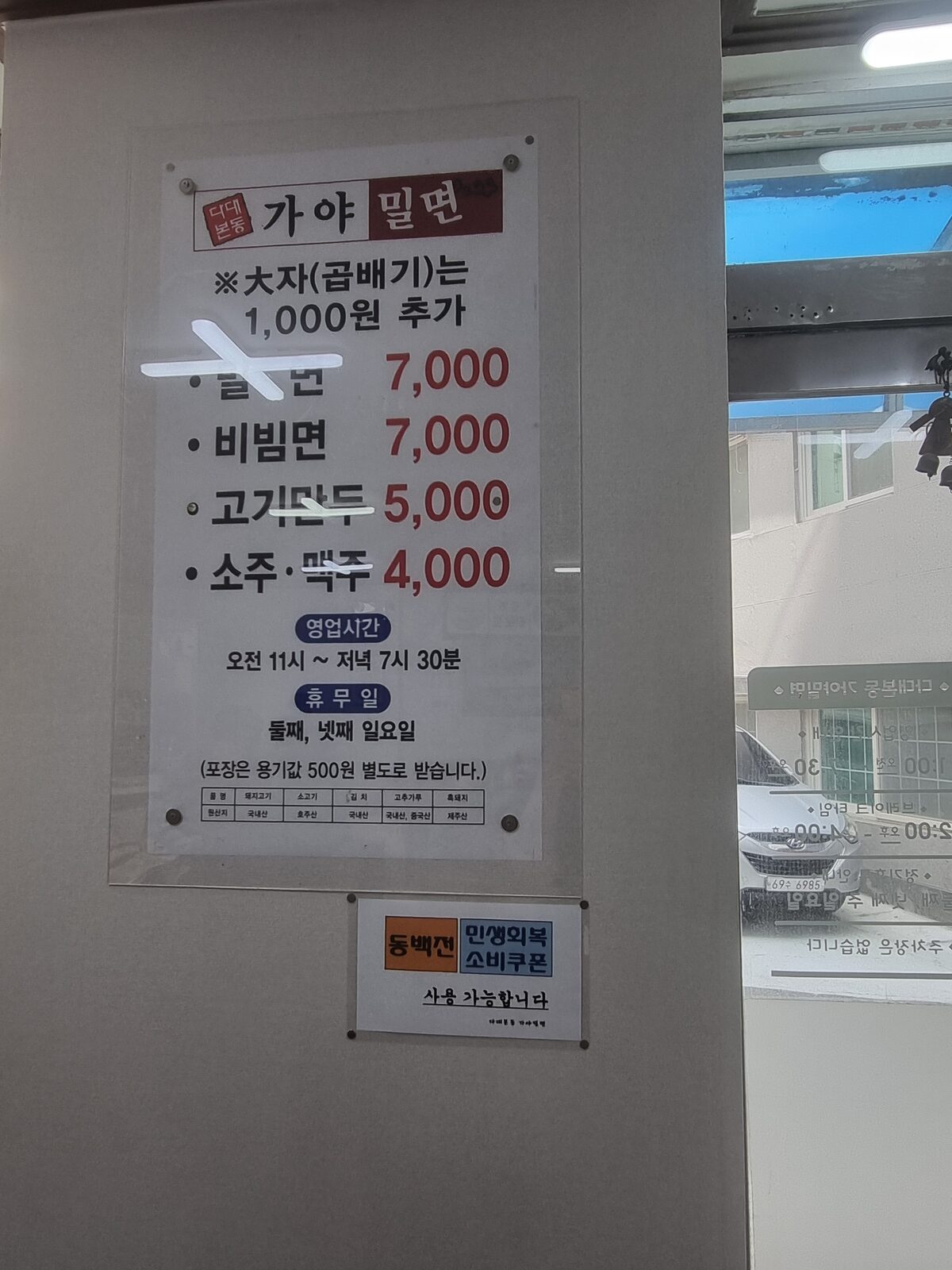
₩7,000 to ₩9,000, and the spread is real. Two shops in the same district can be two thousand won apart.
| ₩7,000 | ⭐ A genuinely good price in 2026. If you see it, that shop is not gouging anyone |
| ₩8,000 | Normal |
| ₩9,000 | Tourist districts, famous names, air-conditioned dining rooms |
| Large portion (gopbaegi, 곱빼기) | +₩1,000 at the shop above. Worth it — standard portions are modest |
⭐ One more thing on that menu board, because it is what this site is for. Korean restaurants are required to print a country-of-origin table, usually in small type at the bottom. The shop above declares pork and kimchi as Korean, chilli powder as Korean and Chinese, and beef as Australian. None of that is hidden — it is just in Korean, in six-point type, where nobody looks.
Prices checked on the ground in Busan, September 2026. Note that the ₩9,000 bowl is not better than the ₩7,000 bowl in any way you can taste. You are paying for the address.
When to eat it
It is sold all year, but it is a summer dish, and Busan summers are brutal — humid, coastal, in the mid-thirties. Between June and September the queues outside milmyeon shops at one in the afternoon are a genuine feature of the city.
What milmyeon shops actually sell alongside the noodles is mandu — and in most shops that means steamed dumplings rather than fried. If you want more than noodles on the table, that is the order. Boiled pork (suyuk) is a dwaeji gukbap dish, not a milmyeon one. Busan is known for both the cold noodle and the pork soup, but they are separate restaurants — do not expect one shop to serve you both.
From someone who eats this
Written by the person who runs this site — Korean, living in Busan.
The noodle is the difference, and almost nothing else is
Naengmyeon noodles are thinner, and a great many of them are made with buckwheat. Milmyeon noodles are wheat — thicker, and they bite back. The broth, the toppings, the mustard and vinegar on the table: most of it is close enough that you would not separate them on taste alone.
Put the two bowls side by side and what divides them happens in your teeth. Calling milmyeon “the Busan version of naengmyeon” makes it sound like a regional seasoning. It is not. It is a different texture.
I do not queue for it
In summer the well-known shops have a line outside. I walk to a different one. There are enough milmyeon shops in Busan that waiting is a choice rather than a requirement — and if the second shop is also full, then fine, I wait. But the first move is always to leave.
If you came to Busan to eat at one particular famous shop, that is a different trip. If you came to eat milmyeon, go to the one without the line.
One bowl is the whole meal
I order milmyeon and nothing else. I am not a big eater, and by the time the broth is gone the bowl has filled me completely. Shops will happily sell you steamed dumplings alongside and plenty of people order them — I do not.
If you are judging the portion from a photograph, it is larger than it looks.
Verdict
Both of these noodles have travelled. Naengmyeon is in Seoul, Los Angeles and Tokyo; milmyeon is in Seoul and in the freezer aisle. The difference is which one is cheap, everyday and three minutes away from where you are standing — and in Busan, in summer, that is this one, at seven thousand won.
If you are here in summer, this is not optional.
| ← Part 2 | Dwaeji Gukbap — Busan’s Pork Soup |
| ↑ Overview | What to Eat in Busan — and What to Skip |
| Next → | Part 4 — Bibim Dangmyeon (coming) |
Want a specific shop? I’ve reviewed Gaya Milmyeon in Dadae-dong — a ₩7,000 bowl, with directions, hours and what the menu board actually says.
Also worth reading: Three Busan Dishes the Port Created — pork soup, raw fish and grilled hagfish side by side, with what changes from shop to shop and which charges land on your bill.