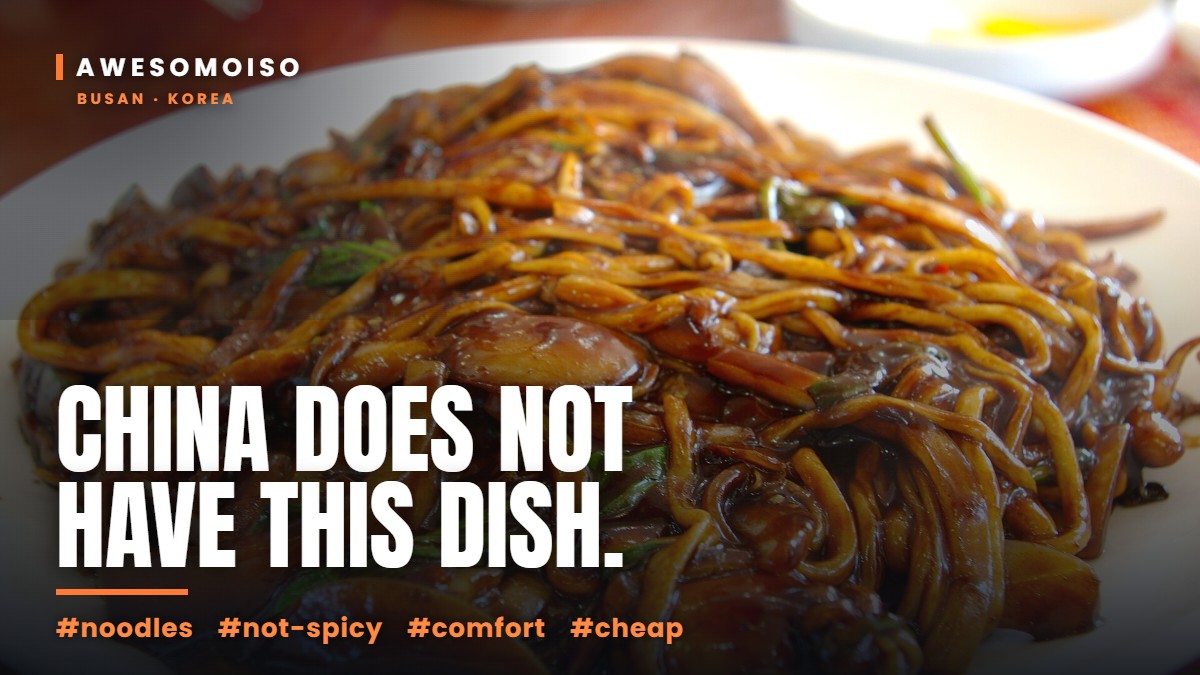
Ask where to eat Chinese food in Korea and you will be sent to a junggukjip (중국집) — literally “Chinese house”. The sign says Chinese. The menu says Chinese.
Order the most popular thing on it and you will get a dish China does not serve.
It arrived at a port, with dock workers
Incheon opened as a treaty port in 1883, and a Chinese settlement formed there the following year. Migrants from Shandong settled in, and the noodles came with them — wheat noodles tossed with a fried fermented paste, quick and filling, the kind of thing a dock worker eats standing up.
What they ate then was not what you will eat now. It was brown rather than black, and it leaned salty and savoury rather than sweet.
The restaurant most often named in this history is Gonghwachun in Incheon’s Chinatown, usually given as opening in 1905 and widely described as the birthplace of jjajangmyeon. Sources disagree on the opening year and on when it took that name, and no record settles who first made the dish — it was not one person’s invention. The old building now houses a Jjajangmyeon Museum, which you can visit.
The caramel — where it stopped being Chinese
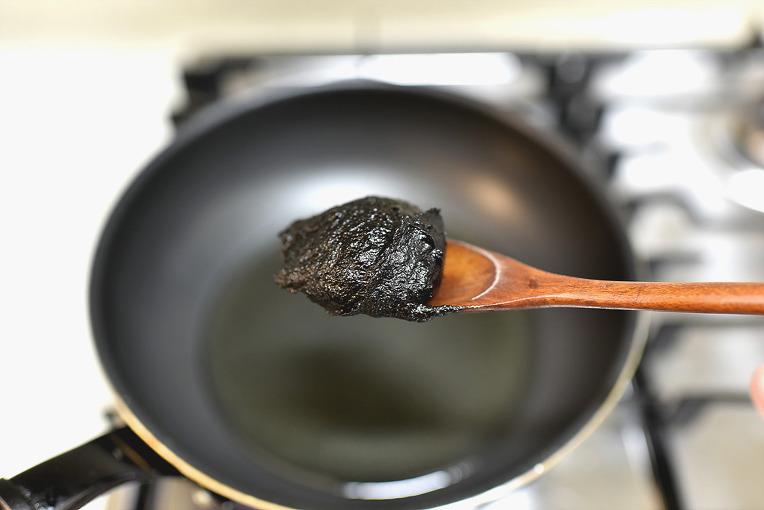
In the 1950s, a caramel-coloured version of the paste came into use. That is the hinge.
- Before: brown. Salty, savoury, fermented.
- After: black, glossy, and sweet enough that sweetness is the first thing you notice.
Nobody rewrote the method. They changed the paste, and the paste changed the dish.
China has zhajiangmian. Korea has jjajangmyeon. They are relatives, and they stopped being the same dish somewhere in the 1950s, in a jar.
What chunjang actually does
Chunjang (춘장) is a fermented soybean-and-wheat paste, and blends differ by brand. It is doing four jobs at once:
- Salt — the fermented saltiness anchors the whole sauce.
- Umami — depth that only comes from fermentation.
- Toasted aroma — which only appears once the paste is fried in oil.
- Colour and body — the near-black gloss.
The frying is where shops separate themselves. Raw chunjang is harsh; oil rounds it off. But too hot or too long and it turns bitter, and you can taste that immediately. A good bowl smells toasted. A careless one tastes burnt.
Why it became everyone’s food
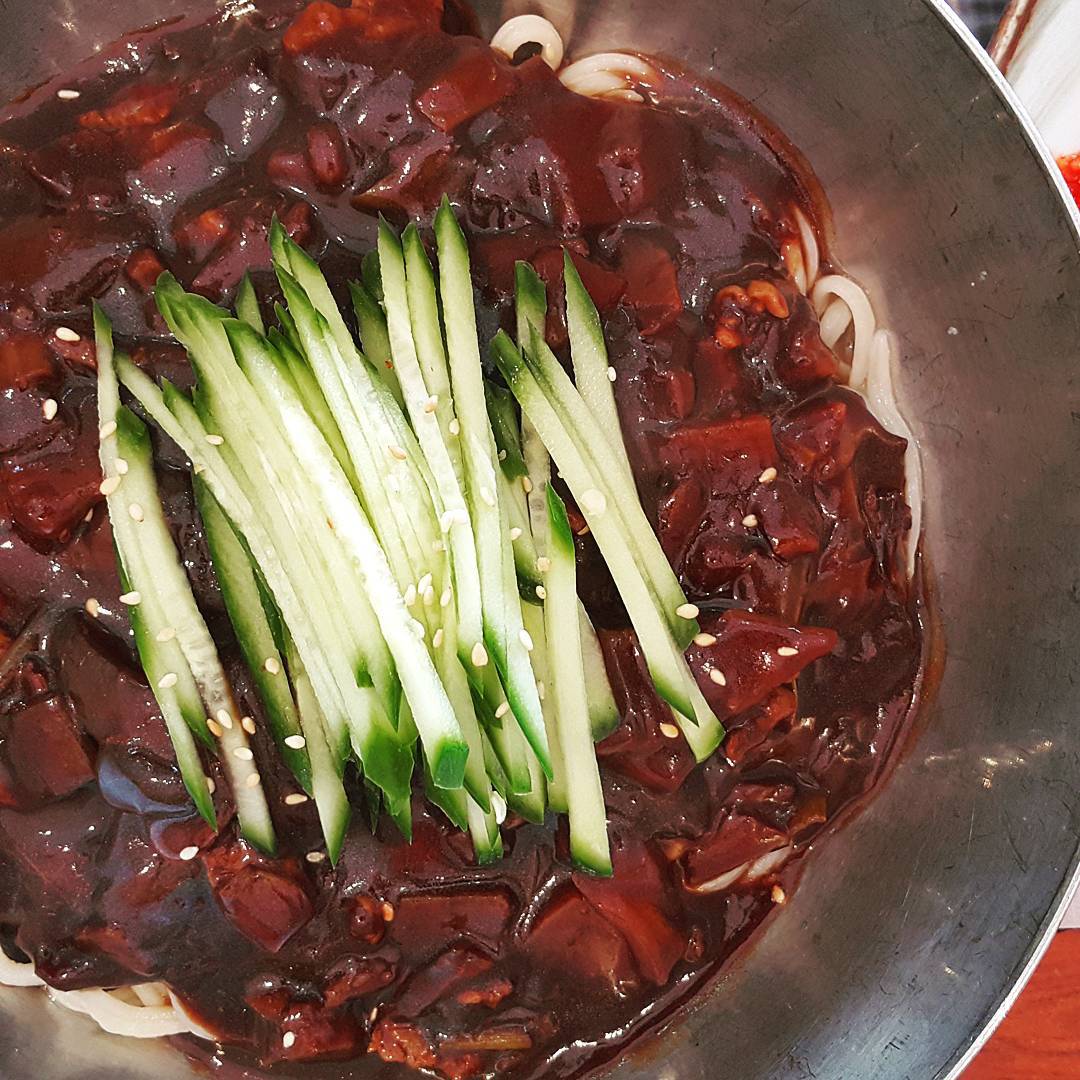
After the Korean War, wheat flour supply expanded and flour-based food spread with it. Through the 1960s a government campaign promoted flour dishes, onion production grew, and pork supply shifted. All of it landed in the same bowl.
But flour alone does not explain it. Four things had to line up:
- Noodles fill you up cheaply.
- Chunjang gives the sauce a flavour strong enough to carry a whole meal.
- Onion brings sweetness that makes the saltiness easy to eat.
- One recipe can produce many bowls, fast — which is the one that mattered commercially.
That fourth point is also why jjajangmyeon became an early anchor of Korean delivery culture. One bowl is a complete meal, the sauce holds, and a restaurant dish became something you ate at home and at the office.
Why it tastes sweet — three sources, not one
Visitors expecting something savoury are often surprised. The sweetness is layered rather than dumped in:
- Onion, cooked down far enough to turn sweet on its own.
- The chunjang itself, whose blend and seasoning vary by brand.
- Sugar the kitchen adds to balance the sauce.
Which is why no two shops taste the same. Three variables, each set by someone else. It is not true that all Chinese versions are salty and all Korean versions are sweet either — China has regional variation of its own.
Six things on the menu, not one
| Menu | Korean | Say it | What is different |
|---|---|---|---|
| Jjajangmyeon | 짜장면 | jja-jang-myeon | The standard. Sauce ladled over the noodles. |
| Ganjjajang | 간짜장 | gan-jja-jang | Stir-fried to order. More wok aroma, more bite in the onion. Sauce often served on the side. |
| Yuni-jjajang | 유니짜장 | yu-ni-jja-jang | Everything minced fine. Smooth, even sauce. |
| Yuseul-jjajang | 유슬짜장 | yu-seul-jja-jang | Ingredients cut into thin strips. Different chew. |
| Samseon-jjajang | 삼선짜장 | sam-seon-jja-jang | With seafood — prawn, squid. Costs more. |
| Jjajang-bap | 짜장밥 | jja-jang-bap | Same sauce, over rice instead of noodles. |
If you have only ever had jjajangmyeon, order ganjjajang once. It is the same dish cooked to order rather than ladled from a pot, and the difference is not subtle.
The one worth ordering if there are two of you
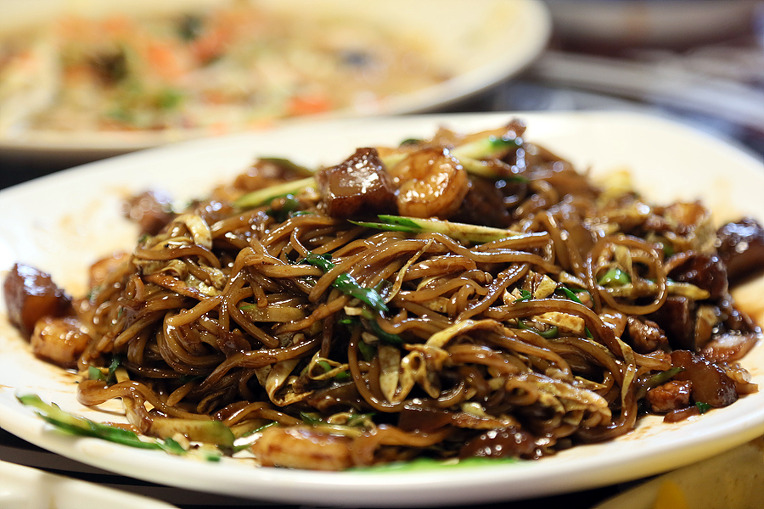
Jaengban-jjajang (쟁반짜장) arrives on one wide platter instead of in bowls. It carries considerably more in it than the standard version, and is usually portioned for two. You share it rather than each eating your own — which suits the way the rest of a Korean meal works.
And one you will not find by browsing
Hayan-jjajang (하얀짜장) is a pale version made without the black paste. It is not a menu option most places offer — it is a particular shop’s own recipe, and people travel to the shop that makes it rather than ordering it wherever they happen to be. Worth knowing the name exists; not worth expecting to see it.
The order Koreans actually place
There is a standard way to order, and nobody thinks about it: one bowl of jjajangmyeon per person, plus one plate of tangsuyuk for the table.
- The noodles are individual. Nobody shares a bowl.
- The sweet-and-sour fried pork goes in the middle and everyone picks at it.
- They cut against each other — heavy fermented sauce against sharp fried pork. That is the point of the pairing.
For a long time this was payday food. Two or three bowls and one plate of tangsuyuk was what a family ordered when eating out was still an occasion rather than a Tuesday. Plenty of Koreans can still tell you exactly what that felt like.
Tangsuyuk sits in our pork guide →
How to eat it
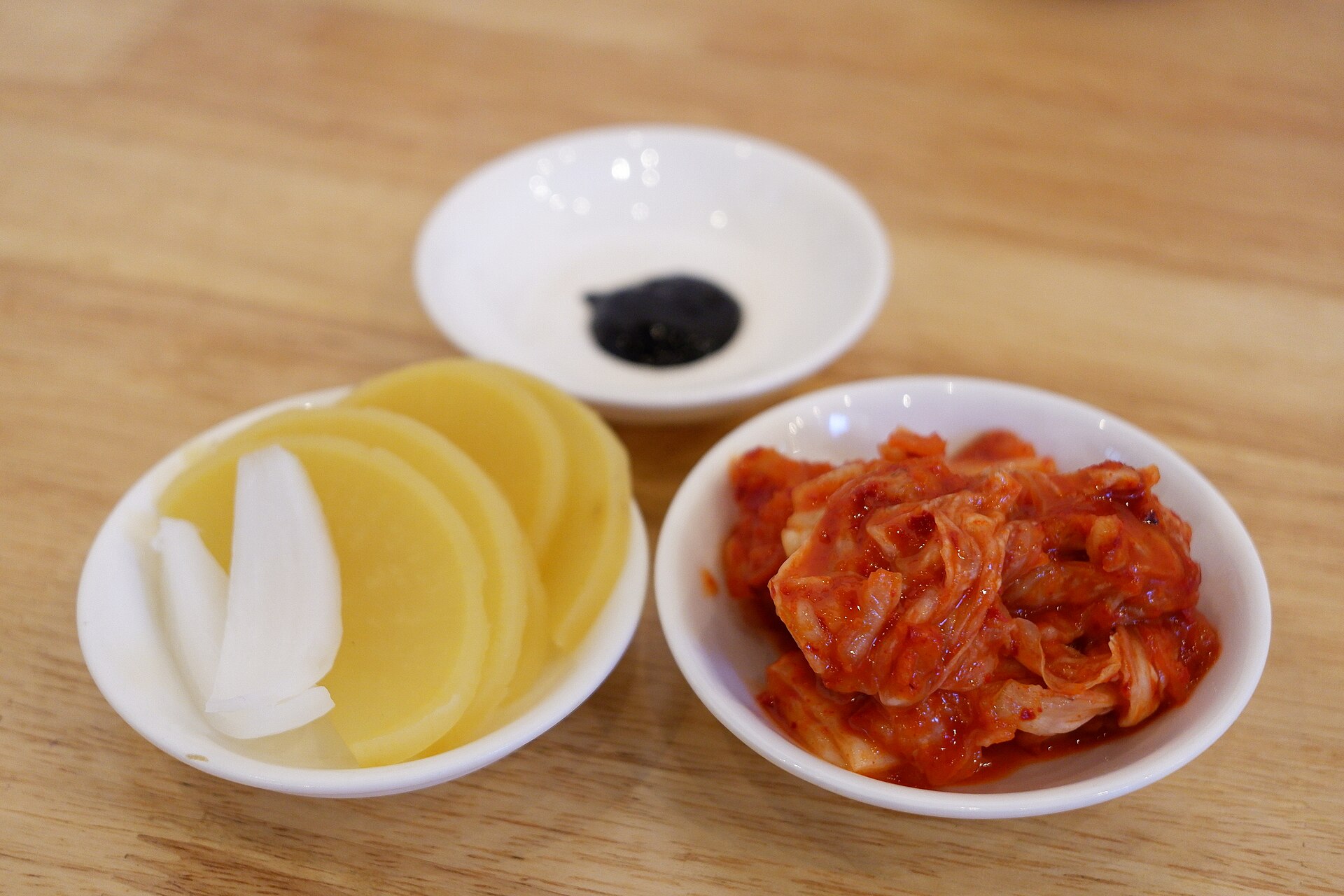
- Mix it first. The sauce sits on top of the noodles. Work it through with your chopsticks before the first bite.
- Eat the danmuji (단무지). The yellow pickled radish is there to cut the richness, and it is free and refillable — as is the raw onion, which you dip in the chunjang on the table.
- It is not spicy. Plain jjajangmyeon contains no chilli at all, which makes it one of the safest orders in Korea if you cannot take heat.
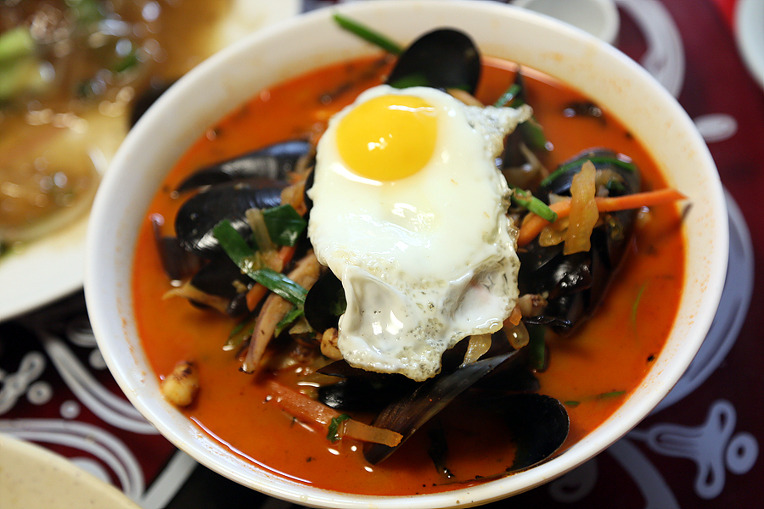
- Torn between this and jjamppong? They are opposites — jjamppong is a red, spicy seafood noodle soup. Some shops sell jjamjjamyeon (짬짜면), a split bowl with both.
Allergens
Wheat is in both the noodles and the chunjang. Soy is in the chunjang. The standard version is pork; samseon-jjajang is seafood. If you react to gluten or soy, this dish is not adaptable — the paste is the dish.
April 14th, and a graduation lunch
Jjajangmyeon is tied to specific days in Korean memory. Family lunch after a graduation or an entrance ceremony. Delivery eaten standing among boxes on moving day. In an era when eating out was rare, a bowl of this was a small celebration.
There is also Black Day, April 14th, when people who are single eat jjajangmyeon together. This is not a traditional holiday — it grew out of pop culture and commercial date-marking, and it is better described that way than as a custom with any age to it.
So is it Korean or Chinese?
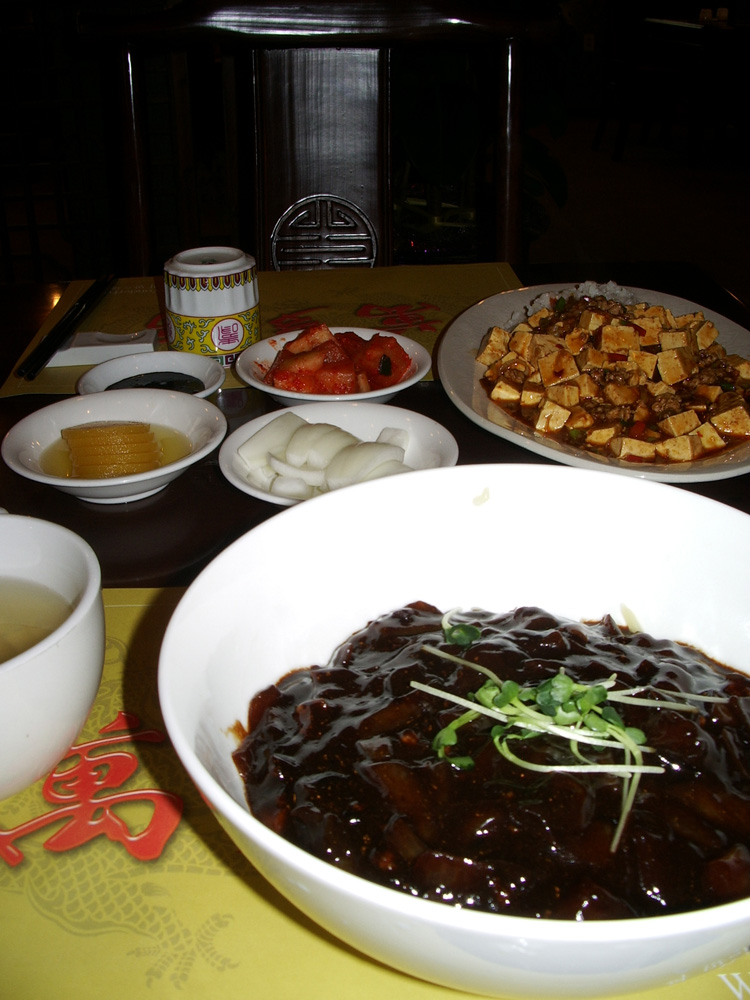
The honest answer needs both halves. The origin is Chinese. The dish grew out of an immigrant community in Incheon and then developed inside Korea’s own restaurant trade — the paste, the sweetness, the vegetables, the way it is served. Calling it Chinese food is wrong. Calling it traditional Korean food is also wrong.
The accurate term is Korean-Chinese cuisine, and it is a whole category rather than one dish.
Which brings us back to the junggukjip. It is not a restaurant serving food from China. It is a format that developed in Korea over more than a century, with a near-fixed menu built on three things: jjajangmyeon, jjamppong, tangsuyuk. Someone arriving from China and walking into one would not recognise half of it — which tells you most of what you need to know about what it is.
One last thing: 자장면 or 짜장면?
Both spellings are standard Korean. 자장면 was the official form; 짜장면 is how people actually say it, and it was accepted as an equally standard form in 2011. You will see both on signs and menus, and both romanisations — jajangmyeon and jjajangmyeon — in English. Same dish.
From someone who eats this
Written by the person who runs this site — Korean, living in Busan.
I order the plain one. Every time
Standard jjajangmyeon, not gan-jjajang. The reason is simple and unromantic: it is cheaper. Gan-jjajang is a better-made plate and I am not arguing otherwise — but this is a dish I eat because it is quick and costs very little, and paying more undoes part of the point.
And I just mix it. No loosening the noodles first, no arranging anything. The sauce goes through and I start.
⭐ One bowl, three stages
This is my own way of eating it and I have not seen it written down anywhere. It turns one bowl into three different bowls.
- Eat the first third plain. As it came. This is the sweet, dark, mild version everyone knows.
- Add chilli powder (고춧가루) and eat the next part. The sweetness drops back and the sauce gets a dry edge to it. Most tables have a shaker; if not, ask.
- Finish with a little vinegar (식초). It cuts the oil and lifts everything at exactly the point where a heavy bowl starts to feel heavy.
⚠️ Go carefully with the vinegar. This one divides people. Put in a very small amount, taste it, and only then decide — added at full confidence it can ruin the last few bites rather than save them.
Tangsuyuk: dipped, not poured
Always dipped. Korea has a long-running argument about whether the sweet-sour sauce should be poured over the fried pork (bueomeok) or served on the side to dip into (jjigeomeok). I am firmly on the dipping side.
The reason is the crust. Tangsuyuk is fried to be crisp, and sauce poured over it starts softening it from the moment it lands. Dipping means the last piece is as crisp as the first. If the crunch is the part you came for, ask for the sauce on the side.
⭐ How I judge the tangsuyuk itself
Two things are not a matter of taste. The rest is.
- No off-smell from the pork. The meat is cured and seasoned before frying, and that step is supposed to take any porky edge out of it. If you can smell the pig, something upstream went wrong — that is a fault, not a style.
- The meat should be tender. Tangsuyuk is normally made from loin, which is tender by nature, so tenderness is the baseline rather than a bonus. If it is chewy or tough, that points at the cut or at where the meat came from, not at the cooking.
Everything after that is preference, and both sides are good.
- Sauce — ketchup-based or soy-based. Shops do one or the other and I would not steer you; both are worth eating.
- Coating — and you do not need to ask about this one. The standard crisp batter is the default: if the menu just says 탕수육, that is what arrives. The chewy glutinous-rice version is always labelled as such — 찹쌀탕수육 (chapssal tangsuyuk). I like both.
Guobaorou (꿔바로우) belongs to that same chewy family and sits closer to the Chinese original. It is its own menu item rather than a variant of tangsuyuk, so if the chewy coating is what you are after, that is another way in.
So the test is narrow: smell it, then bite it. Clean and tender means the shop is doing its job. Sweet or savoury, chewy or crisp — that part is just which one you are in the mood for.
Copy-paste Korean
| What you want | Show this | Say it |
|---|---|---|
| Jjajangmyeon | 짜장면 | jja-jang-myeon |
| Stir-fried to order | 간짜장 | gan-jja-jang |
| The sharing platter | 쟁반짜장 | jaeng-ban-jja-jang |
| Sweet and sour pork | 탕수육 | tang-su-yuk |
| Half and half with jjamppong | 짬짜면 | jjam-jja-myeon |
| More pickled radish, please | 단무지 더 주세요 | dan-mu-ji deo joo-se-yo |
Where to go next
- Korean Pork, All 17 Ways — tangsuyuk and the rest
- What is free at a Korean restaurant — including the danmuji
- Korean Chicken Is Seven Dishes
- Korean Food Matcher — 13 questions, 84 dishes
Jjajangmyeon or jjamppong? Koreans have been arguing about this for decades. Tell us where you land in the comments.
2 thoughts on “Jjajangmyeon Is on Every Chinese Menu in Korea. China Does Not Have It.”