Quick verdict
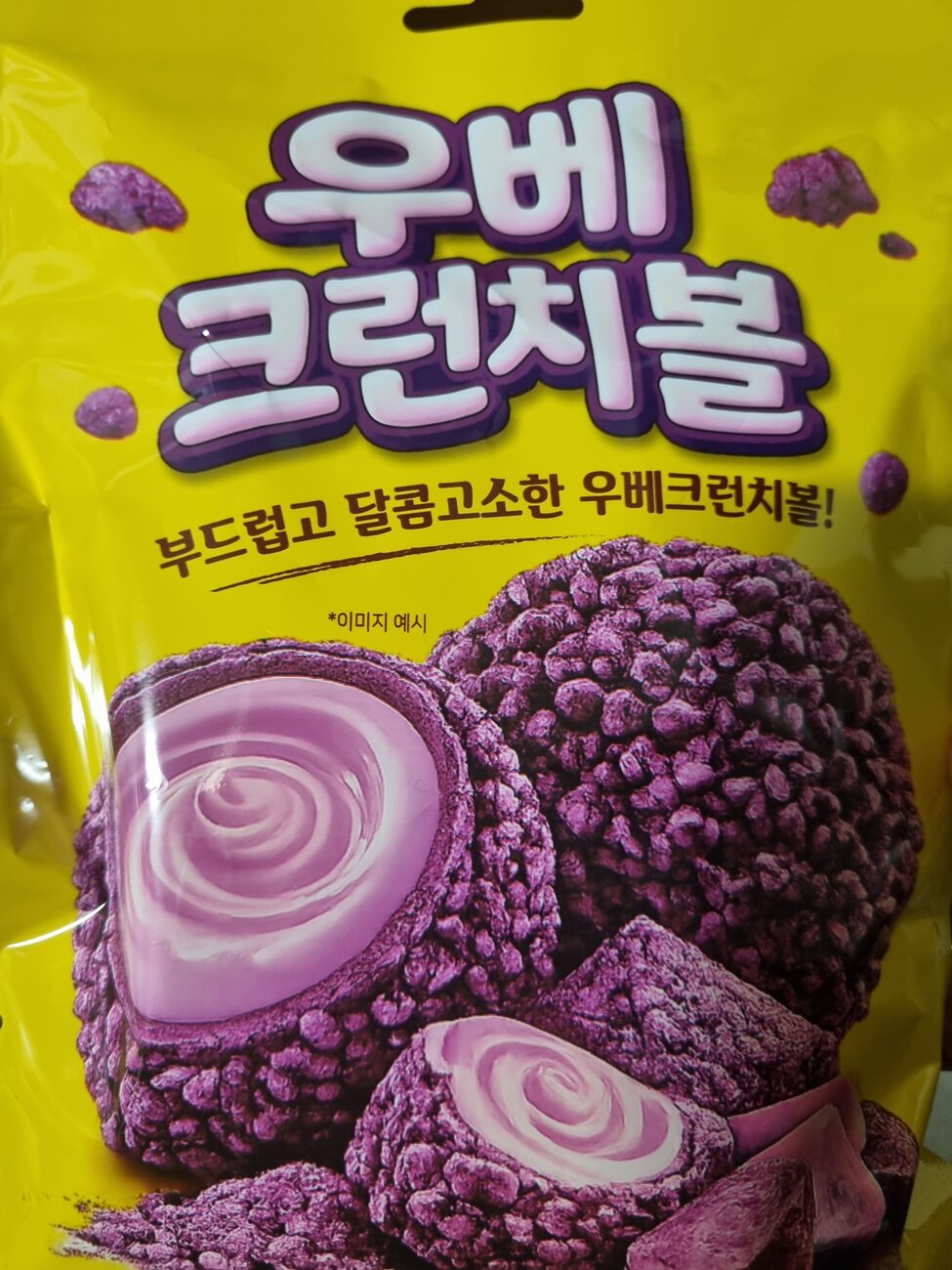
₩3,600 (about $2.70) at CU. Six chocolate-coated crunch balls, sold on the strength of one word: ube.
I bought it because I wanted to know what ube tastes like. I’ve had it now, and I still don’t.
What I got tasted like sweet potato. And when I read the label, I found out why — and something more interesting than the flavour.
The purple doesn’t come from the ube. It comes from two colourings mixed together. One of them is made from insects.
First — what is ube?
Ube is a purple yam from the Philippines. *Dioscorea alata.*
And here’s the thing most people get wrong.
Ube                  Dioscoreaceae family    a true yam
Purple sweet potato  Convolvulaceae family   a sweet potato
They are not related. Not closely, anyway — roughly as related as an apple and a pear.
They also don’t taste the same.
| Flavour | |
|---|---|
| Ube | nutty, with distinct vanilla and coconut notes. Very silky when cooked |
| Purple sweet potato | starchy, earthy, straightforwardly sweet. More fibrous |
Those vanilla-coconut notes are what make ube ube.
This product has none of them.
What it actually tastes like
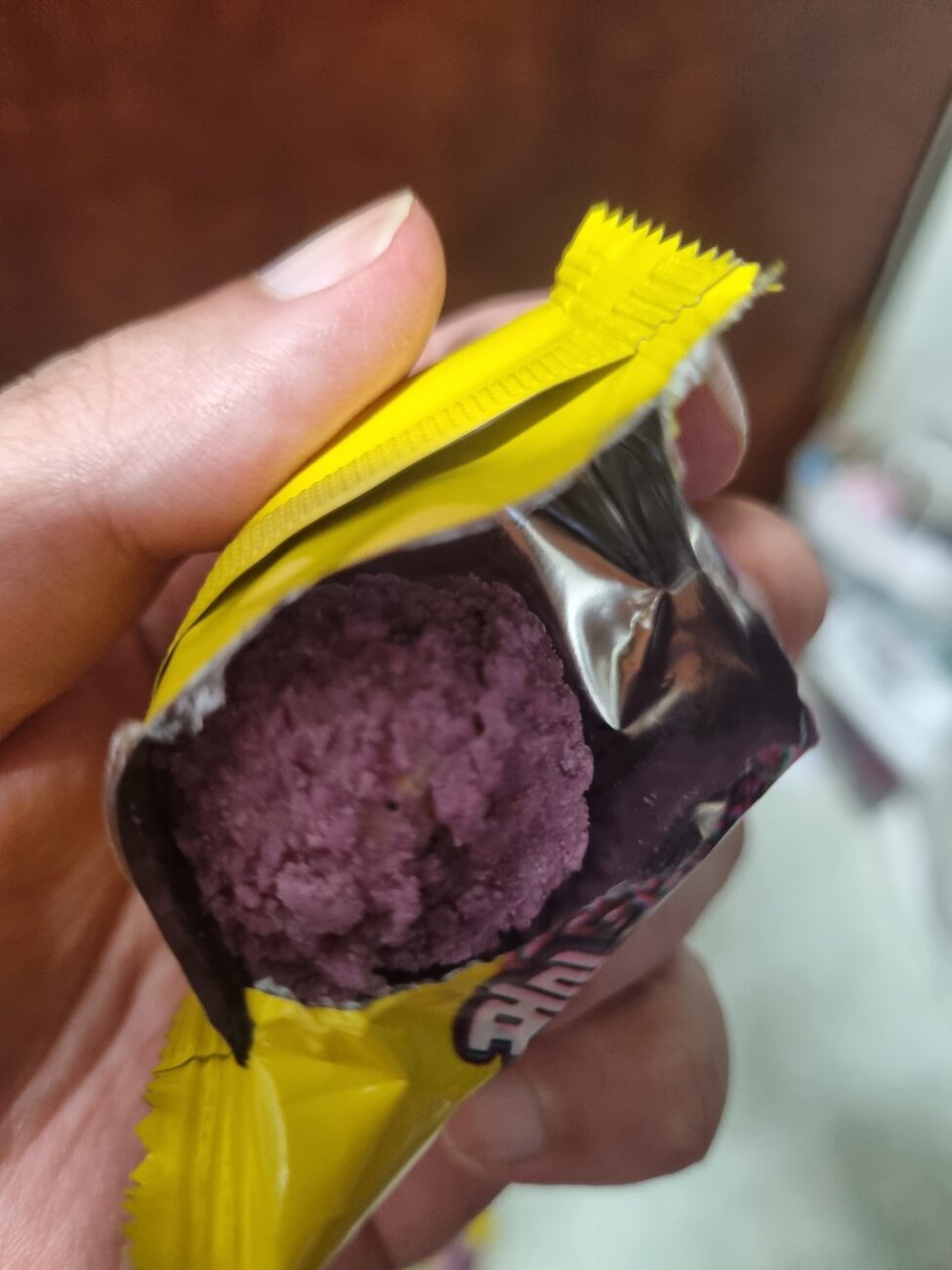
Open the pack and the smell hits you — sweet, sharp, a little overwhelming.
And it smells like sweet potato. Specifically, like the sweet-potato flavour used in Korean ice cream bars and sweet-potato snacks. If you’ve had those, this is a 90%-plus match.
⚠️ There’s a brief raw-potato note at the very start — slightly green, slightly off-putting. It clears within a second, but I noticed it.
The crunch is good. Properly crisp, the texture the name promises. The cream is genuinely creamy. No complaints there.
But the flavour is sweet potato from the first bite to the last. Nothing else arrives.
⭐ Now read the label
This is the part worth the price of the bag.
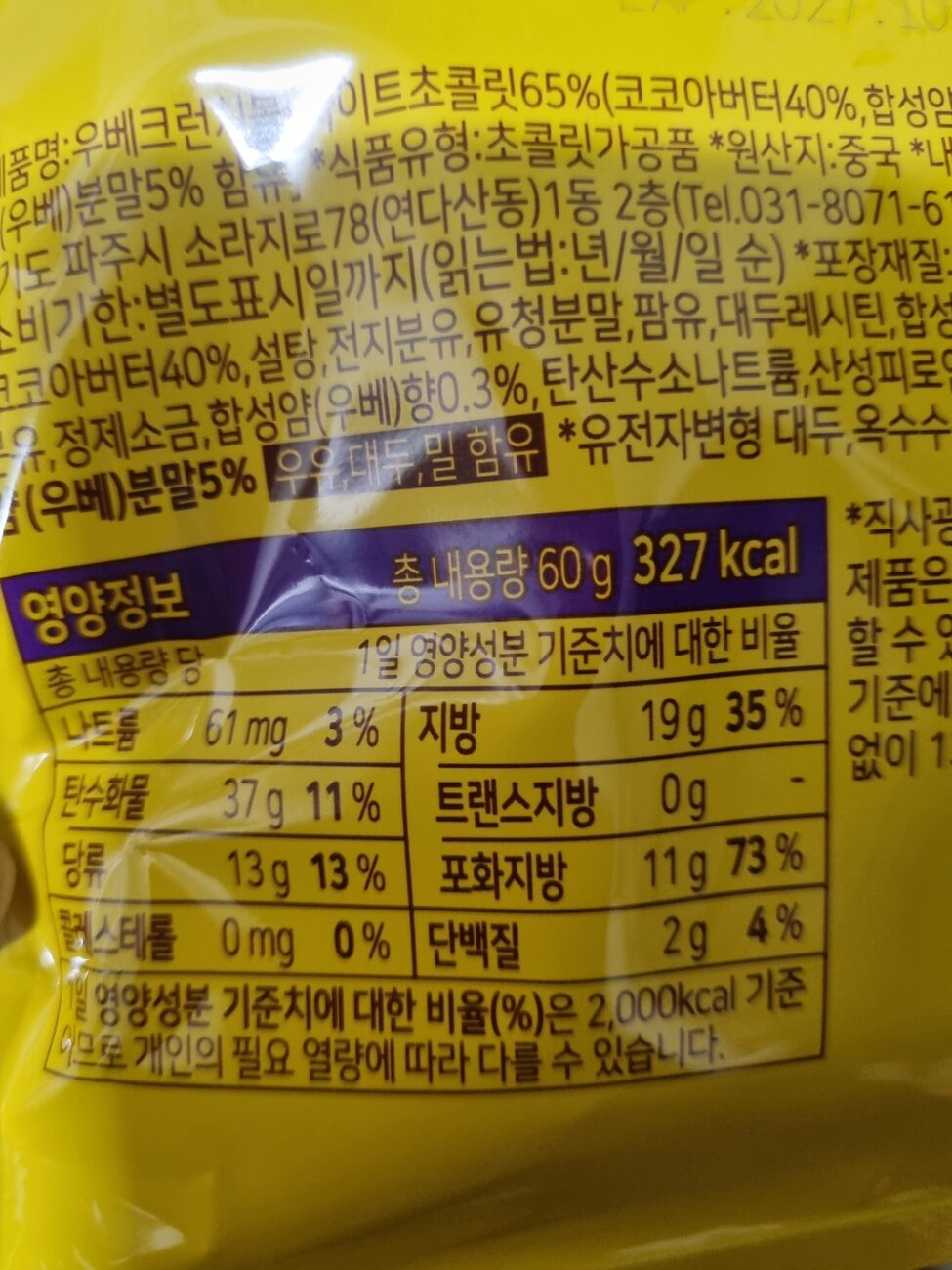
White chocolate 65%
  cocoa butter 40%, sugar, whole milk powder, whey powder,
  palm oil, soy lecithin,
  ⚠️ SYNTHETIC YAM (UBE) FLAVOURING 0.5%

Cookie 30%
  wheat flour, palm oil, sugar, whole milk powder, refined salt,
  ⚠️ SYNTHETIC YAM (UBE) FLAVOURING 0.3%,
  sodium bicarbonate, sodium acid pyrophosphate,
  ⚠️ (GARDENIA BLUE, COCHINEAL EXTRACT / colourings)

Yam (ube) powder 5%
Finding 1 — the purple is manufactured
Gardenia blue      →  blue
Cochineal extract  →  red
                      ─────
blue + red         =  PURPLE
The colour you’re buying is two dyes mixed to make purple.
Not the ube. The ube powder is in there — 5% of it — but it isn’t what makes this thing purple.
I assumed purple meant ube. The purple was the first thing that wasn’t.
Finding 2 — ⚠️ cochineal comes from insects
This matters to a lot of people and almost nobody checks for it.
Cochineal extract (carmine, E120) is made from the dried bodies of scale insects — *Dactylopius coccus.* They’re crushed and processed to produce a red pigment.
It’s a long-established, legal food colouring. But:
| Vegetarian / vegan? | ❌ No. It’s an animal product |
| Halal? | ⚠️ Disputed. Many certifying bodies reject carmine; rulings differ by school of thought |
| Kosher? | ⚠️ Generally not accepted |
⚠️ Nothing on the front of this package suggests an animal ingredient. It’s a purple snack that looks like a plant product. It isn’t entirely.
If you’re vegetarian and shopping in a Korean convenience store, carmine is one of the things you cannot see coming without reading the label.
Finding 3 — the flavouring is added twice
White chocolate  65% × 0.5%  =  0.325%
Cookie           30% × 0.3%  =  0.090%
                                ────────
Synthetic ube flavouring        ≈ 0.42%

Real ube powder                    5%
5% real ube isn’t nothing. That’s more than a token amount.
But they added synthetic ube flavouring on top of it — in two separate places.
Which tells you something: the real ube wasn’t going to carry the flavour on its own.
The real ingredient is there for the label. The flavouring does the work.
And that explains what I tasted. I wasn’t tasting ube. I was tasting a *synthetic idea* of yam — and to a Korean palate, that idea reads as sweet potato.
It’s a white chocolate snack
One more thing the label makes clear.
White chocolate  65%
Cookie           30%
Ube powder        5%
Two-thirds of this product is white chocolate. The food category on the label is literally *”processed chocolate product.”*
It isn’t an ube snack. It’s a white chocolate snack with ube flavouring.
That also explains why the cream was so creamy. It was melted white chocolate.
⚠️ Nutrition — one number stands out
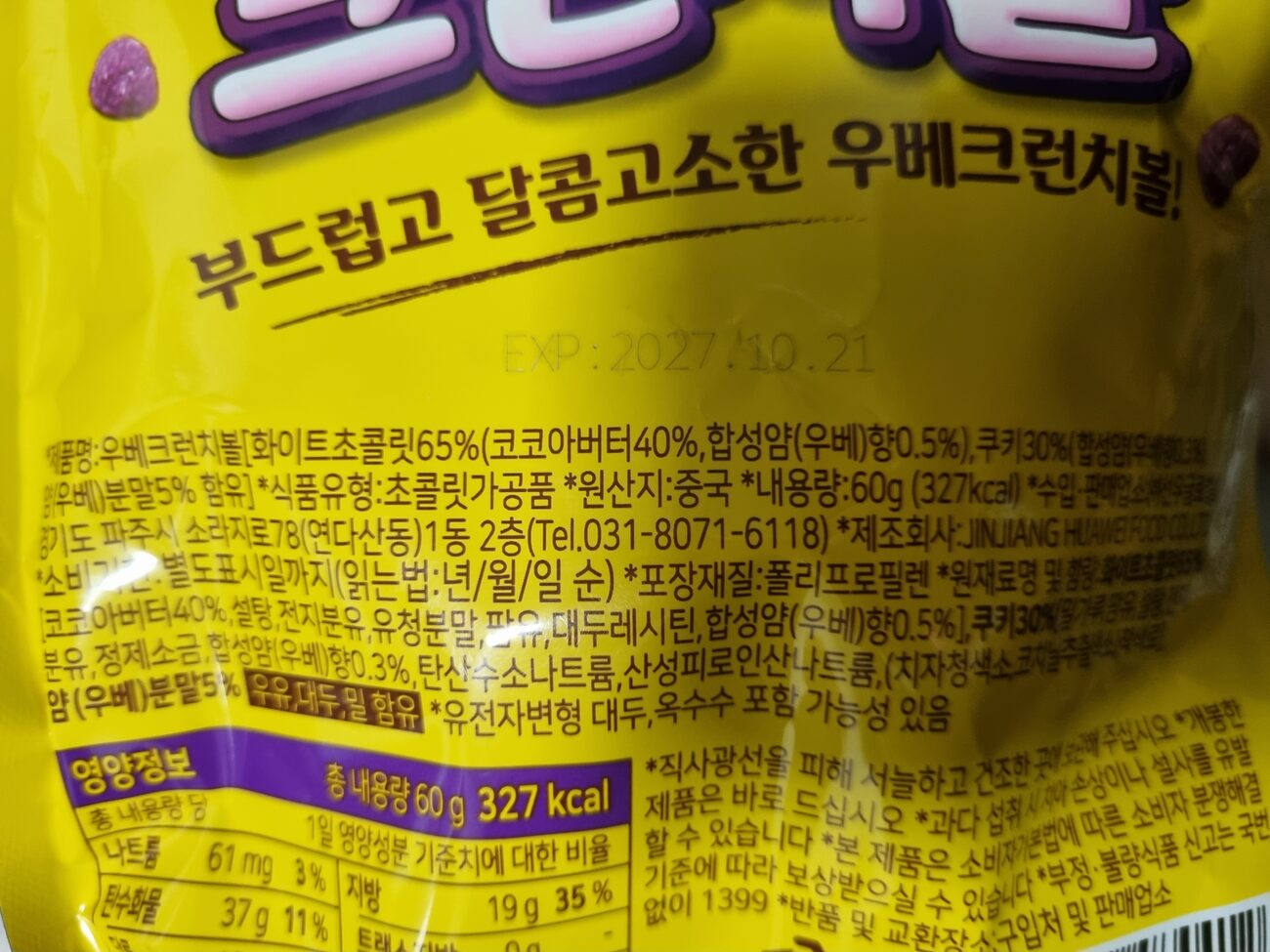
| Per bag (60 g) | Amount | % Daily Value |
|---|---|---|
| Calories | 327 kcal | — |
| Saturated fat | 11 g | 73% |
| Fat | 19 g | 35% |
| Carbohydrates | 37 g | 11% |
| Sugars | 13 g | 13% |
| Sodium | 61 mg | 3% |
| Protein | 2 g | 4% |
| Cholesterol | 0 mg | 0% |
73% of a day’s saturated fat in one small bag.
That’s the cocoa butter — 40% of the white chocolate. Six pieces gets you there.
Sodium is genuinely low, which is unusual and worth noting. But the saturated fat is the headline.
*I’m not a doctor. These are the numbers printed on the package.*
Where it’s made
Origin        China
Manufacturer  Jinjiang Huawei Food Co., Ltd
Importer      Paju, Gyeonggi Province, Korea
A Filipino ingredient, made in China, sold in Korea.
That’s not unusual for convenience store snacks and it isn’t a scandal. But the front of the package says “ube” in large letters and the origin is in small print on the back. I bought it without checking, and only found out at home.
Should you buy it?
| Crunch texture | ★★★★☆ |
| Cream | ★★★★☆ |
| Actually tastes like ube | ★☆☆☆☆ |
| Value — 6 pieces for $2.70 | ★★☆☆☆ |
| Label honesty | ★★★☆☆ Declares everything, but buries it |
| Overall | ★★☆☆☆ 2.0 / 5 |
On how I score: four stars means I’d buy it again. Three means it’s well made and I probably wouldn’t. This is a two — the snack works, but it was sold to me on a promise it doesn’t keep.
As a white chocolate snack, it’s fine. As an introduction to ube, it’s misleading.
If you’ve never had real ube, this will not tell you what ube tastes like. It’ll tell you what a synthetic yam flavouring tastes like, wrapped in white chocolate, coloured with two dyes.
Skip if
❌ You're vegetarian or vegan — cochineal is an insect product
❌ Strict halal or kosher — carmine is disputed at best
❌ You actually want to know what ube tastes like
❌ You're watching saturated fat — 73% in one bag
❌ Milk, soy, or wheat allergy — all three declared
It’s fine if
✅ You like white chocolate
✅ You like Korean sweet-potato-flavoured snacks — this is that
✅ You want the crunch texture
Not sure what to order?
Tell us what you can and cannot eat. We will match you to Korean dishes that actually fit.
Vegan, no pork, shellfish allergy, eating alone, hate chilli — 75 dishes, filtered honestly. We tell you when the answer is “almost nothing”.
Find my dish →