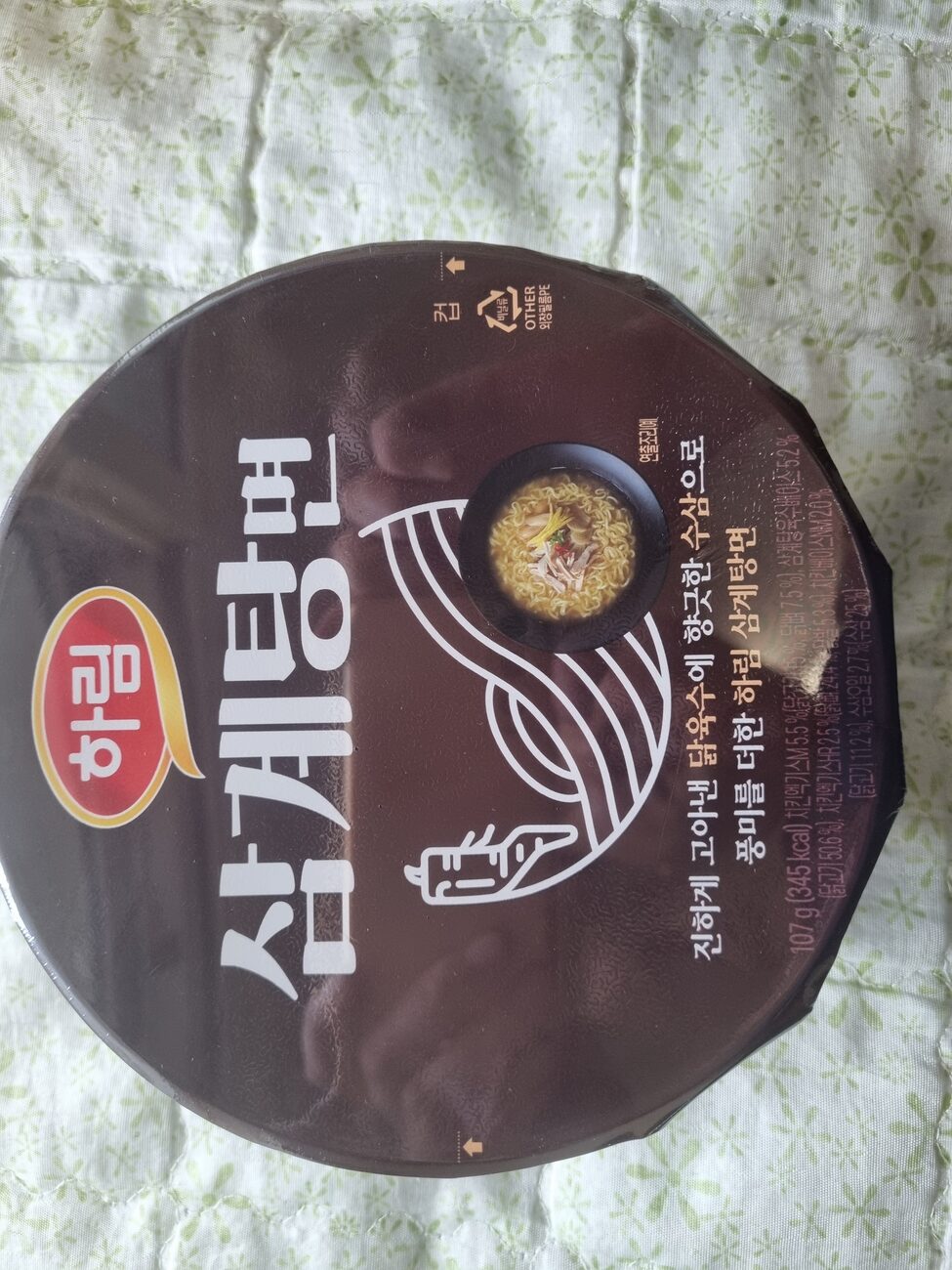
Where: 7-Eleven, Korea Price: ₩2,700 (about $2.00) Size: 107 g / 345 kcal Type: ⭐ Air-dried noodle, not fried
The short version
Korea’s largest chicken company made an instant noodle out of its most famous soup, and the numbers on the back of the cup are remarkable. Compared to the same company’s previous chicken ramyeon, this one has roughly eight times the chicken, one-fifth the saturated fat, and a separate little sachet of fresh-ginseng oil that transforms the bowl the second you squeeze it in.
It also has no chicken in it. Not one piece.
And — this matters for some of you — it contains beef. In a chicken soup noodle. More on that below.
First, what is samgyetang?
If you’ve never had it: samgyetang (삼계탕, *sam-gye-tang*) is a whole young chicken, stuffed with glutinous rice, garlic and jujube, with a ginseng root pushed inside, simmered until the meat falls off the bone. It arrives in a stone pot, boiling. You get a small dish of salt and pepper on the side.
Three syllables, three things:
| sam (蔘) | ginseng | the aromatic |
| gye (鷄) | chicken | the whole bird |
| tang (湯) | soup | the broth |
Koreans eat it in the hottest weeks of summer. The logic is *iyeolchiyeol* — “fight heat with heat.”
Closest thing you already know: a very clean chicken-and-rice soup — think Jewish matzo ball soup or Hainanese chicken rice broth — but with a resinous, slightly bitter herbal note running underneath it, and a whole bird you take apart yourself with chopsticks.
That last part is the whole point of samgyetang. Hold onto it. It’s why this review ends the way it does.
What you actually get
[photo 3 — the two sachets]
Lid off, there are two liquid sachets, which is unusual for a Korean cup noodle:
- Samgye broth — the soup base
- Fresh ginseng oil — added *after* cooking
Plus dried garlic chips, spring onion, egg ribbon, and — a nice surprise — dried red and cheongyang chili.
Microwave, 700 W, 3 minutes, lid off.
The ginseng sachet is the whole product
Taste the broth before the ginseng oil and it’s fine. Clean, savoury, unmistakably chicken, a little like the broth at a Korean *gukbap* shop.
Squeeze in the ginseng oil and it becomes a different noodle. A sharp, cool, faintly bitter aromatic rises off the bowl, the colour warms slightly, and suddenly you are eating something recognisably Korean rather than generic chicken ramen.
The reason it’s a separate sachet is that the aroma would evaporate if it were cooked in. Whoever designed this understood the ingredient. It’s genuinely well made.
The numbers on the back
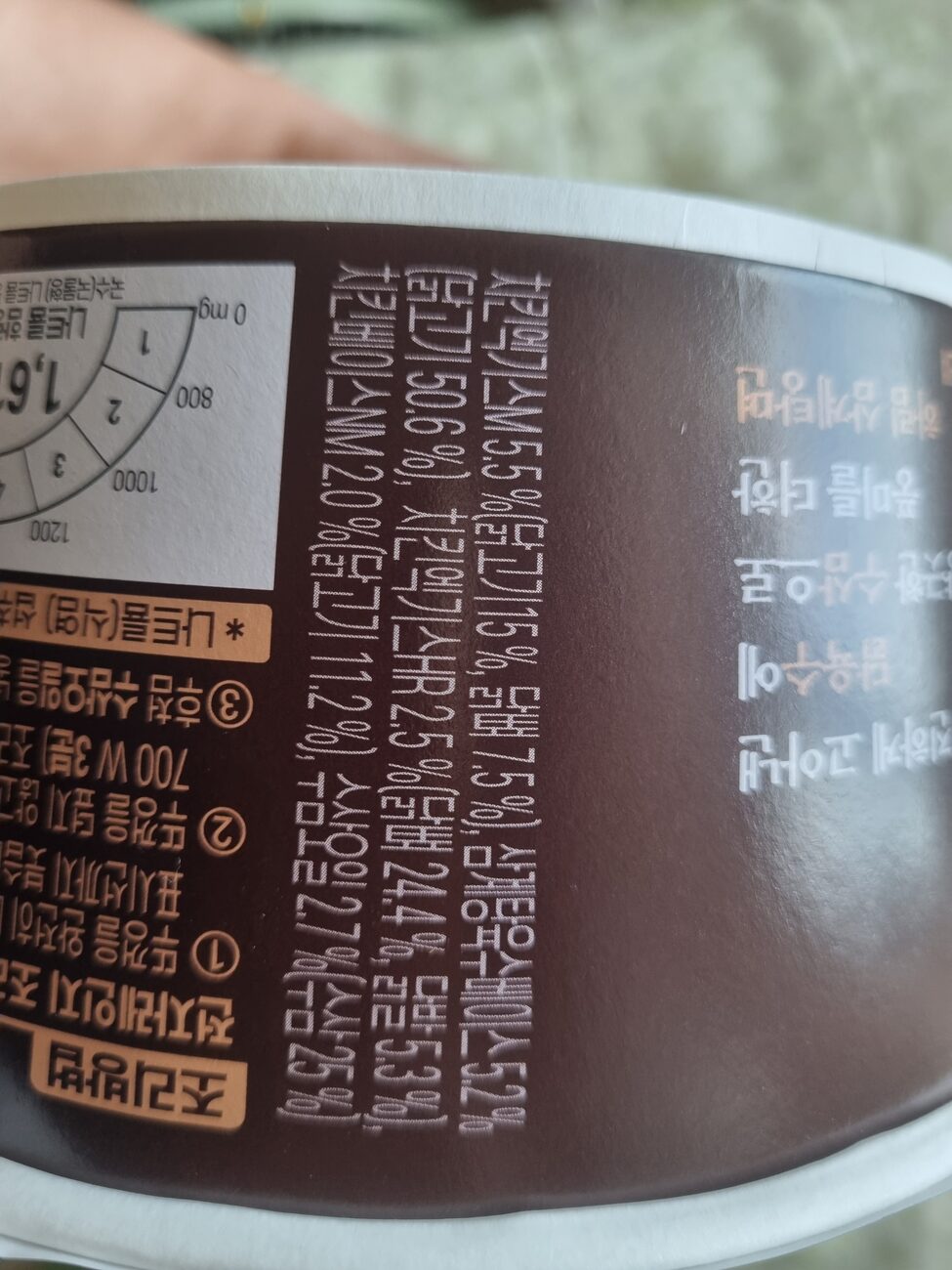
The cup prints the chicken content, which Korean labels often do and which is worth reading:
Chicken extract M       5.5 %  (chicken 15 %, chicken bone 7.5 %)
Samgyetang broth base   5.2 %  (chicken 50.6 %)
Chicken extract HR      2.5 %  (chicken bone 24.4 %, chicken feet 5.3 %)
Chicken base NM         2.0 %  (chicken 11.2 %)
Fresh ginseng oil       2.7 %  (fresh ginseng 25 %)
Multiply it out and the chicken-derived content is about 4.84 % of the cup — roughly 5.2 g in 107 g.
The same company’s Chicken King ramyeon works out to about 0.60 %. So: eight times the chicken, for one and a half times the price. All of it Korean-sourced, from the same factory in Iksan.
And note chicken feet in there. That’s not filler — collagen from the feet is what gives Korean chicken broth its body. It’s how the soup is actually made in a restaurant.
But read this next part honestly
| Chicken King | Samgyetang Myeon | |
|---|---|---|
| Noodle | deep-fried | air-dried |
| Calories | 450 | 345 |
| Fat | 15 g | 4.6 g |
| Saturated fat | 7 g (47 % DV) | 1.3 g (9 % DV) |
| Cholesterol | 5 mg | 0 mg |
| Sodium | 1,560 mg (78 %) | 1,610 mg (81 %) |
| Protein | 9 g | 8 g |
Eight times the chicken — and one gram less protein.
That’s not a contradiction, it’s a lesson. Extracts and broth bases are flavour, not food. They are concentrated simmered stock, not meat. “Eight times the chicken” means the broth is eight times deeper. It does not mean you are eating eight times the chicken.
The fat reduction, though, is real and comes from one decision: this is an air-dried noodle, not a fried one. Korean instant noodles are usually flash-fried in palm oil and the oil stays in the noodle. This one is dried in moving air. That single swap is where 47 % daily saturated fat becomes 9 %.
Sodium went the wrong way, though: 81 % of the daily value in one cup. The broth is good enough that you will drink all of it. That’s the trap.
*I’m not a doctor. These are the numbers printed on the package.*
Vegan, Vegetarian, Halal
| Diet | Suitable? | Why |
|---|---|---|
| Vegan | ❌ No | Chicken extract in the broth |
| Vegetarian | ❌ No | Chicken-based |
| Halal | ❌ Not certified | No certification; check the shared-facility statement on the label |
⚠️ Allergen warning — please read this one
The Korean allergen line reads:
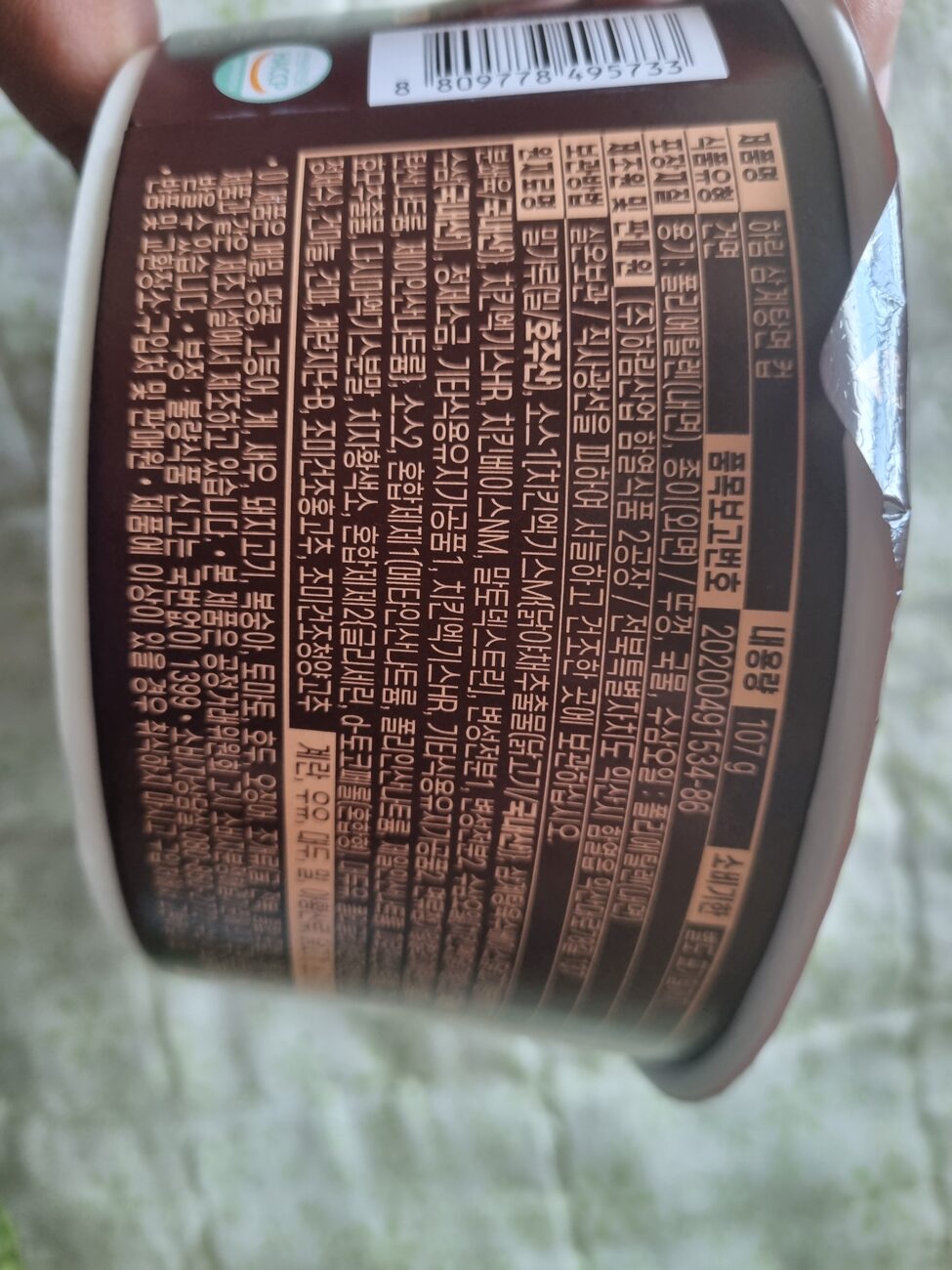
계란, 우유, 대두, 밀, 아황산류, 닭고기, 쇠고기 함유 Contains: egg, milk, soy, wheat, sulfites, chicken, BEEF
There is beef in this chicken noodle.
I read the full ingredient list several times and could not find a line item naming beef. It is most likely inside one of the compound ingredients (“processed edible oil product,” “sauce 2”), but I could not confirm that, so don’t take my guess as fact. What is certain is the declared allergen line.
If you avoid beef — Hindu readers, and anyone eating beef-free for any reason — a chicken-soup name on the front of a Korean cup noodle is not a guarantee. Read the allergen line. It’s the boxed text near the bottom of the back label.
For halal readers: this is not halal-certified and I can’t verify the beef source, so treat it as not suitable.
Pork: pork appears only in the *”produced in the same facility as”* line, which is a cross-contact statement — pork is not an ingredient in this product. That distinction matters and Korean labels do separate the two.
What’s missing
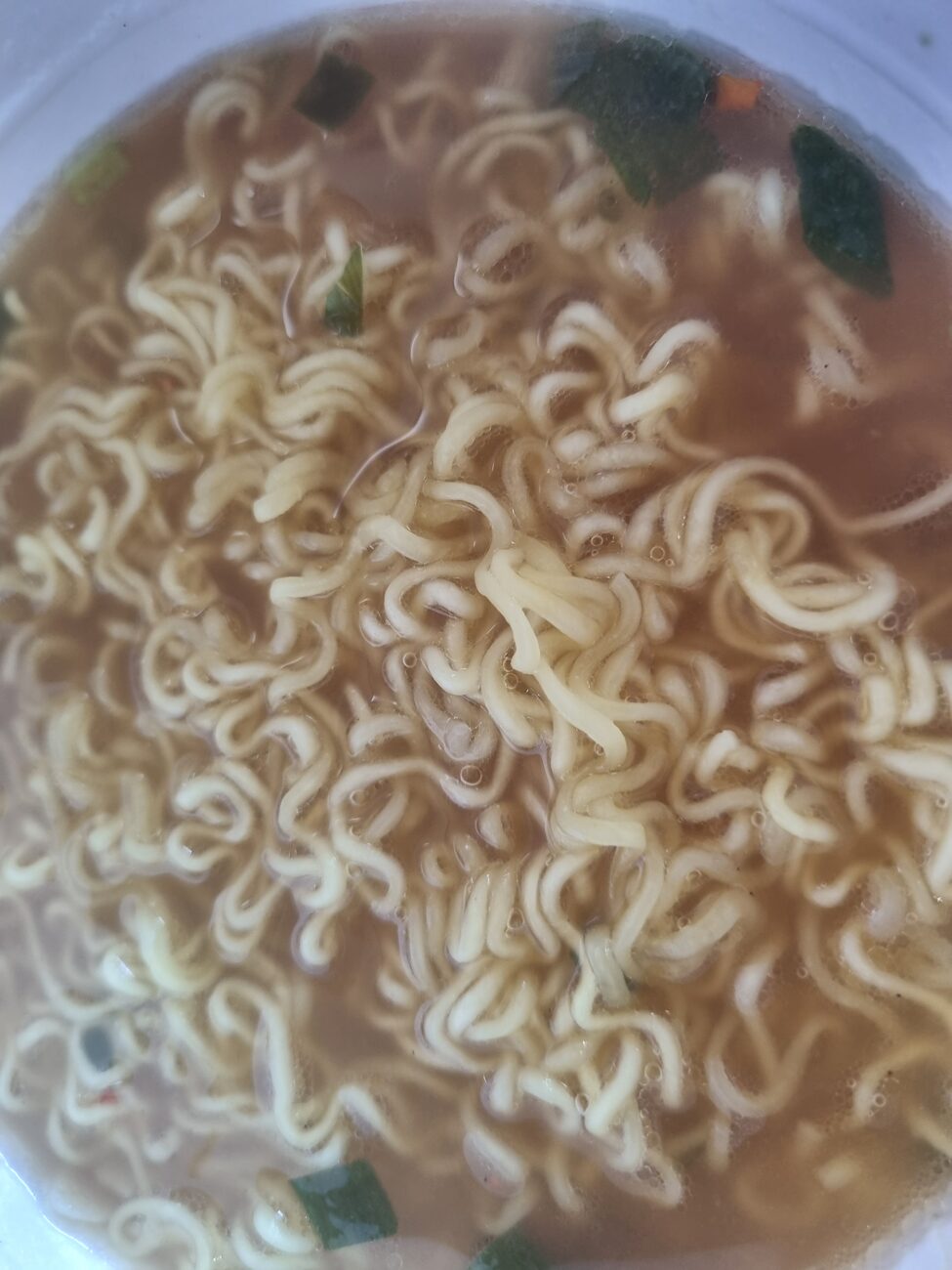
The garnish is dried garlic, spring onion, egg ribbon, and chili.
There is no chicken in it.
Which brings us back to the name. In samgyetang, the *gye* — the chicken — isn’t the broth. It’s the bird you take apart with your chopsticks, dipping each piece in salt. That act is the meal. A samgyetang without a bird in it is a very good chicken noodle soup wearing the wrong name.
And the company that made this is Korea’s biggest poultry company. They sell chicken breast in retort pouches. A few shreds would have cost them almost nothing and would have changed this review completely.
They thought to pour eight times the chicken into the broth. They didn’t think to put one piece of it in the bowl.
⚖️ Where I land differently from my Korean review
I run a Korean-language review blog, and there I gave this 3 out of 5 — good, but I wouldn’t buy it again at ₩2,700 from a convenience store when a four-pack online is about ₩1,428 each, and when two cups plus ₩900 gets you an actual retort samgyetang with a whole bird in it.
That calculation doesn’t apply to you, and here’s why.
I have not found a ginseng-flavoured instant noodle sold outside Korea. There is no equivalent on a shelf in London or Chicago or Sydney. The thing I’m marking down — *”I can get better value elsewhere in Korea”* — is a resident’s complaint, not a visitor’s.
So the honest split is:
- As a thing to try once, in Korea, for two dollars: yes. Do it. The ginseng sachet moment is worth the price on its own, and it’s a legitimate, non-touristy piece of Korean convenience-store culture.
- As something to fill your suitcase with: probably not. It’s good, not unforgettable.
- As a stand-in for real samgyetang: absolutely not. Go eat the real thing. It’s usually ₩16,000–20,000 and it is one of the best meals in the country.
⭐⭐⭐½ (3.5 / 5) — for a visitor. *3 / 5 in the Korean edition. Same noodle, different shelf.*
Quick reference
| Heat level | 🌶 Barely. Chili is present but mild. |
| Adventure level | ⚠️⚠️ The ginseng aroma is unfamiliar to most Western palates — herbal, slightly bitter, a bit like angelica or a gentle amaro. |
| Would I send you? | Yes, once. Try it before you try the real samgyetang, not instead of it. |
| Vegetarian | No |
| Beef-free | ⚠️ No |
| Pork-free | Yes (cross-contact facility only) |
| Gluten-free | No |
How to eat it: microwave 700 W / 3 min, lid off. Broth sachet in first. Then taste it. Then add the ginseng oil and taste it again. Doing it in that order is the whole experience.
Not sure what to order?
Tell us what you can and cannot eat. We will match you to Korean dishes that actually fit.
Vegan, no pork, shellfish allergy, eating alone, hate chilli — 75 dishes, filtered honestly. We tell you when the answer is “almost nothing”.
Find my dish →