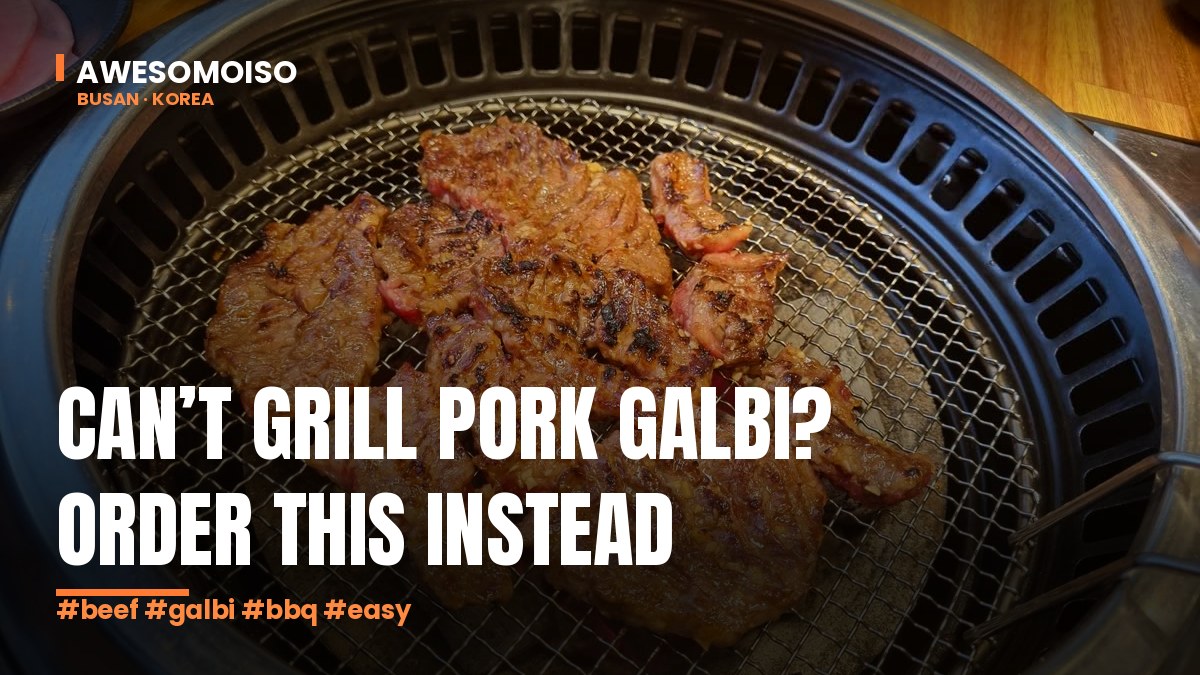
Pork galbi is the dish most visitors try first at a Korean barbecue table, and it is also the one most likely to go wrong in your hands. There is an easier order sitting on the same menu, and at most shops it does not cost more.
Why pork galbi is hard
Pork has to be cooked through. That leaves a narrow window: pull a piece early and it is not done, leave it and the sugar in the marinade catches on the grill while the meat dries out.
It is the sweetness that makes it difficult. The marinade is soy sauce, sugar or syrup, garlic and pear — the same thing that makes it taste good is the thing that burns. On a shared table grill, with pieces going on at different times and everyone talking, most people miss the window at least once.
Marinated beef short rib is the forgiving version
Same marinade. Different animal, and that changes the whole job.
Koreans have a saying about beef: 핏기만 가시면 된다 — once the red is gone, it is ready. It is said about beef and not about pork, and it is the reason nobody at a Korean table watches a beef piece the way they watch a pork one.
That is a description of how Koreans eat, not advice from us about how you should. Tolerance differs from person to person, and cooking it all the way through is perfectly fine — the meat is thinner and the marinade is sweeter than a steak, so a well-done piece is still good. If your immune system is a concern in any way, cook it through. Nobody at the table will mind, and no one will think you got it wrong.
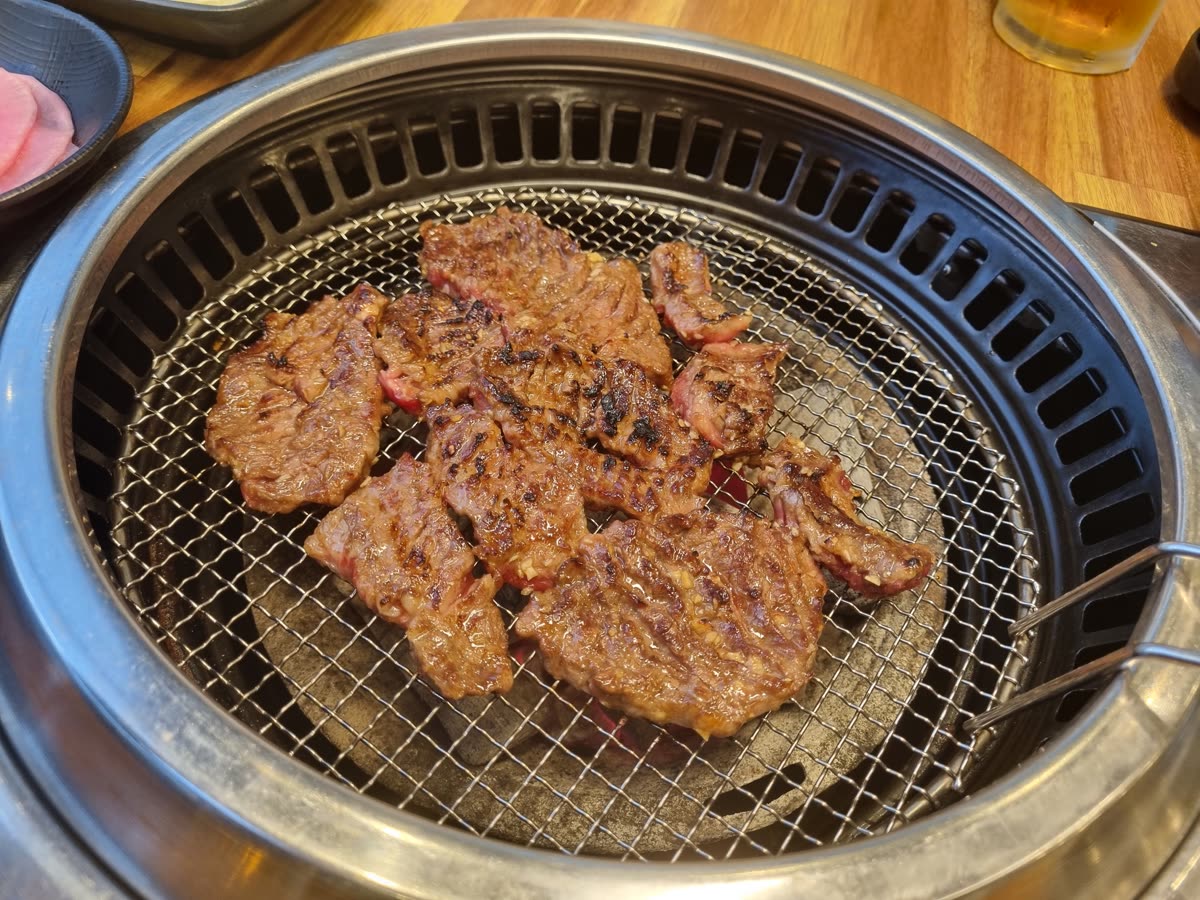
Either way the cut is thin and already marinated, so over charcoal it takes well under a minute a side. You are watching the edges of the meat, not the clock.
| Pork galbi | Marinated beef short rib | |
|---|---|---|
| Must be cooked through | Yes | Your call |
| Room for error | Narrow | Wide |
| Time per side | Several minutes | Under a minute |
| How it fails | Burns while you wait | Overcooked and dry |
⚠️ We are not telling you how done to cook your meat. This describes how the dish is normally eaten in Korea. Young children, older diners, anyone pregnant and anyone whose immune system is suppressed should have beef cooked all the way through. If that is you or someone at your table — or if you simply prefer it — cook it through. It is less tender and that is the only cost.
The one way to ruin it
Leave it on too long and the juice goes and the meat turns tough. This is the opposite failure from pork, and it catches people who have just learned to be careful with pork and apply the same caution here.
Take the piece off while the surface is still glossy. If it has stopped sizzling and gone matte, it is already past its best.
Eat it with pa-jeorim. That is the combination.
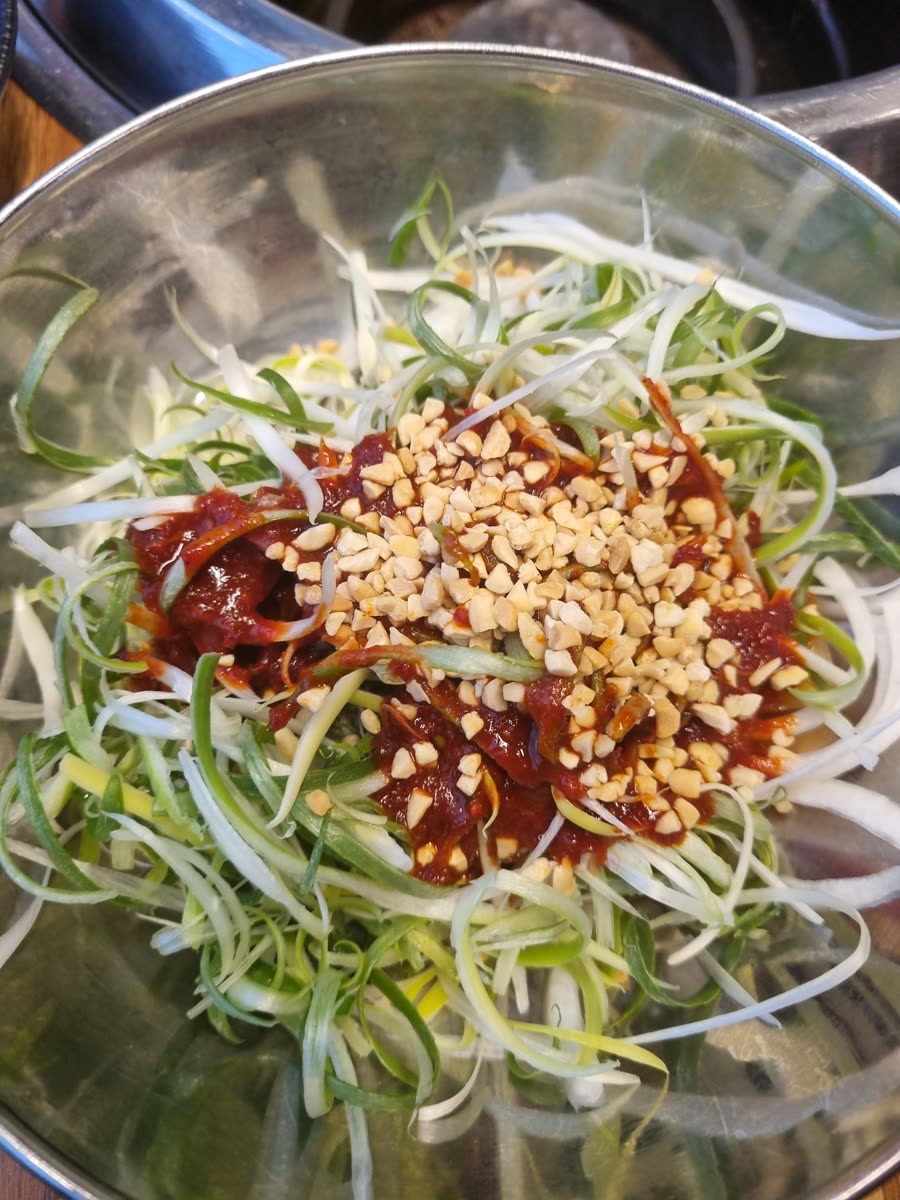
The steel bowl of shredded spring onion in red dressing is not a garnish you pick at. Meat and pa-jeorim together is the point of the plate.
You will almost always get it. At Korean grill houses pa-jeorim is a default, not a request — look at the table and it is usually already there. When a shop does not bring it, there is normally another leaf or vegetable side in its place. It is not guaranteed, though: when vegetable prices spike, some shops cut the free vegetables back, charge for them, or stop putting them out. If it is not on your table, ask — it may be there for the asking, or it may cost extra that day.
The marinade on the beef is sweet and soy-heavy. The onion is raw, sharp and sour, and it cancels that out, which is what lets you keep eating instead of stopping three pieces in. The crushed peanut on top is doing the same job from the other direction — something dry and crunchy against meat that is soft and glossy.
- Take the piece off while it is still glossy.
- Put a pinch of pa-jeorim on top of the meat, not beside it.
- Eat it in one. Lettuce and perilla leaf are optional — the two of them alone are enough.
What arrives with it
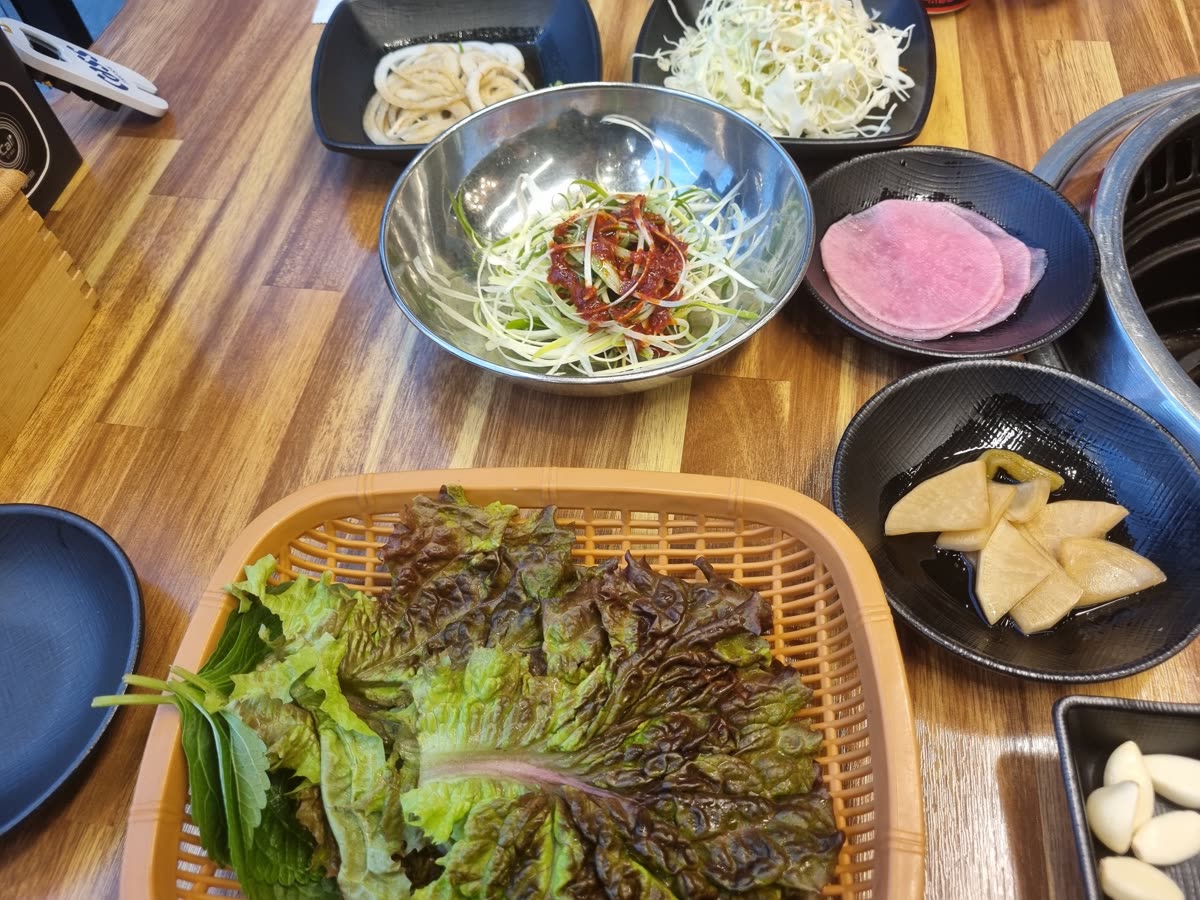
Spring onion salad in chilli with crushed peanut · pickled onion in soy · shredded cabbage · pickled radish wraps · lettuce and perilla leaves · raw garlic.
The spring onion salad is the one to reach for first — at most grill houses it comes with the meat as a matter of course. The rest of the list is where shops differ most, and in a bad year for vegetable prices even the free sides can shrink.
How to find a shop, and how to read the board
Search your area plus 양념 숯불갈비 — (place name) yangnyeom sutbul-galbi, “marinated charcoal galbi”. Type it in Korean into Naver Map or Kakao Map and the shops that do this will come up. It is the phrase the shops themselves use, which is why it works better than translating “Korean BBQ”.
Boards are priced per 100g. The whole category sits between about ₩7,000 and ₩15,000 per 100g — roughly $5 to $10 at ₩1,450 to the dollar.
| Per 100g | What it means |
|---|---|
| ₩7,000 – 10,000 | Imported beef |
| Over ₩10,000 | Almost certainly hanwoo — Korean beef, up to about ₩15,000 |
| Over ₩10,000 and not hanwoo | You are in an expensive shop |
A real bill, from the shop in these photos: ₩72,000 for 800g. That is ₩9,000 per 100g, or about $6.20 — just under the line, so by the rule above, not hanwoo.
That bill also shows you how ordering works. The board quotes 100g, but nobody orders 100g. Meat comes by the several hundred grams for the table to share, so the number on the board is roughly a tenth of what the meat will actually cost you. Read it as a unit price, not a price.
The exception is central Seoul. In the busiest districts a shop can be over ₩10,000 on imported beef and still be an ordinary shop, because the rent is in the price.
None of this is far off pork galbi. You are not paying a premium for the cut that is easier to cook — and hanwoo short rib at this price is the value end of Korean beef, since the same animal bone-in as so-galbi runs several times more.
Before you order
| Vegan | No |
| Vegetarian | No |
| Pescatarian | No |
| Halal | Beef, but ask the shop |
| Gluten | Ask. The marinade is soy-sauce based |
| Nuts | Peanut in the spring onion salad |
Cross-contact is a separate question from ingredients. The grill is shared with pork at most barbecue shops, and the dipping paste on the table often contains anchovy. Neither is in the beef itself.
Prices move with the shop, the district and the grade, and the exchange rate moves too. Read the board.