Vegan, Vegetarian, Halal
| Diet | Suitable? | Why |
|---|---|---|
| Vegan | ❌ No | Chicken seasoning, chicken bone and foot extract, chicken fat |
| Vegetarian | ❌ No | The broth is built entirely from chicken |
| Halal | ❌ Not certified | ⭐ No pork as an ingredient — but no certification, and the label declares a shared facility that also handles pork |
⭐ This is the one to know about if you avoid pork but not chicken. See the pork section above for the full detail — the distinction between “no pork” and “halal” matters here.
Quick Verdict
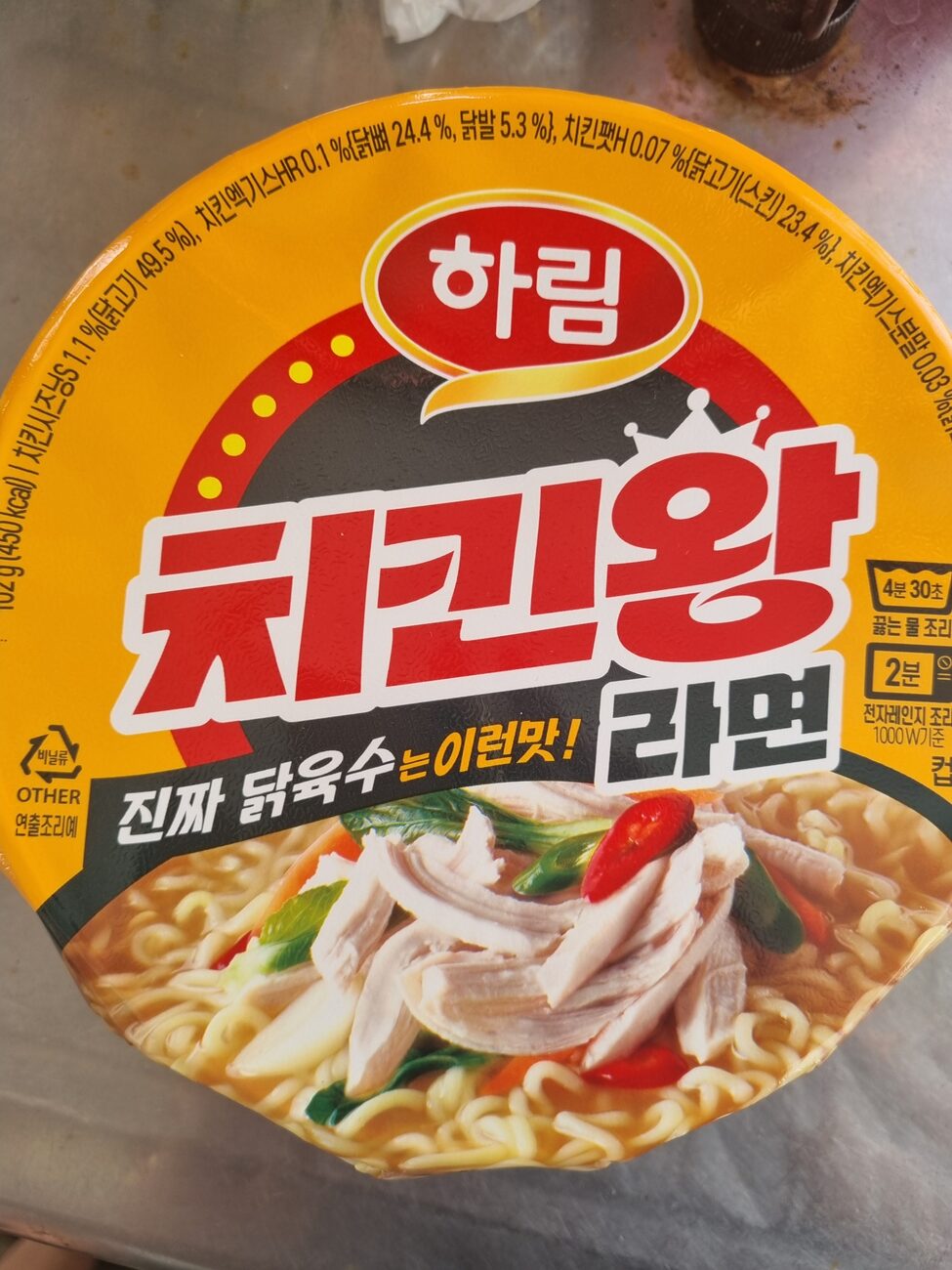
₩1,800 (about $1.30) at GS25. A chicken-broth cup noodle from Harim — Korea’s largest poultry company, making a ramyeon out of their own product.
The broth is excellent. The noodles are excellent.
There is nothing else in the cup. No vegetables, no meat, no garnish. Nothing.
But there’s a reason for that, and the ingredient label tells it clearly: they put four different parts of a chicken into the broth and spent nothing on toppings.
There’s also something here that matters a great deal to some readers, and no marketing mentions it: this is a Korean instant noodle with no pork in it. More on that below.
What Is This?
하림 치킨왕라면 — *Harim Chicken King Ramyeon*
Say “ha-rim chi-kin-wang ra-myeon”.
The tagline on the lid reads “진짜 닭육수는 이런 맛” — *”This is what real chicken broth tastes like.”*
Harim (하림) is worth knowing. It’s Korea’s biggest chicken company — roughly the local equivalent of Tyson. They raise and process the chicken, and in recent years they’ve moved into instant noodles. So this is a poultry company making a chicken noodle, using their own supply chain.
Where to buy: GS25 convenience stores. Also CU, 7-Eleven, and large marts, though availability varies.
Price
₩1,800  ≈  $1.30 / €1.18 / ¥195
102 g · 450 kcal · single serving cup
Context for a visitor: ₩1,800 is on the higher end for a Korean cup noodle. Basic ones run ₩1,000–1,400. This is priced as a premium item, which is exactly why the empty cup is a fair complaint.
⭐ The Pork Question — Read This If It Matters to You
Most Korean instant noodles are difficult if you avoid pork. Pork extract, pork bone broth, and pork fat are common in ramyeon seasoning, and the label often uses Korean-only wording that’s hard to scan quickly.
This one is different.
| Pork in the ingredients? | ✅ No. The only meat is chicken |
| Beef? | ✅ No |
| Alcohol? | ✅ None declared |
| Halal certified? | ❌ No — see below |
| Vegetarian? | ❌ Chicken throughout |
| Contains | Wheat, soy, milk (whey), chicken |
⚠️ Important and easy to get wrong.
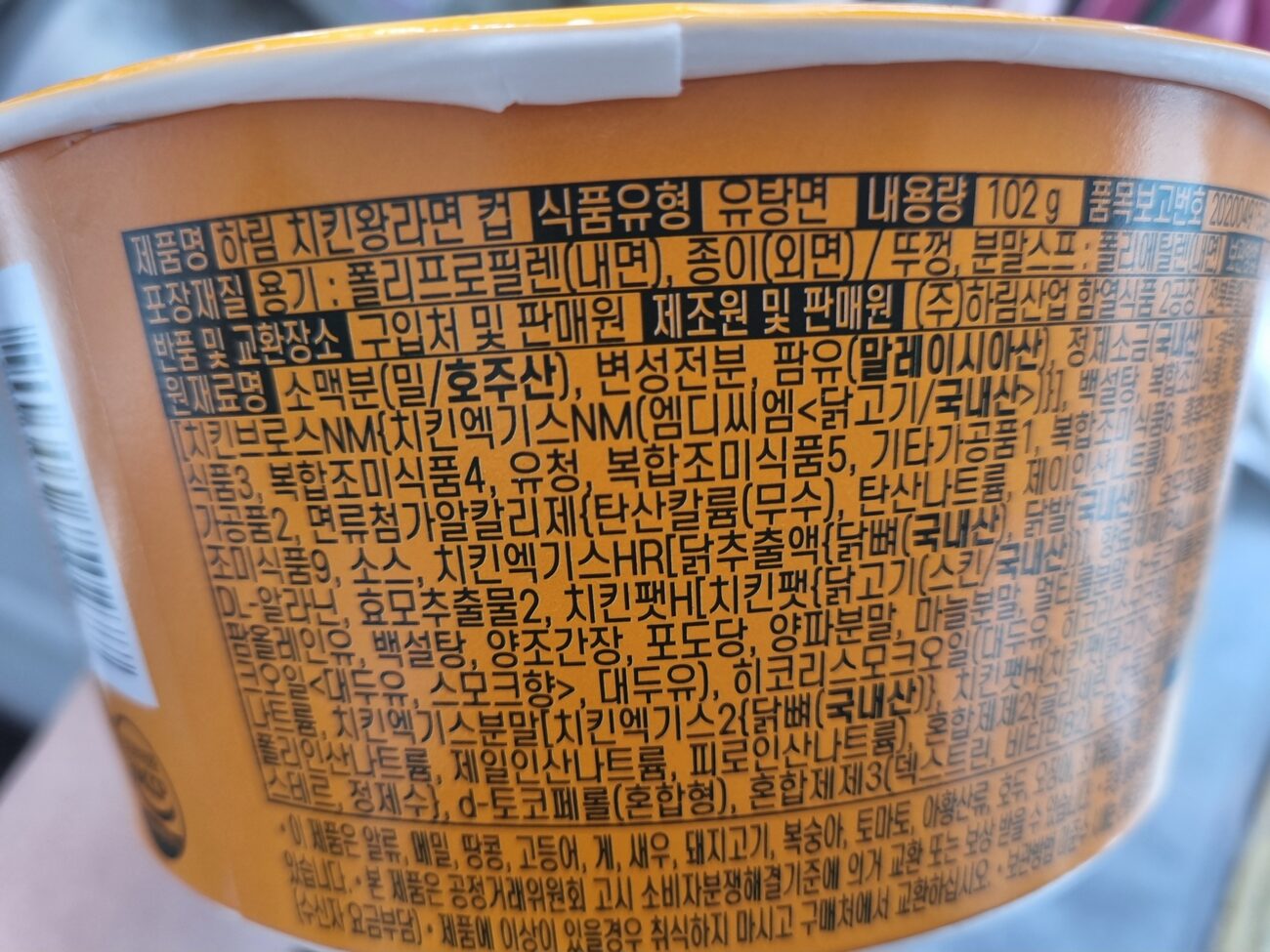
The product contains no pork. But the label also states that the same facility handles pork, along with egg, buckwheat, peanut, mackerel, crab, shrimp, peach, tomato, sulfites, walnut and squid.
That is a cross-contact statement, not an ingredient. Whether that’s acceptable is your call, not mine — practice differs between people and between authorities.
What I can tell you plainly: no pork is used as an ingredient, there is no halal certification, and the facility is shared. Decide from the facts, not from my recommendation.
Manufacturer: Harim Industries, Hamyeol Plant No. 2, Iksan, North Jeolla Province.
What’s Actually in the Broth
Here’s the part I found genuinely impressive.
They didn’t put “chicken” in this. They put four different parts of a chicken in it.
Chicken seasoning S      1.1%   { chicken meat 49.5% }
Chicken extract HR       0.1%   { chicken BONE 24.4%, chicken FEET 5.3% }
Chicken fat H            0.07%  { chicken SKIN 23.4% }
Chicken extract powder   0.03%  { chicken bone 14.0%, chicken skin 1.4% }
Chicken feet. In an instant noodle.
Each one is doing a different job:
| Ingredient | Part | What it contributes |
|---|---|---|
| Seasoning | Meat | The flavour itself |
| Extract | Bone | Depth |
| Extract | Feet | Body — the weight it has on your tongue |
| Fat | Skin | Richness, the fatty note |
This is how you actually make chicken broth. Meat alone gives you a thin, flat stock. Bones and feet are what give a broth its body — chicken feet in particular are almost pure collagen, which is why Korean *dakgomtang* (chicken bone soup) and *dak-bokkeum-tang* cooks add them.
So when the broth tastes noticeably denser than other instant chicken noodles — that’s not marketing working on you. That’s the chicken feet.
And all of the chicken is Korean-sourced. The label marks 국내산 (domestic) on the meat, the bone, the feet, and the skin. The wheat is Australian and the palm oil Malaysian — chicken is the one thing they kept domestic. For a poultry company, that tracks.
But how much chicken is that, really?
Do the arithmetic and the four chicken components come to about 0.6% of the product — roughly 0.6 g in a 102 g cup.
That number is misleading on its own, and I want to be straight about why.
These are extracts and powders — concentrated and dried. An extract is what’s left after you simmer chicken and drive off the water. So it is *not* “0.6 g of chicken.” The fresh-weight equivalent is considerably more. How much more, I can’t tell you — the label doesn’t say, and I’m not going to invent a multiplier.
What the label does tell you clearly is this:
The chicken isn’t missing. The chicken all went into the broth.
Harim spent their ingredient budget on stock and nothing on toppings.
Whether that was the right call is the whole review.
The Empty Cup
Open the lid and you get a noodle block and one sachet of powder. That’s it.
No dried vegetables. No chicken pieces. No garnish of any kind.
The photo on the lid shows shredded chicken breast, chilli and greens — labelled 연출조리예, *”serving suggestion,”* which is doing a lot of work.
At ₩1,800 this is a real complaint. Cheaper cups from other brands include a vegetable sachet.
How It Tastes
Cook it in the microwave. The lid gives both methods, and the microwave gives you a much better noodle.
Boiling water   400 ml, 4 min 30 sec
Microwave       1000W → 2 min   ·   700W → 2 min 30 sec
⚠️ Remove the lid completely before microwaving.
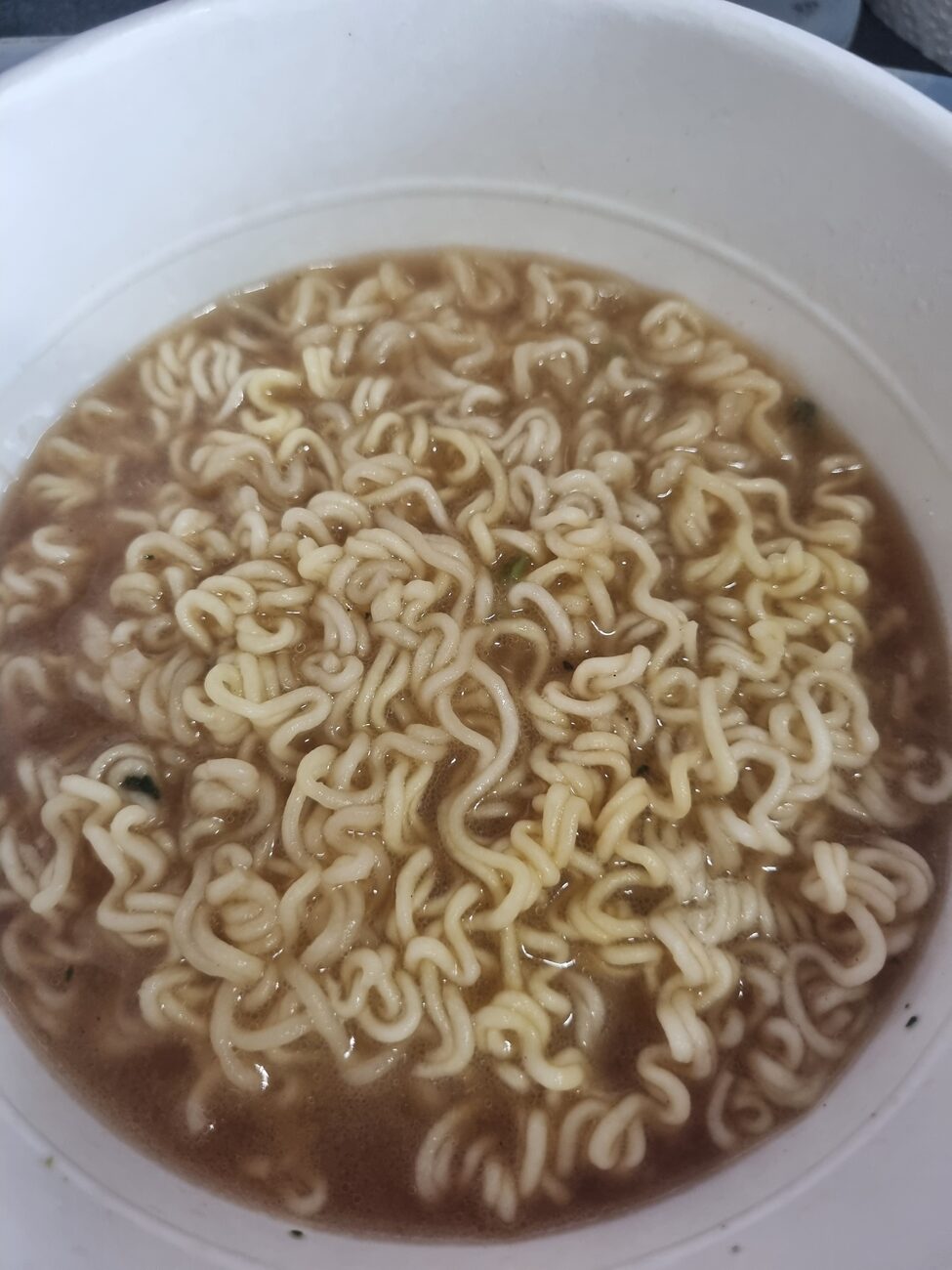
The noodles are the surprise. Thin, but with real spring to them — and not the false springiness of noodles that are simply undercooked. This is a distinct, bouncy, elastic chew. Modified starch is in the ingredient list, which likely explains it.
The broth is deep and clean. It tastes strongly and specifically of chicken stock. If you’ve had Nissin’s chicken cup noodle, it’s that family — but noticeably richer and rounder.
And it is not spicy at all.
Heat level: 0 / 5
This matters more than it sounds. A large share of Korean instant noodles are aggressively spicy. If you’re visiting Korea and want to try convenience-store ramyeon without committing to chilli, this is one of the easiest entry points on the shelf.
What’s missing
There’s no sharpness, no acidity, no chilli — nothing that makes you want the next spoonful. I kept waiting for a finish that never came.
Looking at the label, that’s deliberate. There is no chilli of any kind in this product. Instead there’s soy sauce, onion powder, garlic powder, and hickory smoke oil — they aimed at *roasted chicken*, not *spicy chicken*.
It’s a coherent decision. It just left me a little bored by the end of the cup.
⚠️ Sodium — Look at This One
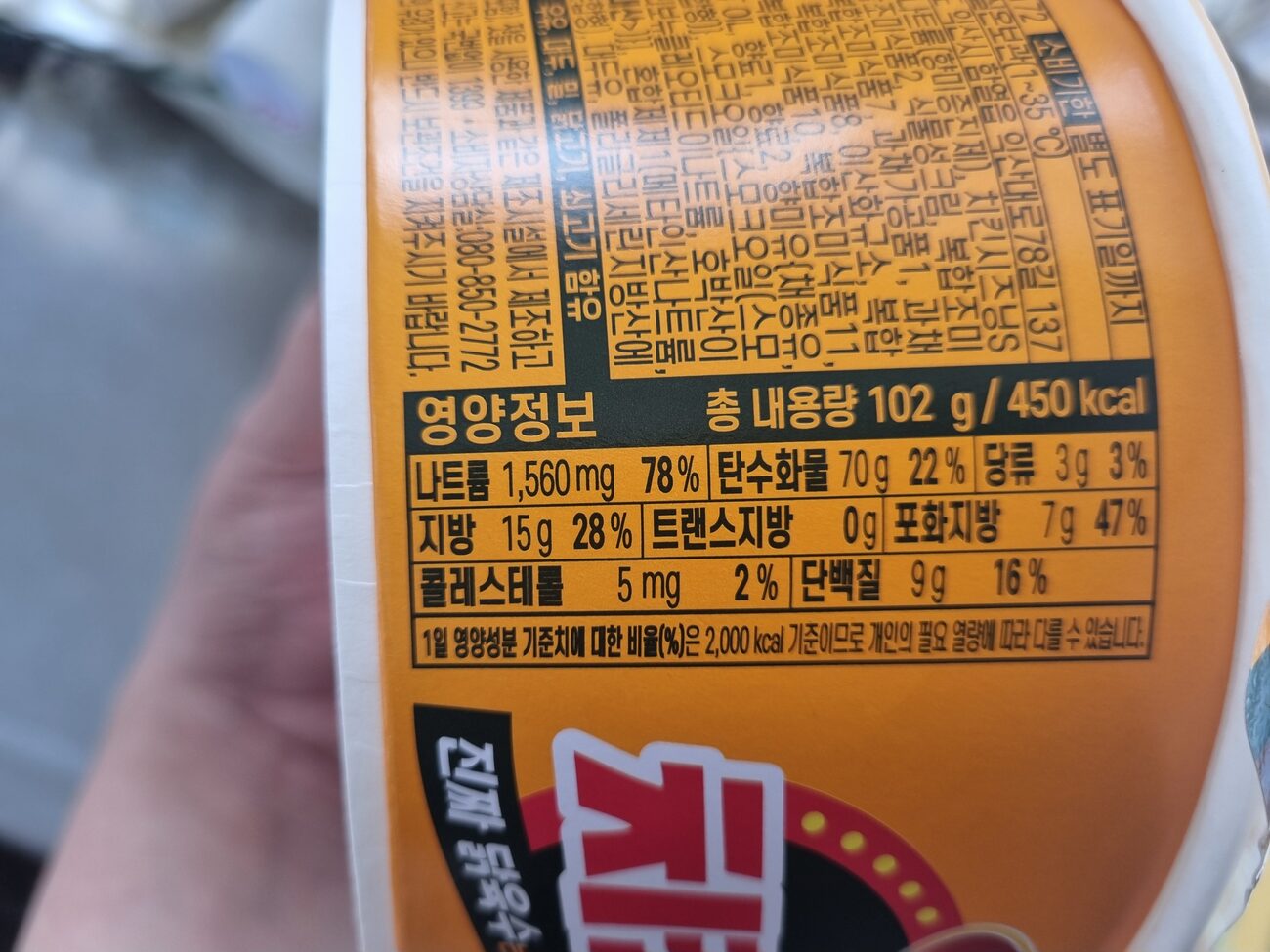
| Per cup (102 g) | Amount | % Daily Value |
|---|---|---|
| Calories | 450 kcal | — |
| Sodium | 1,560 mg | 78% |
| Carbohydrates | 70 g | 22% |
| Sugars | 3 g | 3% |
| Fat | 15 g | 28% |
| Saturated fat | 7 g | 47% |
| Trans fat | 0 g | — |
| Cholesterol | 5 mg | 2% |
| Protein | 9 g | 16% |
78% of a day’s sodium in one cup.
The package prints a sodium gauge and this lands in the highest band on their own scale.
⚠️ And the broth is the good part here, which is the trap — you’ll want to finish it.
Korean instant noodles are high in sodium as a category. This is not unusually bad for the shelf. But it’s worth knowing if you’re eating convenience-store food repeatedly while travelling.
*I’m not a doctor. These are the numbers printed on the package.*
Should You Buy It?
| Broth depth | ★★★★★ Genuinely excellent |
| Noodle texture | ★★★★★ The best part |
| Toppings | ★☆☆☆☆ There are none |
| Ingredient integrity | ★★★★★ Four chicken parts, all domestic |
| Memorability | ★★☆☆☆ No finish |
| No-pork availability | ★★★★★ Rare on this shelf |
| Overall | ★★★☆☆ 3.0 / 5 |
About that score, so you can calibrate it.
On this blog, four stars means I’d buy it again. Three means it’s well made and I probably wouldn’t reach for it twice.
This is a three. The broth and noodles are genuinely good, and I still don’t expect to pick up this cup again — there’s no finish that makes me want the next one.
But a score and a recommendation aren’t the same thing, and here they come apart.
If you avoid pork, this moves to the top of a very short list. Most Korean cup noodles are closed to you; this one isn’t. On that basis it’s worth buying even at a three, because the alternative isn’t a better chicken noodle — it’s no noodle.
Same for chilli. If Korean convenience-store ramyeon has been too spicy to explore, this is one of the few genuinely mild entries on the shelf.
Skip it if you want a complete meal in a cup. ₩1,800 buys you an outstanding broth and an empty bowl.
💡 The obvious fix, if you’re staying somewhere with a kitchen: this broth is good enough to build on. An egg, spring onion, or leftover chicken turns it into something well above its price. The base is doing more work than the price suggests.
Good for
✅ You avoid pork and struggle to find Korean instant noodles
✅ You don't want spicy food
✅ You care about broth more than toppings
✅ First cup noodle for someone new to Korean convenience stores
Skip if
❌ You want vegetables or meat in the cup
❌ You want heat or a bold finish
❌ Wheat, soy, or dairy allergy
❌ You're watching sodium
❌ Strict halal — no certification, shared facility
Not sure what to order?
Tell us what you can and cannot eat. We will match you to Korean dishes that actually fit.
Vegan, no pork, shellfish allergy, eating alone, hate chilli — 75 dishes, filtered honestly. We tell you when the answer is “almost nothing”.
Find my dish →