Quick Verdict
I bought this because I like Suntory The Premium Malt’s — that floral, almost herbal beer you drink for the aroma.
Same company. Completely different beer.
The flowers aren’t there. What comes forward instead is hop bitterness, and the first sip felt oddly familiar — like an older Korean lager with a dry edge.
Then the finish surprised me. Genuinely soft. And the ingredient list explains all of it.
What Is This?
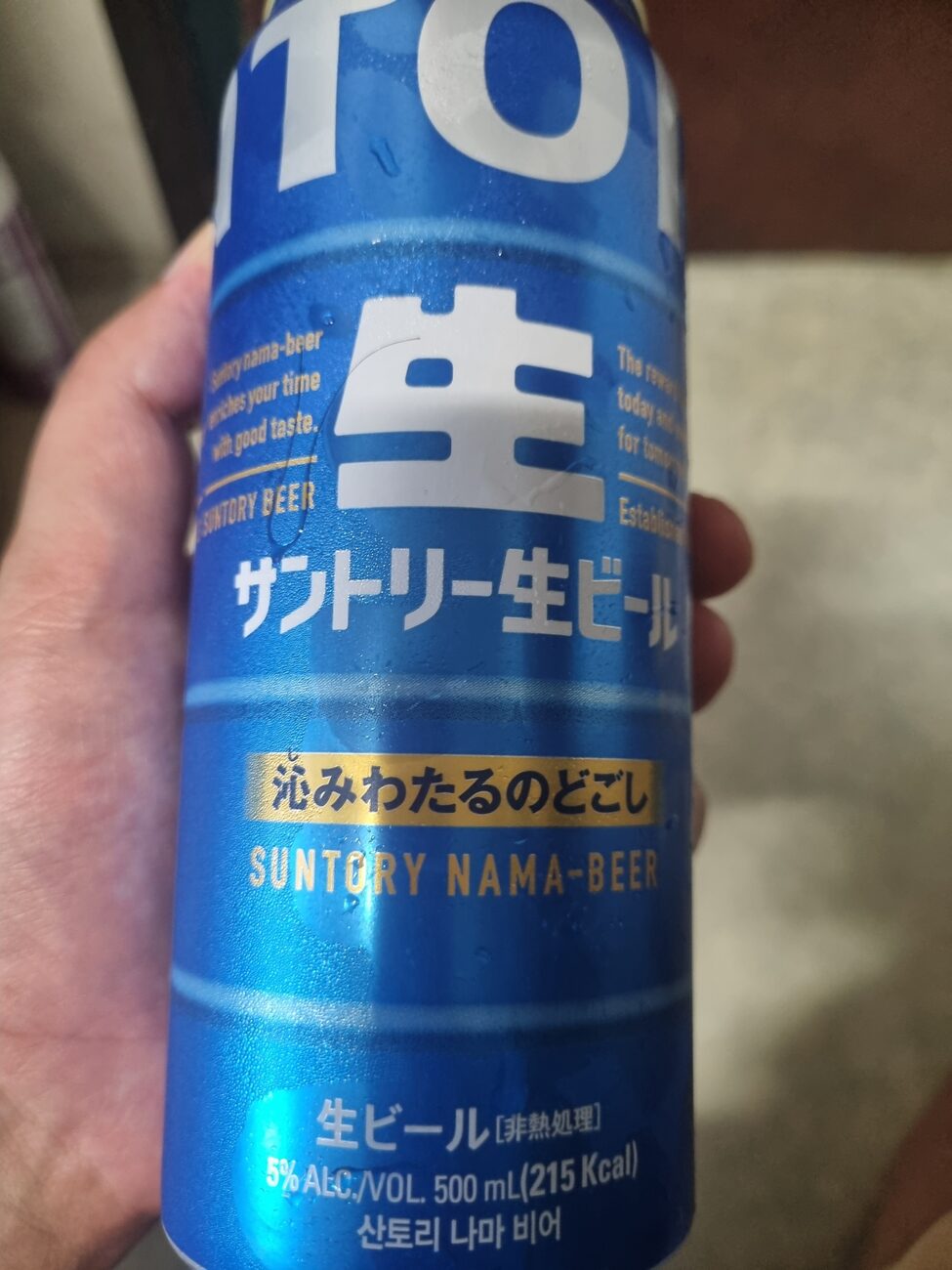
サントリー生ビール / 산토리 나마 비어 — *Suntory Nama Beer*
Say “san-to-ri na-ma bi-eo”. On Korean shelves the Korean name is printed small; look for the blue can with a large 生 character.
| Type | Beer, unpasteurized |
| Volume / ABV | 500 ml / 5% |
| Calories | 215 kcal |
| Origin | Japan |
| Brewer | Suntory Spirits Limited |
| Korean importer | Oriental Brewery (OB) |
| Where I bought it | Top Mart (local supermarket) |
| Price | ₩3,000 (~$2.15) |
One detail almost nobody notices: the Korean importer is Oriental Brewery — the company behind Cass, Korea’s best-selling lager. A Japanese beer brought in by a Korean brewer.
Price in Won & Dollars
₩3,000  ≈  $2.15 / €1.95 / ¥320   for 500 ml
₩600 per 100 ml
Most reviews of this beer online mention buying it at Traders or Costco — warehouse clubs. Finding it at a neighborhood supermarket at this price is worth knowing about.
⭐ What’s Actually Inside
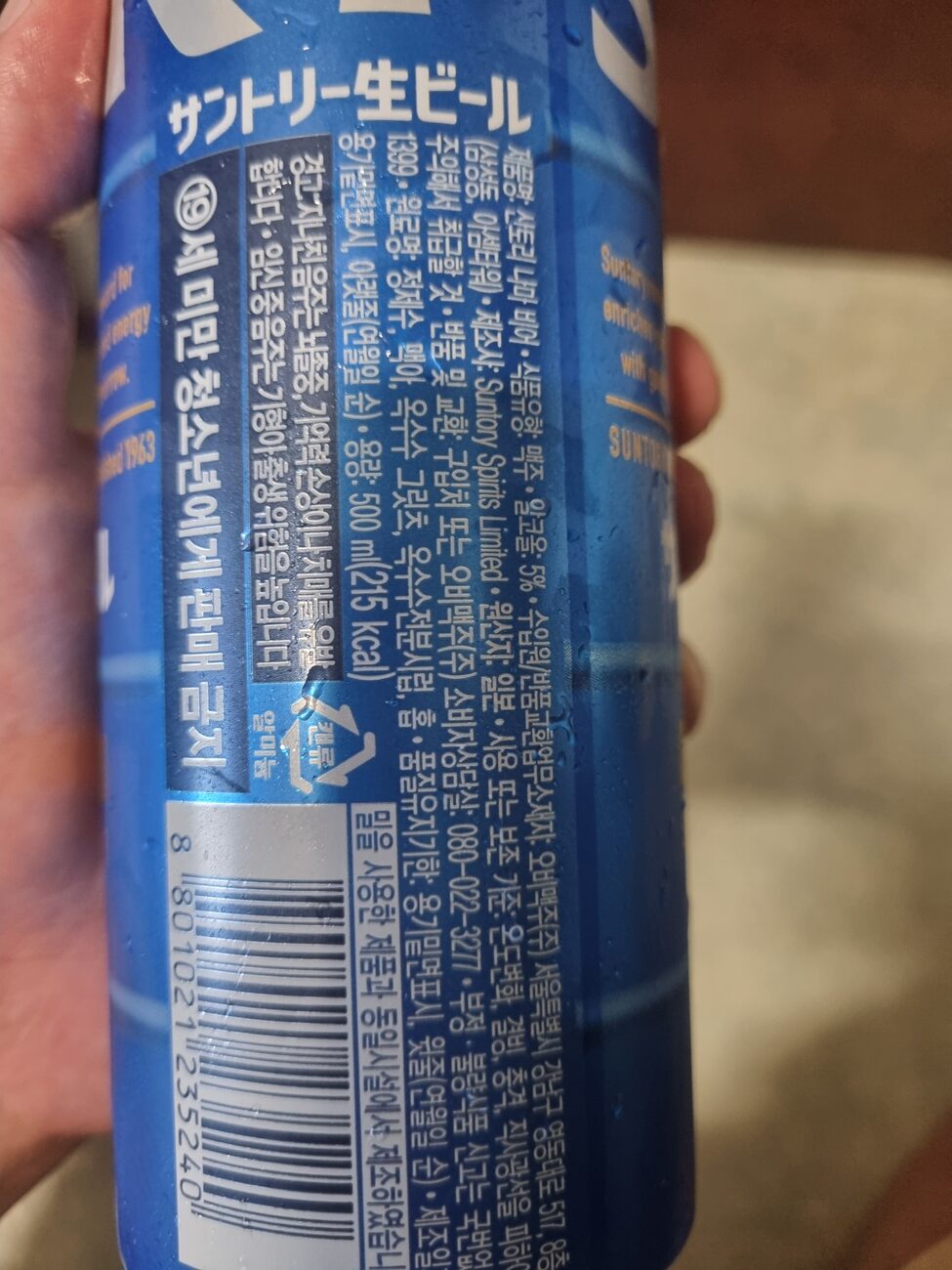
Purified water, malt, corn grits, corn starch syrup, hops
Allergens
None declared. (Contains barley malt — relevant if you avoid gluten.)
Dietary check
| Halal? | ❌ No — alcohol |
| Vegetarian / Vegan? | ✅ Yes |
| Gluten? | ⚠️ Contains barley malt |
What the label reveals
Corn. Two forms of it — grits and starch syrup.
That single word explains the déjà vu I couldn’t place. More below.

What 生 Actually Means
The huge character on the can is 生 (nama), and it’s widely misread.
It does not mean “draft from a keg.”
The can spells it out in small print: 生ビール[非熱処理] — *unpasteurized*.
Traditional beer  →  heated to kill microbes, extends shelf life
Modern method     →  fine filtration removes yeast, no heat needed
                     ↑ Japan calls this 生 (nama)
So it’s beer in a can, brewed without a heat step. Not tavern draft.
How It Tastes
The head is excellent. Fine, tight bubbles that hold.
Then the first sip — and this is where the surprise was.
The floral, herbal aroma I was waiting for never arrived. Instead, hop bitterness sits right at the front. Coming from Premium Malt’s, it’s jarring.
And the opening tastes strangely familiar. Like an older Korean lager with something dry layered on. I expected a Japanese beer to feel different. It didn’t.
The finish flips it.
Remarkably smooth — enough that I said *”huh”* out loud. Clean too. Nothing lingers.
Front bitter, back soft. That’s the shape of this beer.
Three Things the Label Explains
1. It’s built completely differently from Premium Malt’s
This is the core of it.
| The Premium Malt’s | Nama Beer | |
|---|---|---|
| Ingredients | Malt and hops only | Malt + corn grits + corn starch syrup + hops |
| Malt | “Diamond malt” | Standard malt |
| Hops | 100% European aroma hops (Czech Saaz) | Standard hop blend |
| Method | Double decoction | Triple decoction |
| ABV | 5.5% | 5.0% |
Premium Malt’s gets its floral character from Saaz hops from the Czech Žatec region — Suntory advertises the 100% European aroma hop policy openly.
Nama Beer doesn’t use them.
So the flowers being absent isn’t a flaw — there was never anything there to produce them. And with no aroma to mask it, the hop bitterness sits exposed at the front.
My impression wasn’t wrong. It was the recipe.
2. The “Korean lager” feeling has a real cause
Corn grits and corn starch syrup. In brewing these are called adjuncts — grains used in place of some of the malt.
Korean lagers do the same thing. Hite and Cass replace part of the malt with corn starch. (All-malt Korean beers exist — Max is one — but they’re the exception.)
Adjunct lagers share a family resemblance. Lighter body, grain sweetness that doesn’t sit heavy.
So the déjà vu was structural. Same grammar, different language.
3. The soft finish is a process, not an accident
Suntory uses triple decoction on this beer — drawing off part of the mash, boiling it, and returning it. Three times. Premium Malt’s uses two.
The process builds sweetness, roundness, and a smoother mouthfeel.
Suntory wasn’t selling aroma here. They were selling the swallow.
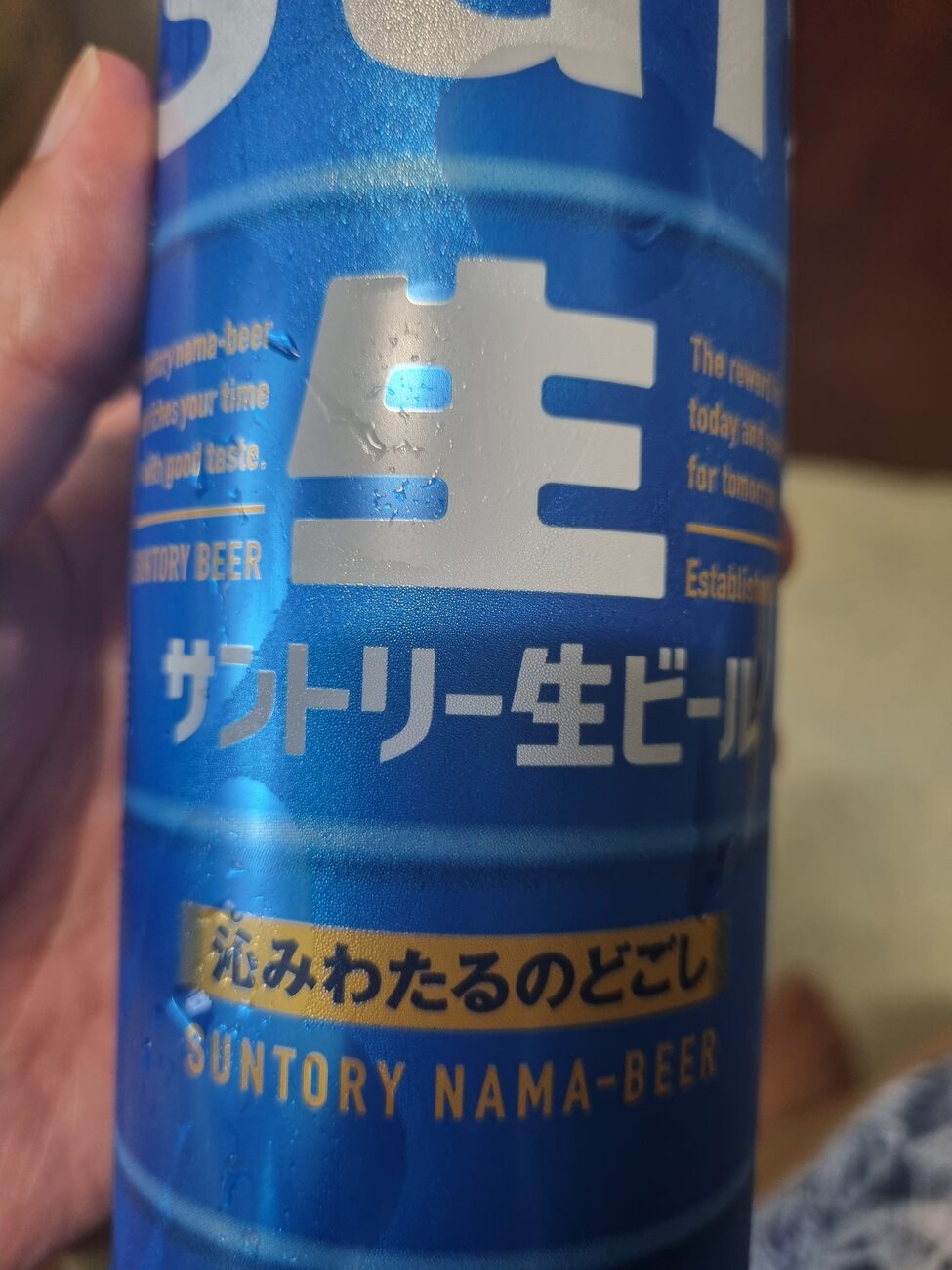
Read what’s printed on the front of the can:
沁みわたるのどごし — *”a throat-feel that soaks through”*
It says so right there. I bought it without reading the label.
If You’re Coming From Belgian Wheat Beers
I should mention my usual preference: Hoegaarden, Blanche, Edelweiss — wheat beers.
If that’s you too, understand this is a different axis entirely.
Those clove-and-banana aromas in wheat beer don’t come from hops. They come from yeast.
Ale yeast, warm fermentation
  → esters (fruit notes) + phenols (spice notes), in quantity

Lager yeast, cold and slow
  → few byproducts → clean and crisp
It’s not “which is better.” They’re different sports. Complaining that a lager lacks wheat beer aroma is like asking why the baseball game has no goalkeeper.
Should You Buy It?
| Aroma | ★★☆☆☆ Not what I expected |
| First sip | ★★★☆☆ Hop bitterness is forward |
| Finish | ★★★★★ Genuinely smooth |
| Drinkability | ★★★★★ This is what it’s selling |
| Value at ₩3,000 | ★★★★☆ |
| Overall | ★★★★☆ 4.0 / 5 |
This is not a beer to sit and study. Premium Malt’s does that job.
It’s a beer to drink with food. The finish is clean enough that the next bite isn’t weighed down. It’ll do well with fried food, grilled meat, anything rich.
The product wasn’t wrong. I was expecting aroma from a beer that was selling drinkability.
Which is why I put my preferences on the table before the review.
And it was printed on the can the whole time. 沁みわたるのどごし. Read the label before you buy.
Good for
✅ Drinking with a meal rather than on its own
✅ You like a clean, quick finish
✅ You're curious about Japanese beer in Korea
Skip if
❌ You want Premium Malt's floral character
❌ Front-loaded hop bitterness bothers you
❌ You're a wheat beer drinker looking for that aroma
Not sure what to order?
Tell us what you can and cannot eat. We will match you to Korean dishes that actually fit.
Vegan, no pork, shellfish allergy, eating alone, hate chilli — 75 dishes, filtered honestly. We tell you when the answer is “almost nothing”.
Find my dish →