What Is It? · Busan · Part 1
The cheapest thing in Busan with a war behind it.
This is Part 1 of a series on what to actually eat in Busan. Start with the overview: What to Eat in Busan — and What to Skip.
You will see it before anyone explains it. A cart on a street corner, a shallow steel tray of pale brown sheets folded onto skewers, standing upright in cloudy broth. Somebody is drinking that broth out of a paper cup, for free, in the cold. Nobody is sitting down.
That is eomuk (어묵), and in Busan it is closer to a civic institution than a snack.
All dollar figures use ₩1,340 = US$1, the rate in September 2026. They’re there for scale, not accounting.
What it actually is
Fish, mostly Alaska pollock, deboned and ground to a paste, mixed with starch and a little seasoning, then shaped and either steamed or fried. The result is firm, mildly savoury, faintly sweet, and almost aggressively inoffensive.
If you need an anchor: it sits somewhere between a fish sausage and surimi — the same family as the imitation crab in a California roll, but denser, chewier, and not pretending to be anything.
It is not spicy. This matters more than it sounds. In a country where a lot of the famous food is red, eomuk is the thing you can hand to a nervous eater and a small child with equal confidence.
Why Busan, specifically
“Busan eomuk” is a proper noun in Korea the way “Parma ham” is in Italy. There’s a reason, and it isn’t marketing.
1876 — the port opens, and the word arrives with the food
After the Treaty of Ganghwa, Japanese merchants arrived in numbers, and Busan — the closest major Korean port to Japan — got their food first. Fish paste came with them under its Japanese name, kamaboko, and the simmered version of it under another one: oden.
That second word stuck to the whole category. Koreans said odeng for decades, and plenty still do. Eomuk is the Korean word that was pushed later, and it’s the one you’ll see written on shop signs and packaging now.
You do not need to referee this. Say eomuk; it’s what’s printed everywhere. Say odeng at a street cart and the woman running it will hand you exactly what you wanted. Nobody has ever been corrected for either.
1915 — it’s already normal
A monthly report from Bupyeong Market in Busan — Korea’s first public market — lists around 260 stalls. Three of them sold fish cake. This was forty years before anyone thought of it as a Busan specialty. It was just what the neighbourhood ate.
1950–53 — the city becomes the country
When Seoul fell, the government moved to Busan, and so did everyone else. For 1,023 days Busan was the wartime capital of South Korea, its population swollen with refugees who had arrived with nothing.
Three things met in one place:
| A working port | fish was the one thing not in short supply |
| Enormous need | hundreds of thousands of people with no money |
| A cheap technique | grind the fish, stretch it with starch, fry it |
Fish cake is what you invent when you need protein to go further than it wants to go. It fed the city through the war, and it never left.
1953 — and the oldest one is still open
The year the armistice was signed, a man named Park Jae-deok, who had learned the technique in Japan, opened a fish cake works in Bongnae Market on Yeongdo, the island across the bridge from downtown Busan.
That business is Samjin Eomuk, and it is still running. It is widely described as Korea’s oldest surviving fish cake maker — a claim I have seen repeated everywhere and contradicted nowhere, which is not quite the same as proof. Remember that name; it comes back at the end of this.
How to eat it without looking lost
At a street cart
- Take a skewer from the tray. Nobody hands it to you.
- Eat it standing up. There is no seating and none is expected.
- The broth is free. Paper cups are stacked by the pot; ladle your own.
- When you’re done, put the used skewers in the cup or tin provided — that’s how they count what you owe.
- Pay at the end. A plain skewer is ₩1,000–2,000 (US$0.75–1.50). The flavoured ones — cheese, spicy, curry, whatever this year’s are — run closer to ₩3,000.
⚠️ The broth refill is genuinely free and you are meant to drink it. Standing in a cold street with a paper cup of fish broth is not a tourist thing to do. It’s what everyone does.
⭐ At a fish cake shop — order the croquette
This is the recommendation most visitors miss, so I’ll put it in bold: get the croquette.
At the proper fish cake shops — Samjin and the others, as opposed to street carts — the fish paste gets breaded and deep-fried into something closer to a savoury pastry. Crisp outside, hot and soft inside, sometimes with curry or vegetables or cheese worked through it.
It’s the best thing in the entire category and it costs a couple of thousand won. The skewer is the tradition; the croquette is the one you’ll want a second of.
Everywhere else
| Eomuk-tang | a proper hot pot of it, ordered sitting down |
| In tteokbokki | the flat pieces floating with the rice cakes |
| As banchan | stir-fried in soy sauce, one of the free side dishes |
| In gimbap | a strip inside the roll |
⚠️ Before you eat it — the label part
This is the part most guides skip, so here it is plainly.
| Fish | Yes, obviously. Usually pollock. |
| Gluten | ⚠️ Almost always. Wheat starch is standard. This is not a gluten-free food. |
| Shellfish | ⚠️ Some products carry shrimp or crab extract. If you’re allergic, this is a real risk — ask, or check the packet. |
| Egg / soy | Common. |
| Pork | Not in the fish cake itself. ⚠️ The broth is another matter and varies by cart — many are anchovy and radish, some are not. |
| Vegetarian | No. It is made of fish. |
If you buy packaged eomuk in a supermarket, the allergen line is printed in a box near the bottom of the back label, and it lists in Korean. The words worth recognising: 밀 (wheat), 대두 (soy), 계란 (egg), 새우 (shrimp), 게 (crab).
Where to try it in Busan
Samjin Eomuk, Yeongdo — the 1953 one
The original works is still on Yeongdo, and it’s been rebuilt into something odd and rather good: a fish cake bakery on the ground floor — croquettes, cheese sticks, things shaped like pastries but made of fish — and upstairs, a small museum about how any of this happened, plus a place to sit and eat what you just bought.
It is a twenty-minute detour from downtown and it is the single best place to understand why this food matters here.
⭐ And then they put it in a burger
Here is the part I did not expect.
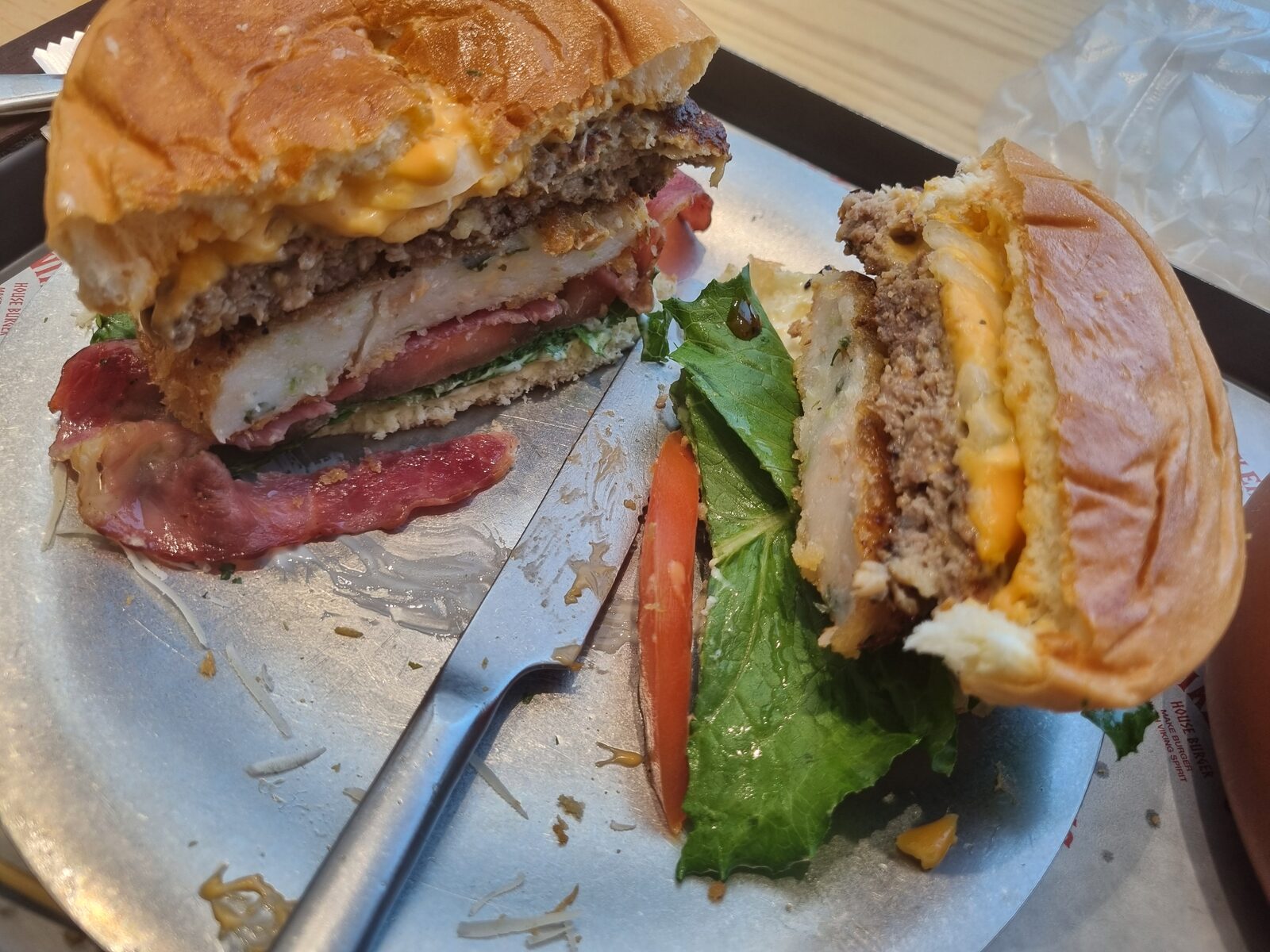
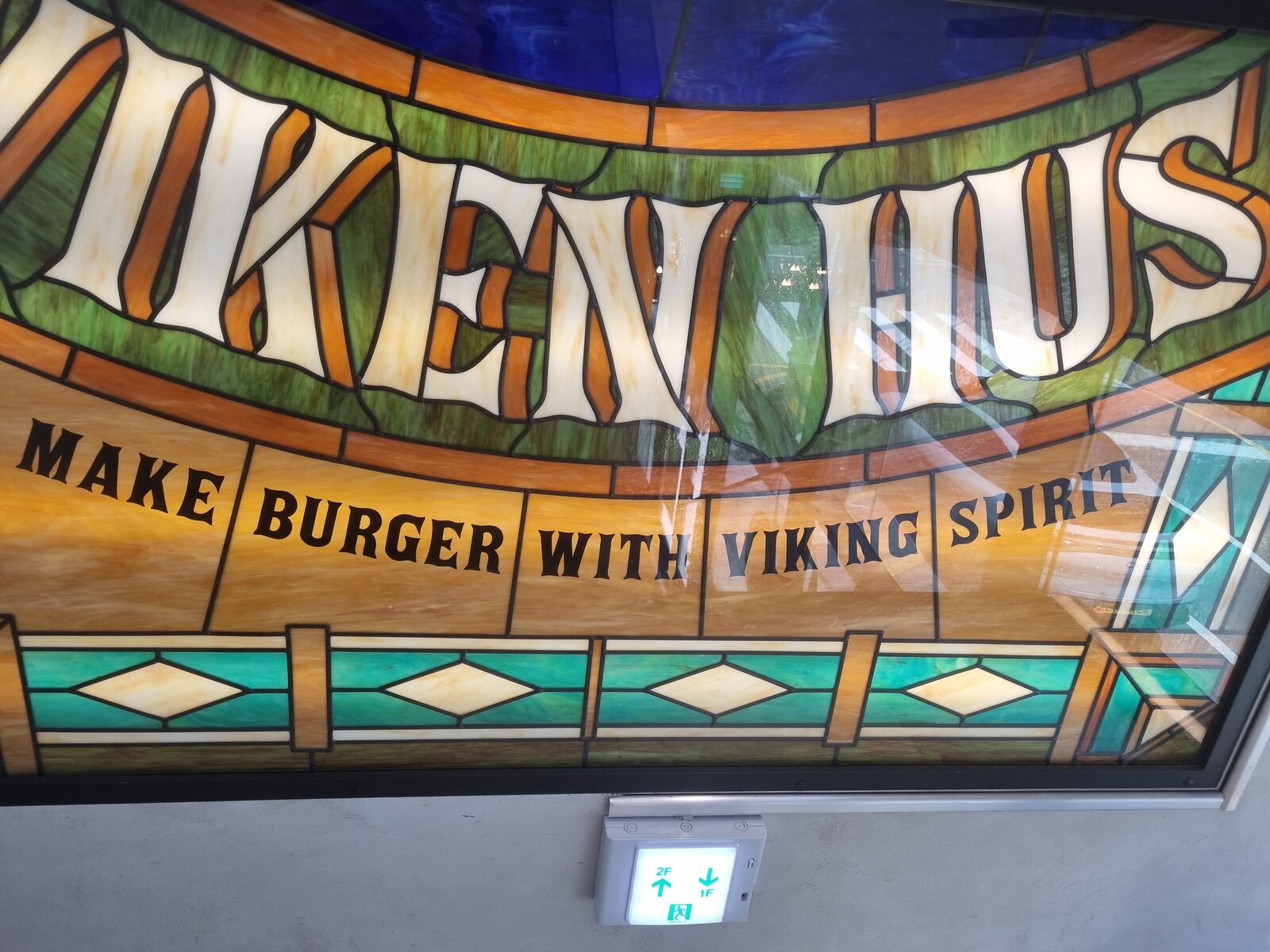
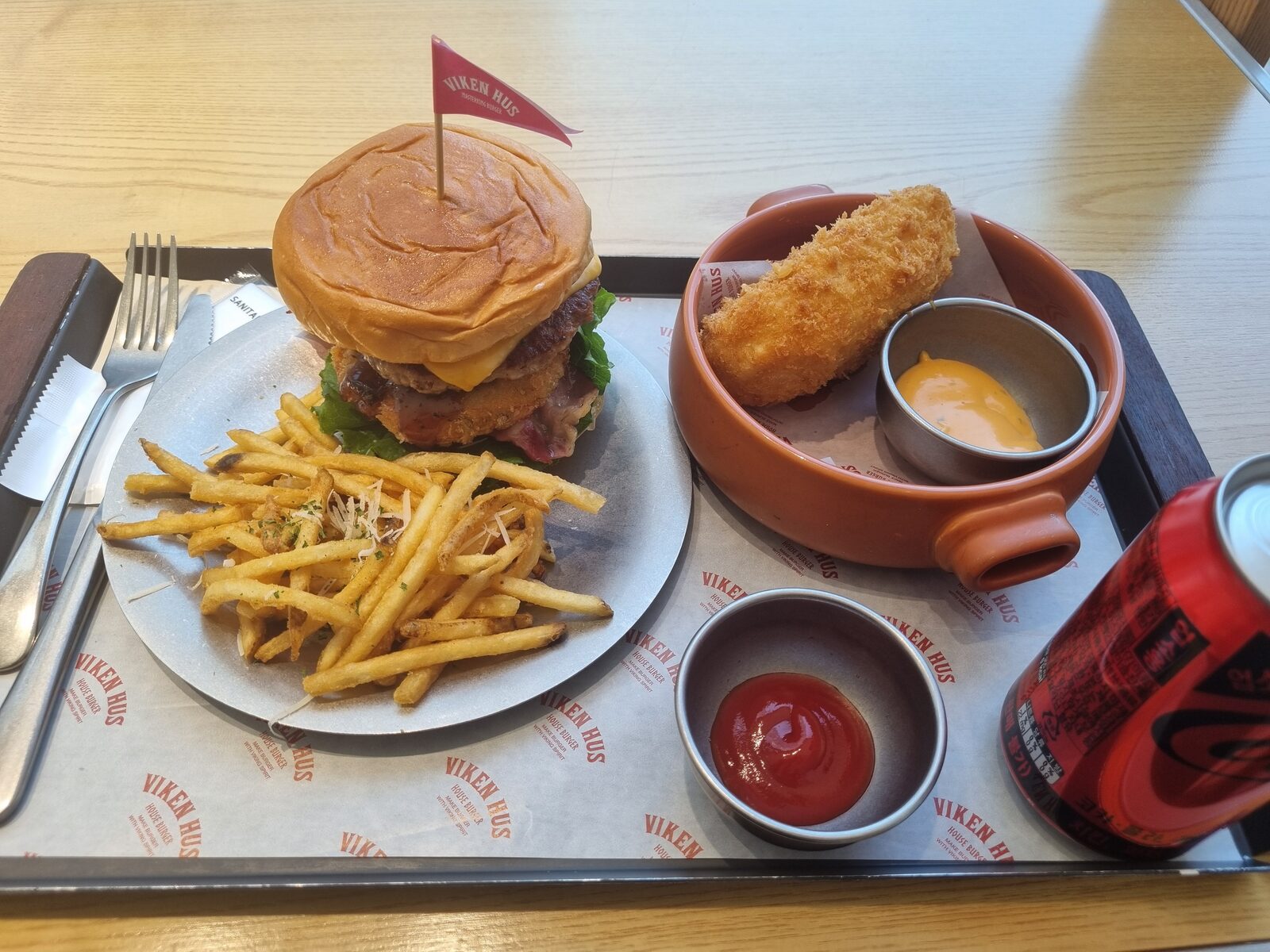
Samjin also runs a burger restaurant — VIKEN HUS, two minutes from Busan Station, on the second floor above their shop. The house burger has a beef patty and, stacked with it, a fish cake patty made from pollock.
It should not work. It does. Samjin only operates in Busan, and I have not found the combination anywhere else — so as far as I can establish, this is the city it lives in.
A company founded by a man who learned to grind fish in post-war Japan now sells that same fish, in a bun, with bacon, to people getting off the KTX. Seventy-three years, one ingredient
⭐ Next in this series: The Fish Cake Burger — What Busan’s Oldest Eomuk Company Does With It Now. I ate it, priced it, and the Korean and English editions of that review reach different conclusions on purpose.
Vegan, Vegetarian, Halal
| Diet | Suitable? | Why |
|---|---|---|
| Vegan | ❌ No | Made from fish surimi |
| Vegetarian | ❌ No | Fish is the main ingredient — pescatarians are fine |
| Halal | ⚠️ Depends | Fish itself is generally acceptable, but check for alcohol-derived flavourings and shared facilities |
⭐ Pescatarian is the one diet this works for. Eomuk is fish, not red meat.
Verdict
It is cheap, it is not spicy, it is sold on every second corner, and it carries more history per won than anything else you’ll put in your mouth here. You can eat it badly, standing in the cold, and still be doing it correctly.
| ← Overview | What to Eat in Busan — and What to Skip |
| Next → | Part 1.5 — The Fish Cake Burger |
Not sure what to order?
Tell us what you can and cannot eat. We will match you to Korean dishes that actually fit.
Vegan, no pork, shellfish allergy, eating alone, hate chilli — 75 dishes, filtered honestly. We tell you when the answer is “almost nothing”.
Find my dish →