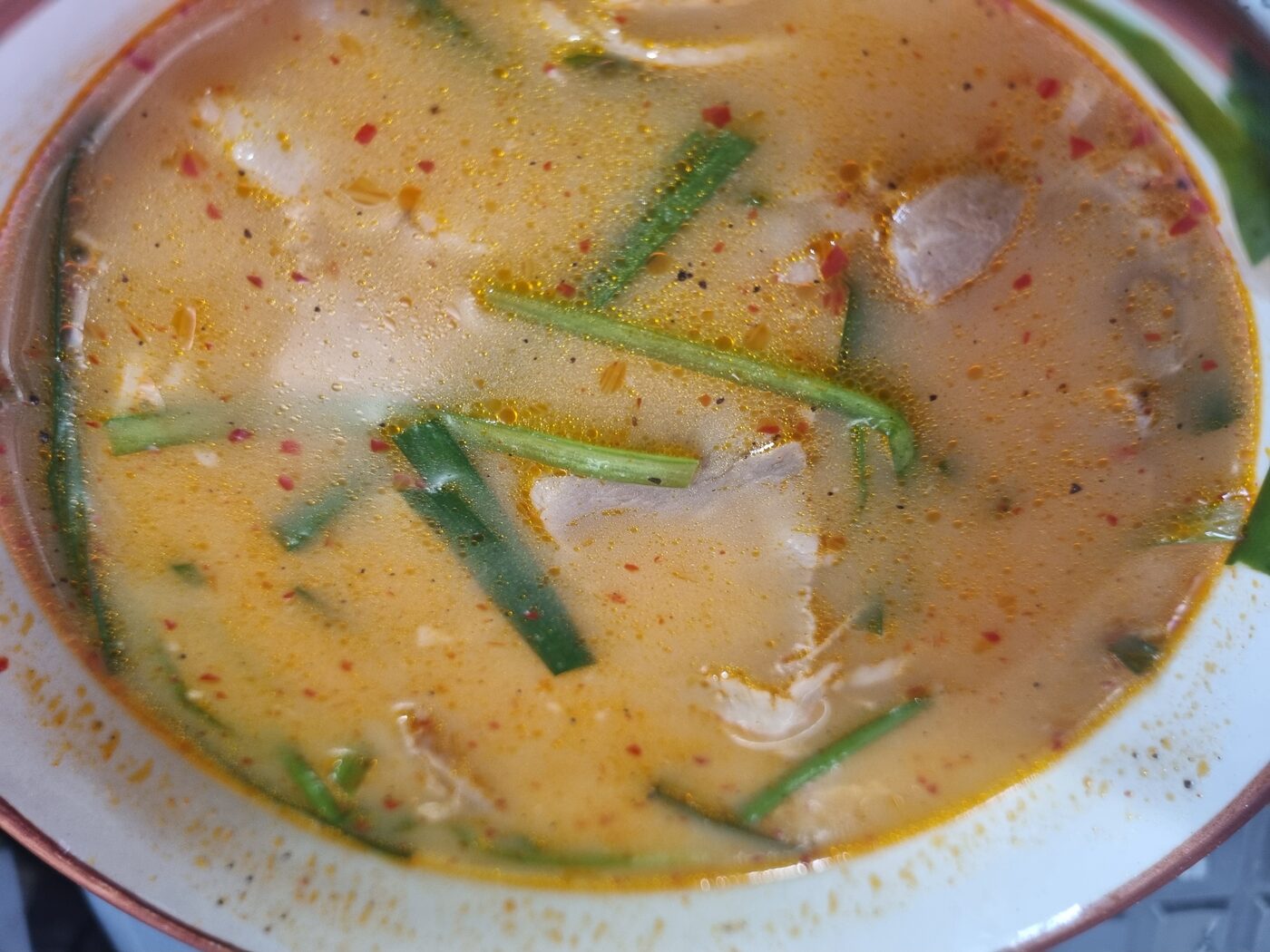
Quick verdict: A frozen Busan pork soup that costs ₩4,180 a bag and tastes thin on its own — until you add a ₩474 beef-bone stick. Together they make a bowl for about ₩4,654 that a restaurant charges ₩9,000+ for. Only worth it if you have a freezer in Korea. If you’re visiting, skip this and eat the real thing.
Who This Is For
If you’re visiting Korea: don’t buy this. It comes in packs of five, it’s frozen, and you’d be eating a home version of a dish you can get fresh a few streets away. Read the dwaeji gukbap guide instead and find a shop.
If you live here — student, worker, long stay — this is the piece of information you actually want: how to get a decent bowl at home for under $4 without cooking bones for ten hours. That’s what the rest of this is.
What Is This?
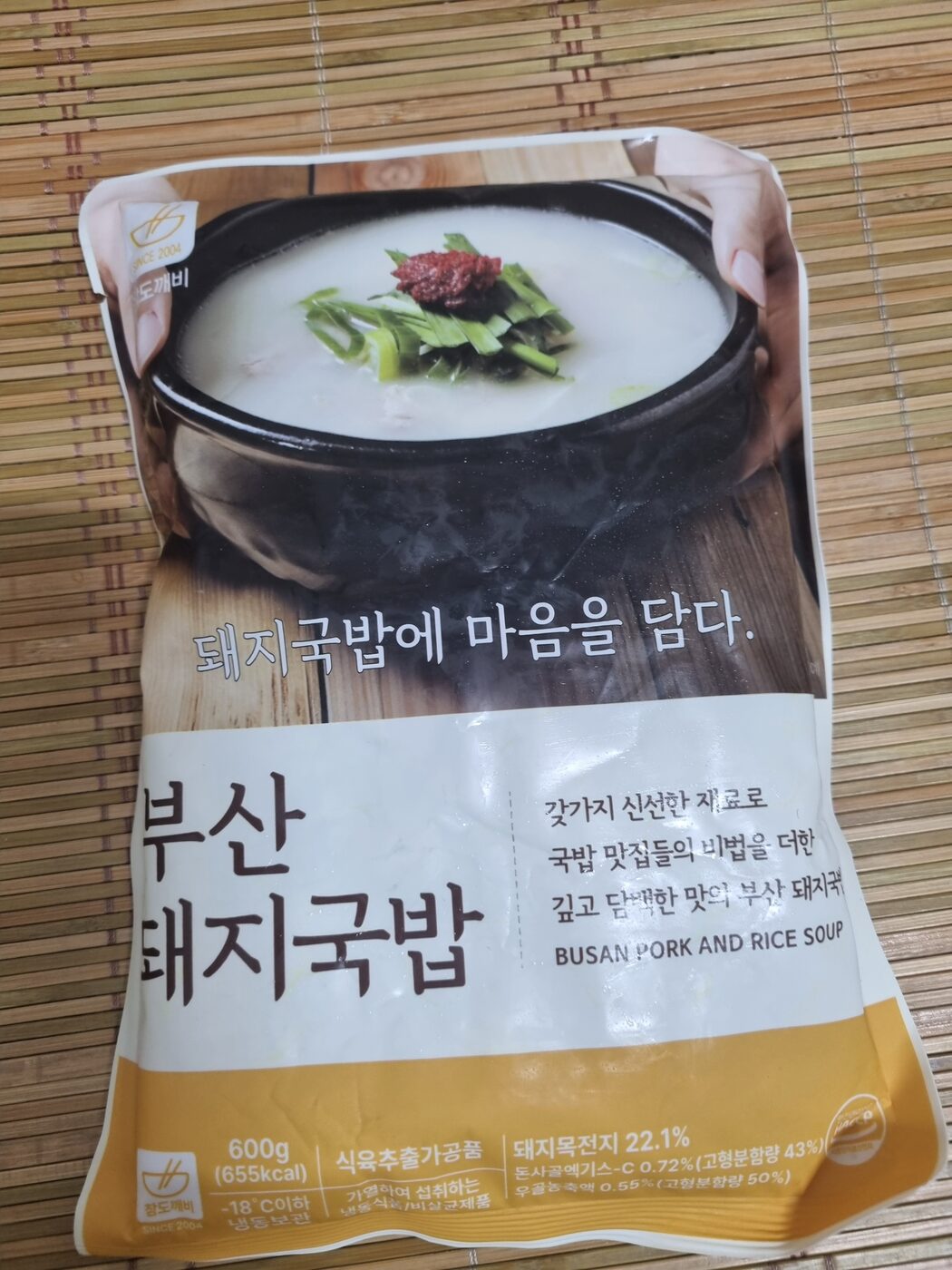
Dwaeji gukbap (돼지국밥) is Busan’s pork-and-rice soup. Three products are involved here, and you need all three:
- Chamdokkaebi Busan Dwaeji Gukbap (참도깨비 부산돼지국밥) — 600g frozen pouch, ships with a chilli paste sachet
- Hapcheon gukbap dadegi (합천돼지국밥 다데기) — 30g seasoning paste, included in the box
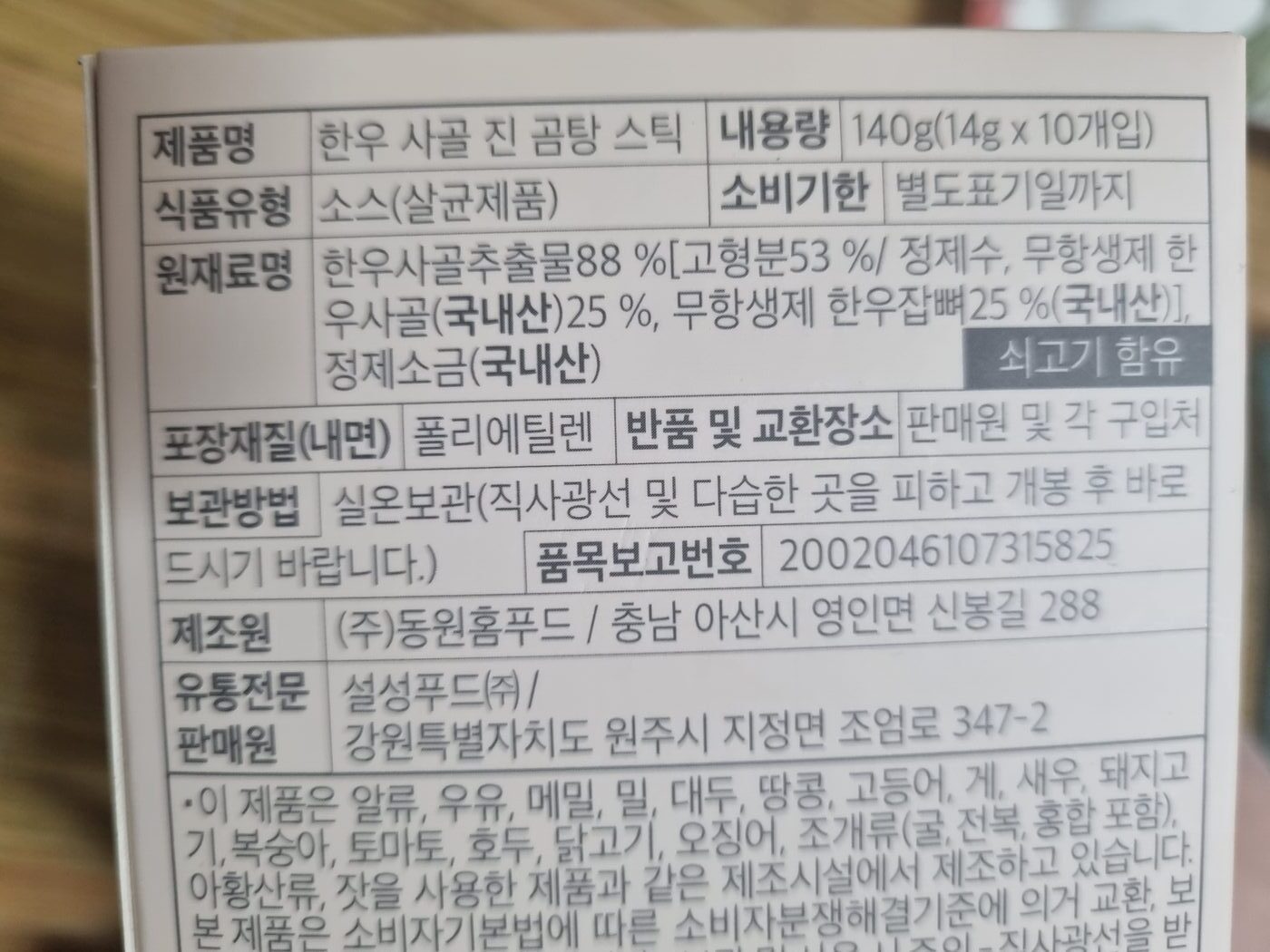
- Seolseong Farm Hanwoo Bone Broth Stick (설성목장 한우사골 진 곰탕 스틱) — 14g stick, bought separately
Price in Won and Dollars
Converted at roughly ₩1,350 = $1 (September 2026). Bought on Coupang.
| Item | Pack | Total | Per serving |
|---|---|---|---|
| Chamdokkaebi gukbap 600g | 5 pouches (5 dadegi included) | ₩20,900 (~$15.50) | ₩4,180 (~$3.10) |
| Seolseong bone broth sticks | 5 boxes × 10 = 50 sticks | ₩23,700 (~$17.55) | ₩474 (~$0.35) |
| One bowl | ₩4,654 (~$3.45) | ||
| Split between two people | ₩2,327 (~$1.72) | ||
A restaurant bowl in Busan now runs ₩9,000–10,000. The sticks are the sneaky part of the maths: you use one per bowl, so fifty sticks covers fifty meals.
⭐ What’s Actually Inside — Why It Tastes Thin
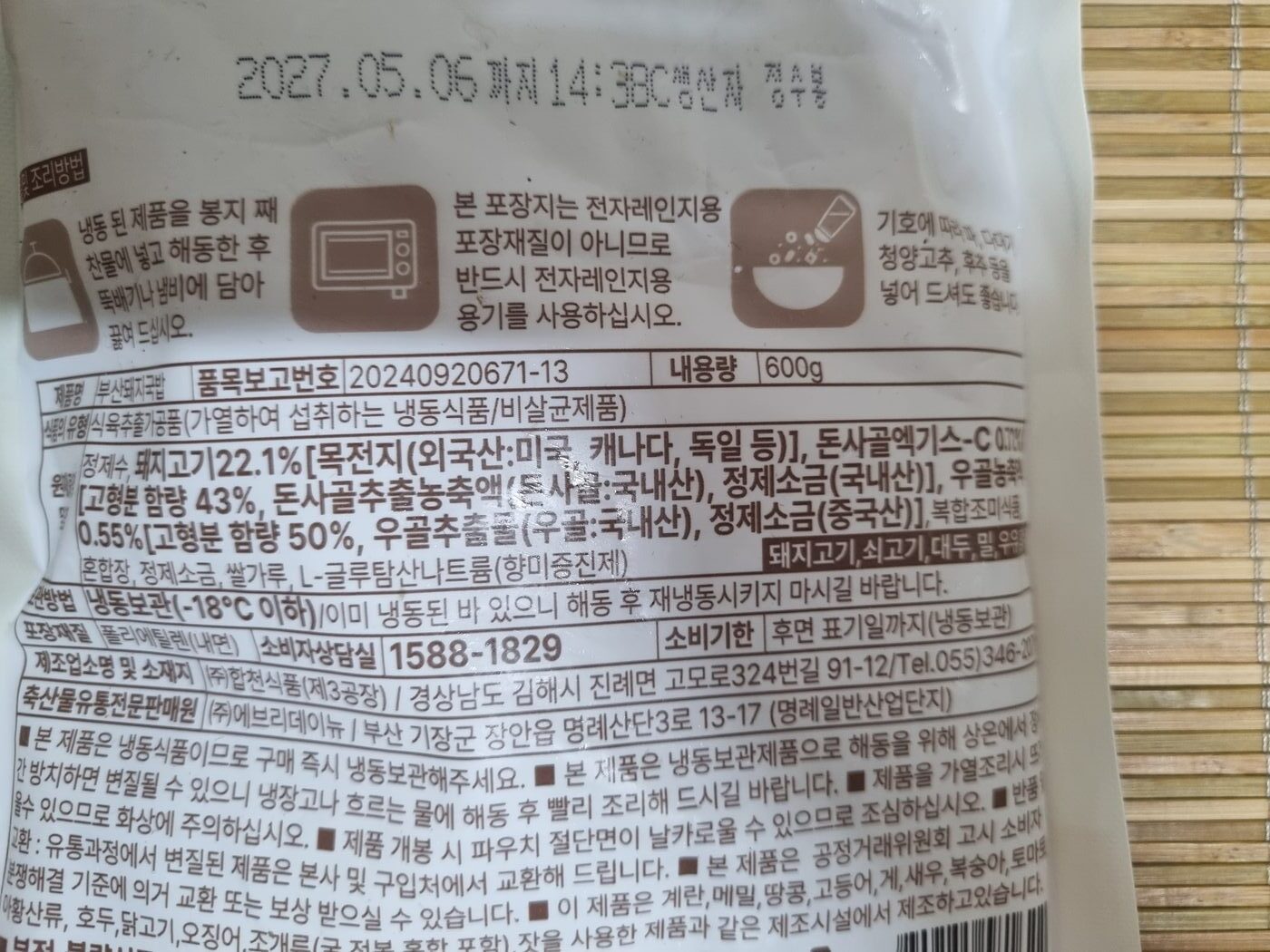
The soup tastes sharp on the front and hollow behind it. The label explains exactly why. Here are the bone-derived ingredients, and nothing else:
| Ingredient | Listed | Solids content | Actual solids |
|---|---|---|---|
| Pork bone extract | 0.72% | 43% | 0.31% |
| Beef bone concentrate | 0.55% | 50% | 0.28% |
| Total | 1.27% | 0.58% |
Bone content is 1.27% of the pouch. Adjusted for solids, under 0.6% — about 3.5g of bone-derived solids in 600g of soup.
Pork is a respectable 22.1%. The meat isn’t the problem. But depth in this dish comes from bones, not meat, and there are almost none.
Now the stick:
| Ingredient | Listed |
|---|---|
| Hanwoo bone extract | 88% (53% solids) |
| — of which hanwoo leg bone | 25%, Korean |
| — of which hanwoo mixed bone | 25%, Korean |
Soup's own bone content:  1.27%
Stick's bone content:       88%
One 14g stick fills precisely the gap the pouch leaves. The sharpness gets a floor under it. ₩474 changes the bowl.
Vegan, Vegetarian, Halal
| Diet | Suitable? | Why |
|---|---|---|
| Vegan | ❌ No | Pork, pork bone extract, beef bone extract |
| Vegetarian | ❌ No | Meat-based on every layer |
| Halal | ❌ No | Pork is the main ingredient |
⚠️ The seasoning sachet also contains salted fermented shrimp — relevant for shellfish allergies and for anyone avoiding crustaceans.
Allergens and Dietary Notes
Read this before you order.
| Product | Declared allergens |
|---|---|
| Gukbap pouch | pork, beef, soy, wheat |
| Dadegi paste | soy, wheat, shrimp |
| Bone stick | beef |
Halal: no. Pork is the main ingredient. Vegetarian: no.
Shellfish allergy: pay attention. The dadegi is built on salted fermented shrimp (젓새우), listed second. Nothing on the front of the sachet says shrimp — it looks like a plain chilli paste. This is exactly the kind of thing a Korean label buries and a translation app won’t catch.
That shrimp base isn’t a flaw, by the way — it’s the point. Busan gukbap shops serve saeujeot (salted shrimp) on the side for you to season your own bowl. This sachet does that job from the inside.
Sodium — Worth Knowing
| Component | Calories | Sodium | % daily |
|---|---|---|---|
| Gukbap 600g | 655 kcal | 650 mg | 33% |
| Dadegi 30g | 20 kcal | 690 mg | 35% |
| Bone stick 14g | 39 kcal | 812 mg | 41% |
| Full pot | 714 kcal | 2,152 mg | 108% |
| Split two ways | 357 kcal | 1,076 mg | 54% |
Eat the whole pot alone and you pass your daily sodium limit. This recipe is built for two — at that split it’s a sensible 357 kcal meal.
Eating alone? Use half the dadegi. It carries 690mg on its own, so halving it drops the bowl substantially. The soup base itself (650mg) is the tame part.
The Recipe
1. Empty the 600g pouch into a pot
2. Do NOT add water (see note)
3. Add the entire dadegi sachet
4. Add ONE bone broth stick
5. Bring to a boil
6. Top with raw garlic chives, sliced
7. Serve
Water is the only variable. I like it on the salty side and add none at all. If you eat lighter, start with 100–200ml. You can always add; you can’t take salt back out.
The chives matter. Korean garlic chives — buchu (부추) — go on raw and wilt in the heat. Don’t blanch or fry them. Gukbap shops in Busan pile them on the same way, and the raw allium edge against the fatty broth is the whole point.
Still one stick for two portions. Two makes it too salty.
The Meat — What “Mokjeonji” Means
The label lists the pork as mokjeonji (목전지), 22.1%, imported from the US, Canada and Germany.
Mokjeonji is neck and front leg butchered as a single piece instead of being separated into collar and shoulder. The shoulder makes up most of it. It’s a cutting style you mostly see on imported pork, which lines up with the stated origin.
It’s leaner and more muscular than pork collar, and cheaper. That explains two things about this product: the meat is sliced thin, and there’s no porky funk at all — a leaner cut doesn’t throw the same oily heaviness into the broth. For a soup this is a reasonable choice.
Cut characteristics are from general butchery references, not a manufacturer statement.
Should You Buy It?
Buy if: you live in Korea with freezer space, you’ve had gukbap out and want it at home, you’re sensitive to pork smell (this genuinely has none), or you eat with one other person.
Skip if: you’re visiting Korea, you want thick slices of pork belly, you’re managing sodium closely, or you need Korean-origin pork — this is imported.
Do not buy the soup without the sticks. On its own it’s a three-star product. With the stick it’s four and a half. That is the entire finding here.
| Rating | Score |
|---|---|
| No off-smell | ★★★★★ |
| Meat content (22.1%) | ★★★★☆ |
| Broth depth — soup alone | ★★★☆☆ |
| Broth depth — with stick | ★★★★★ |
| Value at ₩4,654 | ★★★★★ |
| Overall (residents) | ★★★★½ |
Same score as the Korean edition — but the Korean edition doesn’t need the caveat at the top. For a visitor this product is close to pointless; for a resident it’s a weekly staple. I order it three times a week.
Half a star withheld for two reasons: it isn’t complete without a second purchase, and the meat is thin.
“A broth with 1.27% bone in it, fixed by dropping in something that’s 88% bone.”
Not sure what to order?
Tell us what you can and cannot eat. We will match you to Korean dishes that actually fit.
Vegan, no pork, shellfish allergy, eating alone, hate chilli — 75 dishes, filtered honestly. We tell you when the answer is “almost nothing”.
Find my dish →